






































AI Governance Services vs In-House Governance: Which Is Right for Your Business?
Weighing AI governance services against building in-house? Here's how the two approaches compare on cost, speed, expertise, and long-term fit.
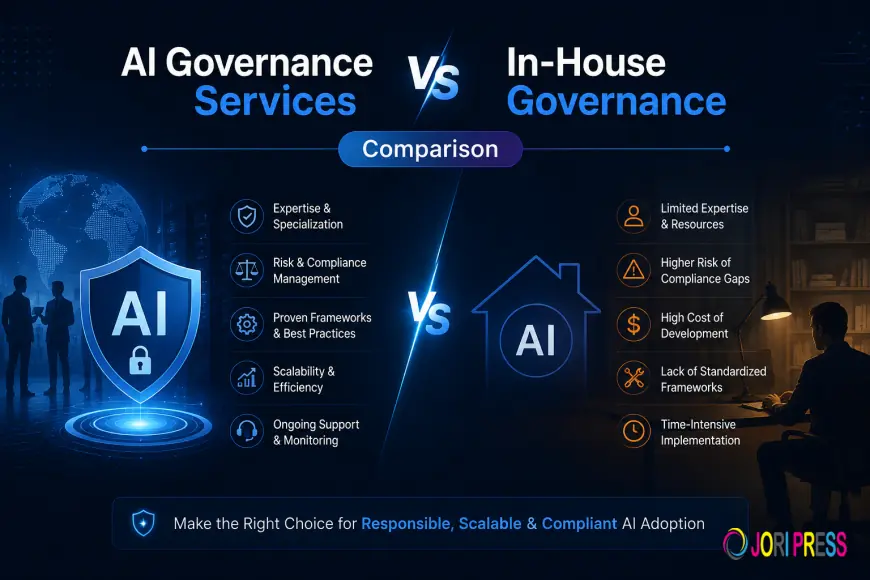
Every business running AI in production eventually hits the same decision point: build a governance function internally, or bring in outside expertise to run it. Both paths work. Neither is automatically right for every company.
The choice usually comes down to how central AI is to your business, how fast regulations apply to your sector, and whether you can attract and retain the specialized talent this work requires. Get the decision wrong, and you either overspend on a function you didn't need at scale or underbuild governance for risks that are already live in production.
This is the AI governance business reality most companies face once AI moves past a pilot project: governance stops being optional the moment a model touches a real customer decision. Here's how AI governance services compare to an in-house team, and which one actually fits where your business is today.
What In-House AI Governance Actually Requires
Building governance internally sounds straightforward until you scope the roles involved. It's rarely a single hire.
A functioning in-house program typically needs:
-
A governance lead who understands both regulatory frameworks and technical implementation
-
ML engineers who can build monitoring, drift detection, and bias testing into existing pipelines
-
Legal or compliance staff fluent in AI-specific regulation, not just general data privacy law
-
Ongoing budget for AI governance software to track model behavior across every deployed system
That's four distinct skill sets, and the person who understands NIST AI RMF documentation requirements is rarely the same person who can implement automated bias testing in your CI pipeline.
Where In-House Makes Sense
In-house governance earns its cost when AI sits at the center of your product, not just supporting it. A fintech company scoring loan applications, a healthcare platform triaging patients, or a hiring platform ranking candidates all have governance needs too continuous and too tied to core business logic to hand off entirely.
Where It Struggles
Smaller AI footprints don't justify the overhead. If your business runs two or three AI use cases across a handful of departments, a full internal governance team sits idle most of the time, and the specialized talent it requires is expensive to hire and hard to retain in a market this competitive.
What AI Governance Services Actually Deliver
AI governance and consulting firms package the same functions in a different structure, usually through project-based framework design followed by ongoing advisory support.
Framework Design
An external AI consultation typically starts with a full audit: what AI systems are running, what risk tier each falls into, and which regulations actually apply to your industry and geography. This is the same starting point an in-house team would take, just compressed into weeks instead of the months it takes to hire and onboard a new internal function.
Implementation Support
Beyond documentation, a competent partner offering AI Consulting Services helps implement the technical side too: monitoring dashboards, bias testing pipelines, and audit logging that satisfies frameworks like ISO 42001 or the EU AI Act.
Ongoing Advisory
Most ai governance solutions providers offer retainer-based advisory after the initial framework ships, covering regulation updates, periodic audits, and incident response guidance without requiring a full-time internal hire.
Head-to-Head Comparison
| Factor | In-House Governance | AI Governance Services |
| Cost structure | Fixed salaries, ongoing | Project or retainer-based |
| Regulatory breadth | Limited to the team's exposure | Cross-industry pattern recognition |
| Scalability | Requires new hires to scale | Scales with contract terms |
| Institutional knowledge | Deepens over time | Requires knowledge transfer |
| Best fit | AI-centric, high-risk businesses | Mid-market, evolving AI footprint |
Neither column is universally "better." The right answer depends on how much AI risk your business is actually carrying right now, not how much it might carry in three years.
The Hybrid Model Most Mid-Market Businesses Land On
Few companies pick a pure version of either approach. The most common pattern pairs a single internal owner, someone accountable for governance decisions day-to-day, with an external AI governance consulting partner who handles framework design, technical implementation, and regulatory tracking.
This works because it solves the actual gap: most mid-market businesses don't lack the willingness to govern AI responsibly; they lack the specialized bandwidth to do it alone. A hybrid structure keeps ownership internal while borrowing expertise that would otherwise take a year to build from scratch.
Questions to Ask Before Deciding
Before committing to either path, work through these honestly:
-
How many AI systems are actually in production, including third-party tools your teams have quietly adopted?
-
What's your actual regulatory exposure based on industry and the geographies you operate in?
-
Can you realistically hire and retain the specialized talent in-house governance requires, given current market competition for these skills?
-
What's your timeline pressure? A regulatory deadline six months out favors external speed over internal hiring cycles.
-
Is AI central to your product, or supporting a handful of internal workflows? Centrality changes the calculus significantly.
If your honest answers point toward limited internal bandwidth and a compressed timeline, external artificial intelligence consulting almost always gets you compliant faster. If AI governance is a permanent, high-stakes function tied directly to your core product, building in-house capacity becomes worth the investment over time.
Making the Call
There's no universal right answer here, only the right answer for where your business actually is. A five-person AI team running one internal tool doesn't need the same structure as an enterprise platform processing regulated financial decisions at scale.
What matters is making the choice deliberately, based on your actual risk exposure and resourcing reality, instead of defaulting to whichever option feels less intimidating to start. Governance built reactively, after a regulator or a customer forces the question, almost always costs more than governance built ahead of it.
What's Your Reaction?
 Like
0
Like
0
 Dislike
0
Dislike
0
 Love
0
Love
0
 Funny
0
Funny
0
 Angry
0
Angry
0
 Sad
0
Sad
0
 Wow
0
Wow
0