






































The Future of AI Software Development with Small Language Models (SLMs)

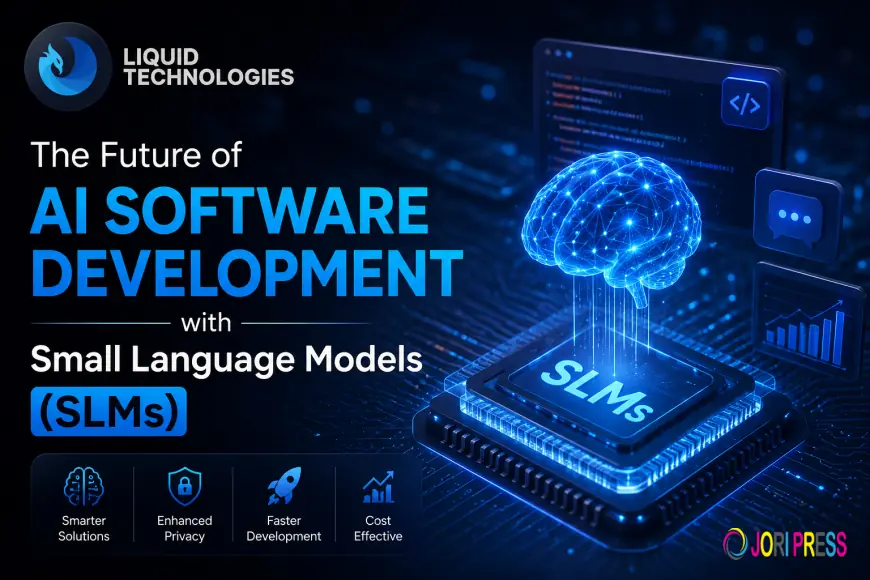
Small Language Models are compact AI systems, typically under 10 billion parameters, built to handle a specific task with speed, privacy, and low compute cost instead of chasing broad general knowledge. They're becoming the future of AI software development because rising GPU costs, tightening data privacy rules, and the growth of edge AI have made "bigger model, better results" an outdated assumption.
For most enterprise tasks, a focused, smaller model now beats a massive general one on speed, cost, and control, and that's forcing a rethink of how AI gets built. Combined with advances in on-device AI, Retrieval-Augmented Generation (RAG), AI agents, and specialized AI chips, SLMs are quickly becoming a practical choice for modern software development.
The future of AI isn't about building the biggest model. It's about choosing the right model for the right job, and that's where Small Language Models are changing the game.
What Exactly Is a Small Language Model
An AI model trained with a deliberately limited parameter range, generally under 10 billion parameters, and often focused on a specific domain rather than general-purpose reasoning. Large language models are built for breadth. They're trained on enormous, varied datasets so they can handle almost any topic. SLMs are built for depth. They're trained more narrowly, on purpose, so they get very good at one category of task.
What Makes Them Different?
Instead of relying on enormous computational power, SLMs are built for efficiency.
They typically feature:
-
Faster inference with lower latency
-
Reduced hardware requirements
-
Lower deployment and maintenance costs
-
Easier fine-tuning for industry-specific tasks
-
Better suitability for on-device and edge AI environments
-
Improved privacy by processing data closer to where it's generated
This balance between performance and efficiency makes SLMs attractive for organizations looking to deploy AI beyond the cloud.
Why "Small" Doesn't Mean "Less Capable"
The word small often creates the wrong impression.
Modern SLMs are not simplified versions of LLMs. They're optimized systems built around focused objectives. This focused design also improves response consistency and makes it easier to align models with company policies, internal documentation, and regulatory requirements.
The Shift Toward Small Language Models
The Problem: AI Got Expensive Fast.
GPU shortages pushed compute prices up, and cloud AI spending has climbed right alongside them. Running a massive LLM for routine work, summarizing an email, and routing a ticket burns budget on capability nobody needed for that job.
The Solution
Match model size to task complexity. A small, purpose-built model handles the routine 90% of requests at a fraction of the cost, freeing large-model budget for the reasoning-heavy 10% that actually need it.
The Problem: Customers Won't Wait
A support tool that takes four seconds to respond breaks the conversation. Automation pipelines that depend on rapid back-and-forth reasoning stall out when every step requires a network round trip.
The Solution
Deploy SLMs close to the user. Fewer parameters and local processing cut latency dramatically, often turning a sluggish interaction into an instant one.
The Problem: Sensitive Data Can't Leave The Building
Healthcare, finance, and government all handle information that can't legally or practically be sent to an external API for processing.
The Solution
Local inference. Privacy-first AI built on SLMs keeps patient records, account data, and case files inside the network where they originated.
The Problem: Cloud-Only AI Can't Keep Up With The Edge
Manufacturing floors, hospitals, logistics hubs, and retail stores are pushing intelligence out of centralized data centers and onto the devices doing the actual work; a sensor that has to round-trip to the cloud to flag an anomaly is too slow for real-time quality control.
The Solution
Edge-deployed SLMs that make decisions on the device itself.
SLM vs LLM Myths and Realities
Myth: Bigger models are always more accurate.
Reality: For a narrowly defined task, a fine-tuned SLM frequently matches or beats a general LLM because it isn't diluted by unrelated training data.
Myth: Small models can't handle enterprise workloads.
Reality: Financial institutions run fraud-detection SLMs on live transaction streams, processing thousands of events per second. Scale isn't the limiting factor; task scope is.
Myth: You have to choose one or the other.
Reality: Most organizations won't replace LLMs entirely. Instead, they'll combine LLMs and SLMs depending on the use case: a large model for open-ended reasoning, a small model for high-volume, repetitive, domain-specific work. This blended approach, known as hybrid AI architecture, is becoming the default enterprise strategy rather than the exception.
Myth: SLMs are only useful in the cloud.
Reality: One of their biggest advantages is running completely offline, on a laptop, a factory sensor, or an in-car system, with zero network dependency.
Myth: Smaller models are automatically cheaper to build.
Reality: They're cheaper to run, but they still require real investment in fine-tuning, domain-specific training data, and ongoing evaluation to perform well.
Where LLMs still win outright is broad, unpredictable reasoning, tasks where you genuinely can't anticipate every scenario in advance. That's the one place scalability still favors size.
Small Language Models on the Ground
Scenario: A Regional Hospital Network
Clinicians need fast, private access to patient records without routing anything through external servers. An SLM deployed on local hospital infrastructure summarizes clinical notes and flags drug interactions instantly, keeping data inside a HIPAA-compliant environment while cutting documentation time significantly.
Scenario: A Payments Company Processing Millions Of Transactions
Fraud detection needs a millisecond decision, not a few seconds. A lightweight SLM embedded directly in the transaction pipeline flags suspicious activity before a payment clears, instead of waiting on a round trip to a hosted model somewhere else.
Scenario: A Mid-Size Saas Company Drowning In Support Tickets
A generic chatbot gives vague, unhelpful answers because it wasn't trained on the product. A support-specific SLM, fine-tuned on the company's own tickets and documentation, resolves common issues directly and escalates only what genuinely needs a human.
Scenario: An Automotive Parts Factory
The production line can't tolerate network lag. An on-device SLM paired with quality-control cameras catches defects instantly, rather than after an entire batch has already shipped.
Scenario: A Retail Chain With Hundreds Of Locations
Centralized demand forecasting is too slow to react to local trends. Store-level SLMs adjust inventory recommendations in real time without waiting on centralized cloud processing.
Beyond these, the same pattern repeats across b(local threat detection without exporting sensitive logs), HR (resume screening and internal policy Q&A), enterprise knowledge assistants (paired with retrieval-augmented generation to answer employee questions from internal data), IoT devices making decisions without constant connectivity, and developer copilots offering faster, code-specific autocomplete inside the IDE.
Trend Highlights: The Tech Making SLMs Sharper
Quantization: Shrinks a model's internal precision to cut size and speed up inference with minimal accuracy loss, making SLMs viable on modest hardware.
Knowledge distillation: Trains a smaller "student" model to replicate a larger "teacher" model's behavior, compressing much of the bigger model's capability into a fraction of the size.
Mixture of Experts (MoE): Activates only the relevant portion of a model per query, delivering small-model efficiency while retaining access to broader capability when needed.
Retrieval-Augmented Generation (RAG): Pairs a smaller model with an external knowledge base so it can pull accurate, current information instead of relying only on what's baked into training.
Agentic AI: Gives SLMs the ability to chain multi-step actions together, retrieving data, calling tools, and completing workflows without constant human prompting.
TinyML: Pushes machine learning onto extremely constrained hardware like microcontrollers, enabling AI features in devices with almost no compute budget.
Edge AI chips and Neural Processing Units (NPUs): Purpose-built silicon designed specifically to run AI workloads efficiently on local hardware instead of in the cloud.
AI PCs and on-device AI: Bring inference directly onto laptops and desktops, letting employees run AI tools without an internet connection or per-query cloud cost.
Hybrid cloud AI: Routes simple tasks to on-device SLMs and reserves cloud LLMs for the rare cases that genuinely need deep reasoning.
Key Considerations Before Adopting SLMs
Before greenlighting an SLM rollout, a few honest trade-offs are worth putting on the table:
-
Limited general knowledge. A support-focused SLM shouldn't be asked to draft legal contracts. Scope creep is the most common cause of disappointing results.
-
Fine-tuning requirements. A generic small model underperforms until it's trained on data that actually reflects the business's real use case; this takes real time and real domain expertise.
-
Evaluation difficulty. A model can look accurate in testing and still fail on edge cases the training data never covered.
-
Hallucinations persist. Smaller size doesn't eliminate them. Pairing SLMs with RAG systems grounded in verified data meaningfully reduces this risk.
-
Security and governance don't shrink with the model. Access controls, audit logs, and monitoring still need to be built around every SLM deployment, especially in regulated industries.
-
Maintenance is ongoing. Models drift as business processes and data change, so teams need a regular retraining and revalidation cadence, not a one-time setup.
The businesses that get the most from SLMs treat these as engineering decisions to plan for upfront, not surprises to react to after launch.
Step by Step: Building AI Applications with SLMs
-
Choose the right model size for the actual task, not the biggest one available on the market.
-
Use RAG before scaling up. Give a small model access to fresh, accurate data instead of over-engineering a bigger one.
-
Fine-tune only when necessary; reserve it for tasks that genuinely require domain-specific behavior.
-
Measure latency continuously, not just once at launch.
-
Deploy at the edge when the use case involves real-time decisions or sensitive data.
-
Monitor inference costs across the full pipeline, not just per-query pricing.
-
Build in human feedback loops to catch drift and errors early.
-
Keep security central to the architecture from day one, not bolted on afterwards.
-
Optimize prompts specifically for the smaller model's behavior, techniques tuned for LLMs don't always transfer.
-
Benchmark regularly against both technical accuracy and actual business outcomes.
Final Thoughts
Small Language Models give organizations a way to reduce infrastructure costs, improve response times, strengthen data privacy, and deploy AI in places where cloud-only solutions aren't practical. As edge computing, AI agents, on-device processing, and industry-specific automation continue to expand, their role will only become more significant.
For many organizations, success won't come from choosing between SLMs and LLMs. It will come from knowing where each fits within a broader AI strategy.
At Liquid Technologies, we help businesses design and develop AI solutions that align with their operational goals. As AI enters its next phase, one thing is becoming clear: the smartest solutions won't always be the biggest. They'll be the ones built with the right model, for the right task, at the right time.
What's Your Reaction?
 Like
0
Like
0
 Dislike
0
Dislike
0
 Love
0
Love
0
 Funny
0
Funny
0
 Angry
0
Angry
0
 Sad
0
Sad
0
 Wow
0
Wow
0