









































Tabernanthalog (TBG): What It Is, How It Differs From Ibogaine, and What Research Shows
For researchers and readers interested in ibogaine analogues, TBG provides a useful example of the distinction between chemical discovery, preclinical evidence, and clinical medicine.

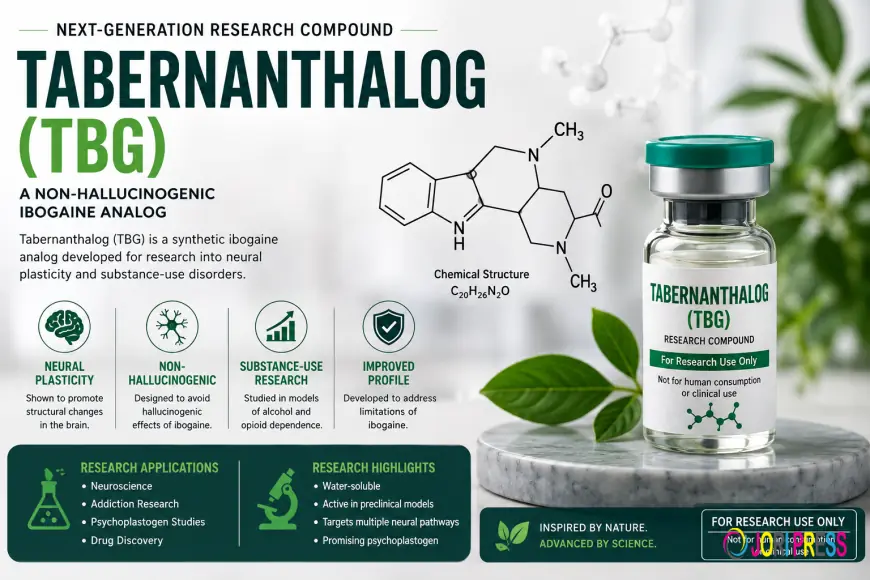
Tabernanthalog, commonly abbreviated TBG, is a synthetic analogue of ibogaine developed as part of research into compounds that could retain some of ibogaine's potentially useful biological properties while avoiding important limitations associated with the parent compound.
Unlike ibogaine, TBG was designed to be water-soluble and non-hallucinogenic. Early laboratory research has investigated its effects on neural plasticity and behaviors relevant to substance-use and mood disorders. However, the evidence remains primarily preclinical, and TBG should not be confused with an approved medical treatment.
{https://noribogain.com/noribogaine-treatment/}
What Is Tabernanthalog?
Tabernanthalog is a synthetic compound derived from the structural concepts of ibogaine chemistry. It is often described in scientific literature as an ibogaine analogue and psychoplastogen.
The compound was developed through structure-based chemical design. Researchers sought to separate potentially useful biological activity from characteristics of ibogaine that have complicated its development, particularly hallucinogenic effects and cardiac safety concerns.
How Is TBG Related to Ibogaine?
Ibogaine is a naturally occurring indole alkaloid found in Tabernanthe iboga. Although TBG is structurally related to ibogaine, it is not simply another form of natural iboga or ibogaine.
The distinction is important:
-
Iboga refers to the botanical source.
-
Ibogaine is a naturally occurring alkaloid.
-
Tabernanthalog (TBG) is a synthetic ibogaine analogue.
-
Ibogaine HCl is the hydrochloride salt form of ibogaine.
These materials have different chemical and pharmacological characteristics.
Why Was Tabernanthalog Developed?
Ibogaine has attracted scientific attention because of observations involving substance-use behavior and its effects on neural systems. However, its development as a conventional therapeutic has been complicated by concerns including hallucinations and potentially dangerous cardiac effects.
Researchers therefore investigated whether chemical modification could produce an ibogaine-inspired compound with a different safety and pharmacological profile.
The original Nature study reported that TBG was designed as a water-soluble, non-hallucinogenic analogue and demonstrated activity in several rodent models.
Tabernanthalog and Neural Plasticity
One of the most interesting areas of TBG research concerns neural plasticity.
Neural plasticity refers broadly to the brain's ability to modify connections and functional organization in response to experiences or biological signals.
In preclinical experiments, TBG promoted structural changes associated with neural plasticity. Researchers have therefore investigated the compound as a potential psychoplastogen—a term used for compounds capable of producing relatively rapid changes in neuronal structure and connectivity.
Importantly, evidence of neuroplasticity in laboratory models does not establish that TBG produces the same effects in humans.
Research Into Substance-Use Disorders
Early animal research found that TBG reduced alcohol- and heroin-seeking behaviors in specific experimental models. These findings helped establish interest in TBG as a potential starting point for future drug-discovery research.
However, animal-model findings are an early stage of pharmaceutical development. Additional research is necessary to determine whether laboratory observations translate into meaningful and safe effects in humans.
A 2026 review describes the broader field as an evolving area of ibogaine-analogue research and emphasizes the need to distinguish promising preclinical findings from established clinical evidence.
What Receptors Does TBG Interact With?
TBG has a complex pharmacological profile.
Research has investigated its activity at serotonin-related targets as well as other neurological systems. More recent work has also examined its effects on nicotinic acetylcholine receptors, including α7 and α9α10 receptor subtypes. A 2024 study reported that TBG inhibited these receptors through distinct mechanisms.
The complexity of these interactions is one reason researchers continue to investigate how TBG produces its biological effects.
Is Tabernanthalog a Psychedelic?
TBG was specifically developed as a non-hallucinogenic analogue of ibogaine.
That characteristic is central to its scientific significance. Researchers are interested in whether certain biological effects associated with psychedelic or ibogaine-related compounds can be separated from the subjective hallucinogenic experience.
However, "non-hallucinogenic" in preclinical research should not be interpreted as a blanket statement about human safety or clinical effects.
TBG and Ibogaine: Key Differences
| Feature | Ibogaine | Tabernanthalog |
|---|---|---|
| Origin | Naturally occurring | Synthetic |
| Relationship | Parent iboga alkaloid | Ibogaine analogue |
| Hallucinogenic activity | Associated with psychoactive effects | Designed to be non-hallucinogenic |
| Research stage | Human and preclinical research | Primarily preclinical |
| Major research interest | Substance-use disorders and pharmacology | Neuroplasticity and drug discovery |
| Cardiac concerns | Significant concern | Designed to address limitations of ibogaine, but human safety remains unestablished |
The comparison does not mean TBG has been proven safer or more effective in humans. Its clinical profile remains an active research question.
Why TBG Is Important in Modern Research
TBG represents a broader strategy in medicinal chemistry: modifying an existing molecule to preserve potentially useful biological activity while reducing undesirable characteristics.
This approach is particularly interesting in ibogaine research because scientists are attempting to understand which structural features are responsible for different biological effects.
Recent reviews describe ibogaine analogues as an expanding area of drug discovery, while emphasizing that different analogues may have substantially different mechanisms and safety profiles.
Frequently Asked Questions
What does TBG stand for?
TBG stands for tabernanthalog, a synthetic analogue of ibogaine.
Is tabernanthalog the same as ibogaine?
No. TBG is a chemically modified synthetic analogue, whereas ibogaine is a naturally occurring alkaloid found in Tabernanthe iboga.
Why are scientists studying TBG?
Researchers are investigating TBG because of its effects on neural plasticity and its potential relevance to substance-use and neurological research.
Is TBG approved as a medicine?
The research described in the scientific literature is primarily preclinical. TBG should not be presented as an approved treatment for addiction, depression, or another medical condition.
Is TBG safe for human use?
Human safety cannot be established from animal or laboratory studies alone. More research is required to characterize its pharmacology, toxicity, dosing, interactions, and long-term effects.
Conclusion
Tabernanthalog is an important example of how researchers are using medicinal chemistry to explore new compounds inspired by ibogaine.
Its reported ability to promote neural plasticity, combined with its intentionally non-hallucinogenic design, has made TBG an interesting subject in modern psychoplastogen research. At the same time, most evidence remains preclinical, meaning considerable work is still required before conclusions about human therapeutic use can be made.
What's Your Reaction?
 Like
0
Like
0
 Dislike
0
Dislike
0
 Love
0
Love
0
 Funny
0
Funny
0
 Angry
0
Angry
0
 Sad
0
Sad
0
 Wow
0
Wow
0