




































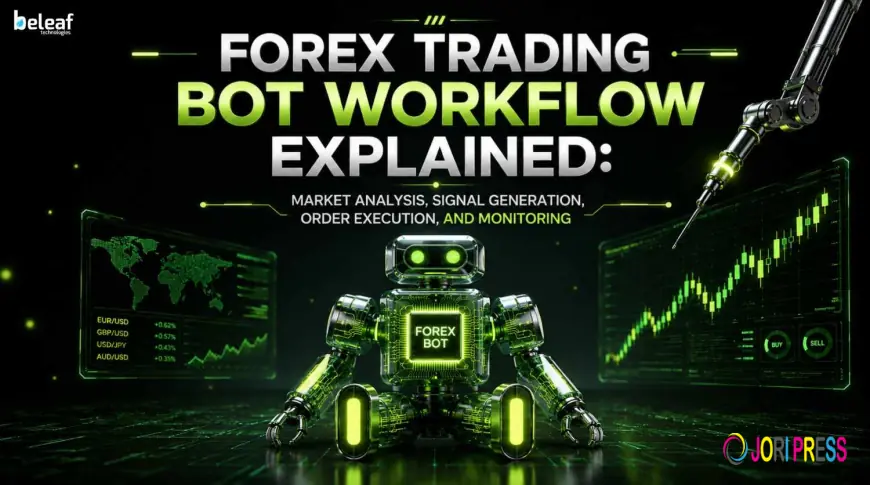
Forex Trading Bot Workflow Explained: Market Analysis, Signal Generation, Order Execution, and Monitoring
A forex bot moves through four connected stages, reading the market, deciding on a signal, placing the trade, and watching it unfold. This breakdown shows exactly where automated systems earn trust or quietly fall short

Anyone curious about automated currency trading eventually wants to know exactly what happens behind the scenes, from the moment price data enters the system to the moment a trade actually closes. Understanding this workflow matters because it reveals whether a forex bot is making thoughtful, structured decisions or simply reacting blindly to random price movement. This guide breaks down the entire process into four core stages, market analysis, signal generation, order execution, and monitoring, explaining exactly what happens at each step and why every stage plays a critical role in how well an automated trading system performs in real market conditions.
Stage One: Market Analysis
Every automated trading system begins with market analysis, where the system continuously collects and processes live price data across selected currency pairs. This stage forms the foundation for every decision that follows, since inaccurate or delayed data can lead to poor trading outcomes regardless of how well the rest of the system is designed.
During this stage, the system typically evaluates several types of information.
-
Real time price movement across multiple time frames
-
Technical indicators such as moving averages, RSI, and MACD
-
Historical price patterns relevant to the chosen strategy
-
Broader market context, including volatility and trading volume
A well designed system does not rely on a single data point but instead cross checks multiple signals before moving forward, reducing the chance of acting on misleading price noise.
Stage Two: Signal Generation
Once market analysis is complete, the system moves into signal generation, where it determines whether current conditions match the predefined rules needed to justify a trade. This is essentially the decision making brain of the entire process, translating raw data into a clear buy or sell signal.
Signal generation usually involves the following steps.
-
Comparing live indicator values against strategy thresholds
-
Confirming alignment across multiple indicators before generating a signal
-
Filtering out weak or conflicting signals that fail confirmation checks
-
Assigning confidence levels in more advanced systems using AI models
Strong signal generation logic helps prevent a common problem in automated trading, where a bot reacts to every minor price fluctuation instead of waiting for genuinely meaningful opportunities.
Stage Three: Order Execution
After a valid signal is confirmed, the system moves into order execution, where the actual trade is placed in the market. Speed and accuracy matter enormously here, since even small delays can affect entry price, especially during fast moving market conditions.
Execution typically includes the following components.
-
Sending buy or sell orders directly to the broker's trading server
-
Applying predefined stop loss and take profit levels automatically
-
Adjusting position size based on account risk settings
-
Handling slippage and confirming that the trade was filled correctly
Reliable execution depends heavily on both the quality of the trading platform and the stability of the broker connection, since even a perfectly timed signal can lose value if execution is delayed or mishandled.
Stage Four: Monitoring and Adjustment
Once a trade is live, the final stage involves ongoing monitoring, ensuring that open positions continue to align with the original strategy as market conditions evolve. This stage often gets overlooked, yet it plays a major role in protecting capital and adapting to unexpected market behavior.
Monitoring typically includes the following actions.
-
Tracking open trades against real time price movement
-
Adjusting trailing stop loss levels as a trade moves favorably
-
Watching for major news events that could affect open positions
-
Logging performance data for future strategy refinement
Systems that skip proper monitoring often struggle to adapt when market behavior shifts suddenly, which can turn a well planned trade into an unnecessary loss.
How These Four Stages Work Together
Each stage in this workflow depends directly on the one before it. Weak market analysis leads to unreliable signals, poor signal generation leads to bad trade decisions, and inconsistent execution or monitoring can undermine even the most well researched strategy. This is exactly why a forex bot must be evaluated as a complete system rather than judging any single stage in isolation.
Quick Answer for Common Questions
For readers looking for a fast summary, a forex bot generally follows four core stages, it analyzes live market data, generates a trading signal based on predefined rules or AI models, executes the trade through a connected broker, and continuously monitors the position until it closes. Each stage must function reliably for the overall system to perform consistently, which is why traders evaluating any forex bot should review its performance across all four stages rather than focusing on marketing claims alone.
Why Understanding This Workflow Matters for Traders
Traders who understand this workflow are far better equipped to evaluate whether a forex bot is genuinely well built or simply marketed effectively. Instead of relying on vague performance claims, traders can ask specific questions about data sources, signal confirmation logic, execution speed, and monitoring capabilities, leading to much more informed decisions before committing real capital to any automated system.
Conclusion
The complete workflow behind a forex bot, from market analysis and signal generation to order execution and ongoing monitoring, reveals just how much technical coordination goes into successful automated trading. Each stage carries its own risks and requirements, and a weakness in any single part of the process can significantly affect overall performance. By understanding how these four stages work together, traders gain a much clearer framework for evaluating any forex bot, allowing them to separate genuinely well built systems from those that only appear reliable on the surface.
What's Your Reaction?
 Like
0
Like
0
 Dislike
0
Dislike
0
 Love
0
Love
0
 Funny
0
Funny
0
 Angry
0
Angry
0
 Sad
0
Sad
0
 Wow
0
Wow
0