






































XRF Instrument Suppliers in India: Key Features, Applications, and Selection Criteria
XRF Instrument Suppliers in India offer advanced solutions for elemental analysis. Explore key features, applications, and selection criteria.

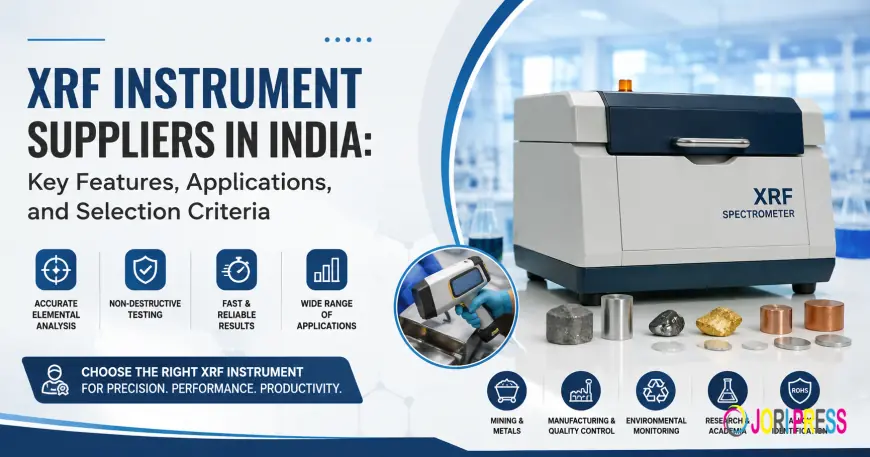
X-Ray Fluorescence (XRF) spectroscopy is widely used for elemental analysis across laboratories, manufacturing industries, research institutions, mining, metals, cement, ceramics, and environmental testing. As the demand for fast, accurate, and non-destructive material analysis continues to grow, choosing the right XRF instrument suppliers in India has become an important decision for laboratories and industrial organizations.
A reliable supplier does more than provide an XRF analyzer. The right supplier can help organizations select suitable equipment, understand technical specifications, install the system, provide training, and maintain the instrument for consistent long-term performance.
This article explains the key features of XRF instruments, their major applications, and the important criteria to consider when selecting XRF instrument suppliers in India.
What Is an XRF Instrument?
An XRF instrument is an analytical device used to determine the elemental composition of a material. The technique works by exposing a sample to X-rays, which cause the atoms in the material to emit characteristic secondary X-rays. These emitted signals are measured and interpreted to identify and quantify the elements present.
XRF analysis is valued because it can provide rapid elemental information while requiring relatively little sample preparation. Depending on the instrument type and application, XRF can be used for solids, powders, liquids, alloys, coatings, minerals, and other materials.
Why Choose Reliable XRF Instrument Suppliers in India?
Selecting an experienced supplier is important because XRF instruments can vary considerably in terms of detector technology, elemental range, resolution, software, sample handling, portability, and intended application.
Reliable XRF instrument suppliers in India can help customers select an instrument according to their specific testing requirements rather than simply recommending a standard model.
A dependable supplier can also support:
-
Instrument selection and technical consultation
-
Installation and commissioning
-
Operator training
-
Application support
-
Calibration assistance
-
Preventive maintenance
-
Troubleshooting and technical service
-
Software support and updates
-
Spare parts and accessories
These services can have a significant impact on the overall usability and lifetime value of an XRF system.
Key Features to Look for in an XRF Instrument
Before purchasing an XRF analyzer, laboratories and industries should evaluate its technical features carefully.
1. Elemental Detection Range
The required elemental range depends on the application. Some laboratories may need analysis of common elements in metals, while others may require broader elemental coverage for geological, environmental, or industrial samples.
Understanding which elements need to be detected and quantified should be one of the first considerations when comparing instruments.
2. Detection Limits
Detection limits determine how effectively an instrument can identify low concentrations of specific elements.
For applications involving trace-element analysis, it is important to compare the instrument's detection limits for the elements and sample types relevant to the laboratory.
3. Accuracy and Repeatability
Analytical accuracy and repeatability are critical for quality control and research applications.
When evaluating XRF systems, users should consider:
-
Measurement precision
-
Repeatability
-
Calibration options
-
Reference standards
-
Software capabilities
-
Application-specific performance
The instrument should be suitable for the level of analytical accuracy required by the intended application.
4. Measurement Speed
One of the major advantages of XRF technology is rapid analysis.
For manufacturing and quality-control environments, faster measurement can help increase sample throughput and reduce delays. Laboratories processing large numbers of samples should therefore evaluate measurement time along with analytical performance.
5. Sample Handling
XRF instruments are available with different sample-analysis configurations. Depending on the model, they may accommodate:
-
Solid samples
-
Powders
-
Pellets
-
Liquids
-
Metal alloys
-
Coatings
-
Geological samples
The supplier should be able to explain which sample types are supported and whether additional sample preparation equipment is required.
6. Software and Data Management
Modern XRF instruments generally rely on software for instrument control, calibration, data analysis, reporting, and result storage.
Important software features may include:
-
Automated measurement routines
-
Calibration management
-
Result reporting
-
Data export
-
User access management
-
Database functionality
-
Quality-control monitoring
A user-friendly interface can also reduce the training required for routine operators.
7. Portability
For field applications, a handheld XRF analyzer may be more suitable than a laboratory-based system.
Portable XRF instruments can be useful for on-site screening and material identification in industries such as mining, recycling, metal identification, and environmental investigations.
The choice between handheld, benchtop, and laboratory-based XRF should depend on where the analysis will take place and the required analytical performance.
Major Applications of XRF Instruments
XRF technology is used across a wide range of industries because of its versatility and non-destructive analytical capabilities.
Mining and Geology
XRF is widely used for identifying and measuring elements in geological materials, ores, rocks, and minerals.
Handheld XRF analyzers can be particularly useful for field screening, exploration, grade control, and rapid geochemical assessments.
Metals and Alloys
In metal manufacturing and fabrication, XRF can help identify alloy compositions and verify whether materials meet specified requirements.
It can be used for applications such as:
-
Alloy identification
-
Incoming material inspection
-
Quality control
-
Scrap sorting
-
Grade verification
Cement and Building Materials
Cement and construction-material industries require elemental analysis for raw materials and finished products.
XRF can assist in monitoring the elemental composition of materials such as limestone, clinker, cement raw materials, and other mineral-based products.
Environmental Testing
XRF can be used for screening elements in environmental samples such as soil and sediment.
Its ability to provide rapid elemental information makes it useful for environmental investigations and contamination screening.
Ceramics and Glass
XRF is commonly applied to the analysis of raw materials and finished ceramic and glass products.
It can help manufacturers monitor elemental composition and maintain consistency between production batches.
Research and Material Science
Research laboratories use XRF for elemental characterization of various materials.
It can complement other analytical techniques when researchers need information about elemental composition alongside structural, morphological, or chemical data.
Electronics and Manufacturing
XRF can also be used in electronics and manufacturing for material verification and coating analysis.
For example, specialized XRF systems can be used for measuring coating thickness and elemental composition in suitable applications.
Types of XRF Instruments
When comparing XRF instrument suppliers in India, it is useful to understand the major categories of instruments available.
Handheld XRF Analyzers
Handheld XRF analyzers are compact instruments designed for mobile or on-site testing.
They are commonly used for:
-
Metal identification
-
Mining and geology
-
Recycling
-
Environmental screening
-
Field inspections
Their portability allows users to analyze materials without transporting every sample to a laboratory.
Benchtop XRF Instruments
Benchtop systems provide a compact laboratory solution for organizations that require regular elemental analysis but have limited laboratory space.
They are suitable for applications where samples can be brought to the instrument for analysis.
Laboratory XRF Systems
Laboratory-based XRF instruments are designed for more extensive analytical workflows and higher sample throughput.
They can be appropriate for research laboratories, industrial quality-control facilities, and organizations with demanding analytical requirements.
Selection Criteria for XRF Instrument Suppliers in India
Choosing the right supplier is just as important as choosing the right instrument.
1. Technical Expertise
Look for suppliers with a strong understanding of XRF technology and your specific application.
A technically knowledgeable supplier should be able to explain instrument specifications and recommend an appropriate system based on your sample types, detection requirements, throughput, and budget.
2. Product Range
A supplier offering different XRF configurations may provide more flexibility during the selection process.
For example, your requirements may be better suited to a handheld XRF analyzer today, while another application may require a benchtop or laboratory system.
3. Application Support
Application support is particularly important when introducing XRF into a laboratory for the first time.
Ask whether the supplier provides assistance with:
-
Method development
-
Calibration
-
Sample preparation
-
Instrument operation
-
Result interpretation
4. Installation and Training
Proper installation and operator training can help organizations achieve reliable results and use the instrument effectively.
Before purchasing, confirm what installation and training services are included.
5. After-Sales Service
XRF instruments are long-term investments. Reliable technical support can help minimize downtime and maintain instrument performance.
Consider the supplier's capabilities for:
-
Preventive maintenance
-
Repairs
-
Troubleshooting
-
Spare parts
-
Calibration support
-
Software updates
6. Warranty and Service Terms
Always review warranty coverage and service conditions before purchasing.
Understand what is covered, the duration of the warranty, and how technical support is provided after installation.
7. Total Cost of Ownership
The purchase price should not be the only factor when comparing XRF instruments.
Consider the overall cost, including:
-
Instrument price
-
Installation
-
Training
-
Calibration
-
Accessories
-
Consumables
-
Maintenance
-
Software
-
Service contracts
Evaluating total cost of ownership can provide a clearer picture of the long-term investment.
8. References and Industry Experience
A supplier with experience supporting laboratories and industries similar to yours may be better positioned to understand practical application requirements.
Where possible, ask about previous installations, application experience, and customer support capabilities.
XRF Supplier vs. Instrument Manufacturer
It is also useful to distinguish between an instrument manufacturer and a local supplier or distributor.
Manufacturers develop and produce the instruments, while suppliers or distributors may provide sales, installation, training, technical support, and local service.
For Indian laboratories, working with a supplier that can provide strong local support can be valuable because technical assistance, maintenance, and application guidance may be easier to access.
How to Choose the Right XRF Instrument
The right instrument depends on the application rather than simply the instrument's specifications.
For example:
-
Field testing: A handheld XRF analyzer may be appropriate.
-
Routine laboratory analysis: A benchtop XRF system may provide a practical solution.
-
High-throughput industrial testing: A laboratory-grade system may be more suitable.
-
Metal identification: Consider an analyzer designed for alloy and elemental identification.
-
Research applications: Evaluate elemental range, sensitivity, software, and calibration flexibility.
A detailed discussion with experienced XRF instrument suppliers in India can help match the instrument to the actual analytical requirements.
Conclusion
XRF spectroscopy provides a fast and versatile approach to elemental analysis across mining, metals, cement, ceramics, environmental testing, manufacturing, and research.
However, selecting the right instrument requires more than comparing prices. Organizations should evaluate elemental range, detection limits, accuracy, measurement speed, sample handling, software, portability, and application requirements.
Equally important is the choice of supplier. Reliable XRF instrument suppliers in India can provide technical guidance, installation, training, application support, maintenance, and after-sales service that contribute to the long-term success of an XRF investment.
By carefully evaluating both the instrument and the supplier's technical and service capabilities, laboratories and industries can make a more informed decision and select an XRF solution that aligns with their analytical requirements and future needs.
What's Your Reaction?
 Like
0
Like
0
 Dislike
0
Dislike
0
 Love
0
Love
0
 Funny
0
Funny
0
 Angry
0
Angry
0
 Sad
0
Sad
0
 Wow
0
Wow
0