









































Why Modbus TCP Gateways Are Critical for Smart Manufacturing

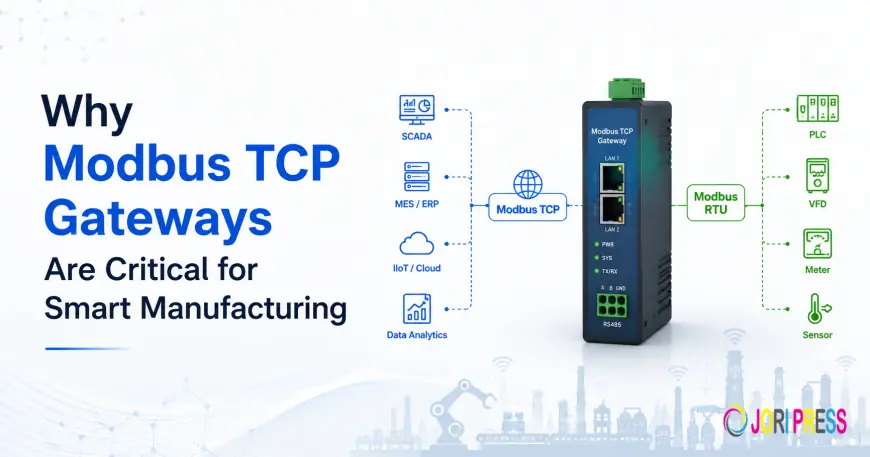
The manufacturing industry is undergoing a significant transformation driven by Industry 4.0, Industrial Internet of Things (IIoT), artificial intelligence, and advanced automation technologies. Modern factories are increasingly relying on connected devices, real-time data exchange, and intelligent control systems to improve productivity, reduce operational costs, and enhance decision-making.
However, many manufacturing facilities still operate with legacy equipment that uses traditional communication protocols such as Modbus RTU over serial networks. Integrating these older systems with modern Ethernet-based infrastructures can be challenging. This is where Modbus TCP Gateways play a vital role.
A Modbus TCP Gateway acts as a bridge between serial Modbus devices and Ethernet networks, enabling seamless communication across different industrial systems. By connecting legacy equipment to modern industrial networks, these gateways help manufacturers unlock the full potential of smart manufacturing.
Understanding Modbus TCP Gateways
A Modbus TCP Gateway is an industrial networking device that converts Modbus RTU or Modbus ASCII communication into Modbus TCP communication.
It allows devices operating on serial communication interfaces such as:
-
RS232
-
RS422
-
RS485
to communicate over Ethernet networks using the Modbus TCP protocol.
The gateway serves as a translator, ensuring that data can flow seamlessly between legacy devices and modern control systems.
How It Works
The gateway performs three key functions:
Data Collection
It gathers data from serial Modbus devices such as:
-
PLCs
-
Sensors
-
Energy meters
-
Variable Frequency Drives (VFDs)
-
Remote Terminal Units (RTUs)
Protocol Conversion
The gateway converts serial Modbus messages into Ethernet-based Modbus TCP packets.
Data Transmission
Converted data is transmitted to:
-
SCADA systems
-
Industrial PCs
-
Cloud platforms
-
Manufacturing Execution Systems (MES)
-
Enterprise Resource Planning (ERP) systems
This process enables real-time communication throughout the factory network.
The Growing Need for Smart Manufacturing
Smart manufacturing relies on continuous data exchange between machines, systems, and operators.
Key characteristics of smart manufacturing include:
-
Real-time monitoring
-
Predictive maintenance
-
Automated decision-making
-
Remote access
-
Industrial IoT integration
-
Data-driven optimization
To achieve these capabilities, all devices within a manufacturing environment must be connected and capable of sharing information efficiently.
Unfortunately, many industrial facilities still use equipment that was designed long before Ethernet and IIoT technologies became standard.
Replacing all legacy equipment is often expensive and impractical.
Modbus TCP Gateways solve this challenge by providing a cost-effective path toward digital transformation.
Why Modbus TCP Gateways Are Critical for Smart Manufacturing
1. Enable Integration of Legacy Equipment
One of the biggest obstacles in industrial modernization is the presence of legacy machinery.
Many industrial devices still rely on:
-
Modbus RTU
-
Serial communication
-
RS485 networks
These systems often continue to function reliably and do not require replacement.
A Modbus TCP Gateway enables manufacturers to:
-
Connect legacy equipment to Ethernet networks
-
Extend equipment lifespan
-
Avoid costly system upgrades
-
Modernize operations gradually
This approach significantly reduces capital expenditures while supporting digital transformation goals.
2. Support Real-Time Data Collection
Data is the foundation of smart manufacturing.
Factories need immediate access to operational information such as:
-
Machine status
-
Production rates
-
Energy consumption
-
Equipment health
-
Environmental conditions
Modbus TCP Gateways facilitate continuous data collection from field devices and transmit it to centralized monitoring systems.
Benefits include:
-
Faster response times
-
Better production visibility
-
Reduced downtime
-
Improved decision-making
Real-time access to information enables manufacturers to optimize processes and increase efficiency.
3. Enhance SCADA System Connectivity
SCADA systems are central to industrial automation.
They provide:
-
Monitoring
-
Control
-
Data logging
-
Alarm management
Many SCADA platforms use Ethernet-based communication protocols.
Modbus TCP Gateways allow SCADA systems to communicate with serial Modbus devices seamlessly.
Advantages include:
-
Unified system monitoring
-
Simplified network architecture
-
Improved operational control
-
Faster troubleshooting
This enhanced connectivity helps manufacturers gain complete visibility across their operations.
4. Enable Industrial IoT (IIoT) Implementation
The Industrial Internet of Things depends on the ability to collect and analyze data from industrial devices.
Modbus TCP Gateways serve as a critical link between:
-
Shop floor devices
-
Edge computing systems
-
Cloud platforms
They allow traditional industrial equipment to participate in IIoT ecosystems.
Key benefits include:
-
Predictive maintenance
-
Remote monitoring
-
Advanced analytics
-
Digital twin implementation
-
Asset optimization
Without protocol conversion and connectivity solutions, many legacy devices would remain isolated from modern IIoT infrastructures.
5. Improve Production Efficiency
Smart manufacturing focuses on maximizing productivity while minimizing waste.
Modbus TCP Gateways contribute by providing accurate, real-time operational data.
Manufacturers can:
-
Monitor production processes continuously
-
Detect inefficiencies quickly
-
Identify bottlenecks
-
Optimize machine performance
As a result, facilities experience:
-
Increased output
-
Reduced downtime
-
Lower operational costs
-
Improved resource utilization
6. Simplify Network Management
Managing multiple communication protocols can be complex.
Without gateways, manufacturers often need separate systems for:
-
Serial devices
-
Ethernet devices
-
Monitoring systems
Modbus TCP Gateways simplify network management by creating a unified communication platform.
Benefits include:
-
Reduced wiring complexity
-
Easier maintenance
-
Simplified troubleshooting
-
Lower IT overhead
This streamlined infrastructure improves overall operational reliability.
7. Enable Remote Monitoring and Control
Modern manufacturers require access to operational data from anywhere.
Modbus TCP Gateways allow devices to communicate through Ethernet and internet-connected networks.
Remote capabilities include:
-
Equipment monitoring
-
Alarm notifications
-
Process control
-
Performance analysis
This is especially valuable for:
-
Multi-site operations
-
Remote facilities
-
Utility systems
-
Industrial campuses
Remote access improves responsiveness and reduces maintenance costs.
8. Facilitate Predictive Maintenance
Unexpected equipment failures can cause significant production losses.
Predictive maintenance strategies rely on continuous monitoring of machine health indicators such as:
-
Temperature
-
Vibration
-
Current consumption
-
Pressure
-
Flow rates
Modbus TCP Gateways enable real-time data transfer from sensors to analytics platforms.
Benefits include:
-
Early fault detection
-
Reduced downtime
-
Lower maintenance costs
-
Increased equipment lifespan
Predictive maintenance is a cornerstone of successful smart manufacturing initiatives.
9. Improve Scalability
Manufacturing operations evolve over time.
As facilities grow, new devices and systems must be integrated efficiently.
Modbus TCP Gateways support scalability by:
-
Allowing additional devices to be connected easily
-
Supporting network expansion
-
Enabling flexible system architecture
Manufacturers can expand operations without redesigning entire communication infrastructures.
10. Strengthen Data Accessibility
Modern manufacturing relies on data-driven decisions.
Modbus TCP Gateways make operational data available to:
-
Production managers
-
Engineers
-
Maintenance teams
-
Executives
Information can be integrated into:
-
MES platforms
-
ERP systems
-
Cloud dashboards
-
Analytics software
Greater accessibility leads to improved planning, forecasting, and operational optimization.
Key Applications of Modbus TCP Gateways in Smart Manufacturing
Production Line Monitoring
Track machine performance and production metrics in real time.
Energy Management
Connect energy meters and monitor power consumption across facilities.
Process Automation
Integrate field devices with centralized automation systems.
Predictive Maintenance
Collect sensor data for advanced diagnostics and failure prediction.
Remote Equipment Management
Monitor and control industrial assets from centralized locations.
Quality Control Systems
Provide real-time production data for quality assurance initiatives.
Features to Look for in a Modbus TCP Gateway
When selecting a Modbus TCP Gateway, consider the following features:
Multiple Serial Interfaces
Support for:
-
RS232
-
RS422
-
RS485
High-Speed Data Processing
Fast protocol conversion for real-time applications.
Industrial-Grade Design
Features such as:
-
Wide operating temperatures
-
Rugged enclosures
-
Surge protection
Security Features
Protection against unauthorized access and cyber threats.
Easy Configuration
User-friendly setup and management tools.
Cloud Compatibility
Support for modern IIoT and cloud-based monitoring platforms.
Future of Modbus TCP Gateways in Smart Manufacturing
As Industry 4.0 adoption accelerates, the importance of Modbus TCP Gateways will continue to grow.
Future developments are expected to include:
-
Enhanced cybersecurity features
-
Edge computing integration
-
AI-powered diagnostics
-
Advanced protocol support
-
Improved cloud connectivity
-
Faster data processing capabilities
These innovations will further strengthen the role of Modbus TCP Gateways in enabling connected and intelligent manufacturing environments.
Conclusion
Smart manufacturing depends on seamless communication between machines, systems, and digital platforms. While many industrial facilities continue to rely on legacy equipment, modern manufacturing demands real-time connectivity, data visibility, and operational intelligence.
Modbus TCP Gateways provide the critical bridge between traditional serial devices and modern Ethernet-based networks. They enable legacy equipment integration, support Industrial IoT initiatives, enhance SCADA connectivity, improve efficiency, and facilitate predictive maintenance.
By investing in reliable Modbus TCP Gateway solutions, manufacturers can accelerate their digital transformation journey while maximizing the value of existing infrastructure. As smart factories become the industry standard, Modbus TCP Gateways will remain a foundational technology powering the future of industrial automation.
What's Your Reaction?
 Like
0
Like
0
 Dislike
0
Dislike
0
 Love
0
Love
0
 Funny
0
Funny
0
 Angry
0
Angry
0
 Sad
0
Sad
0
 Wow
0
Wow
0