






































Why IS 710 Plywood is Preferred for Moisture-Prone Areas
Discover why IS 710 plywood is preferred for moisture-prone areas. Learn about its moisture resistance, durability, dimensional stability, applications, and how to choose a reliable IS 710 plywood supplier.

When selecting plywood for areas exposed to humidity, water splashes, or changing moisture levels, ordinary plywood may not always provide the durability a project requires. Kitchens, bathrooms, utility areas, balconies, and other moisture-prone spaces need a panel that can maintain its strength and dimensional stability over time.
This is where IS 710 plywood becomes a preferred choice. Manufactured to meet the requirements of the Indian Standard specification for marine plywood, IS 710 plywood is designed for applications where resistance to moisture and demanding environmental conditions is important.
For homeowners, architects, interior designers, and contractors, understanding why this plywood performs better in humid environments can help in making a more informed material selection.
What Is IS 710 Plywood?
IS 710 plywood refers to plywood manufactured according to IS 710, the Indian Standard specification for marine plywood. The standard establishes requirements related to the construction, quality, bonding, and performance of plywood intended for applications involving prolonged exposure to moisture.
Unlike standard interior-grade plywood, marine plywood is manufactured with a strong emphasis on bond durability and resistance to moisture-related deterioration.
However, it is important to understand that “marine plywood” does not mean the sheet is completely waterproof under every condition. Proper edge sealing, installation, ventilation, and maintenance still play an important role in achieving long-term performance.
Why Is IS 710 Plywood Suitable for Moisture-Prone Areas?
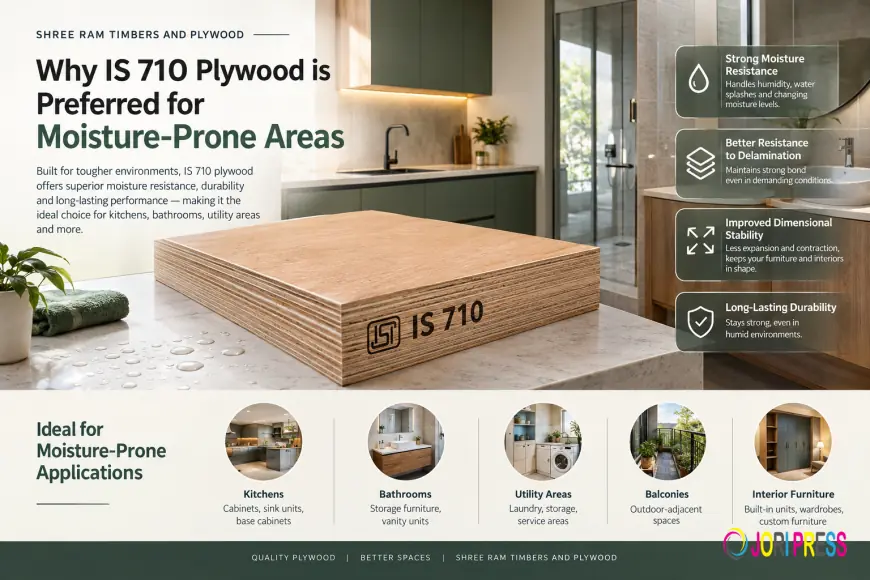
1. Strong Moisture Resistance
The biggest reason builders choose IS 710 plywood for humid environments is its ability to withstand moisture better than many conventional plywood grades.
In places such as kitchens and utility areas, plywood can experience humidity, steam, accidental spills, and occasional water exposure. If the adhesive bond inside the panel is weak, moisture can eventually cause layers to separate.
IS 710 plywood is manufactured with bonding requirements intended to provide better resistance to such conditions. This makes it a suitable material where ordinary interior plywood may have limitations.
2. Better Resistance to Delamination
Delamination occurs when the individual veneers within plywood begin to separate. Moisture penetration, poor-quality adhesive, inadequate manufacturing, or prolonged exposure to unfavorable conditions can contribute to this problem.
A reliable IS 710 plywood supplier should provide plywood manufactured according to the applicable standard and suitable for the intended application.
The stronger bonding associated with marine-grade plywood helps reduce the risk of veneer separation when the panel is exposed to demanding moisture conditions.
3. Improved Dimensional Stability
Wood naturally responds to changes in moisture. It can absorb and release moisture depending on the surrounding environment, which may lead to expansion or contraction.
In cabinetry and furniture, excessive movement can affect alignment, joints, shutters, and surface finishes. Quality plywood with properly manufactured veneer layers offers better dimensional stability than many lower-grade alternatives.
This is particularly valuable in humid climates, where moisture levels can fluctuate throughout the year.
4. Suitable for Kitchens and Utility Areas
Kitchens are among the most common locations where moisture-resistant plywood is considered.
Cabinet interiors, sink units, base cabinets, and storage areas may encounter water splashes, steam, and cleaning moisture. Using a suitable plywood grade can provide an additional level of protection for the underlying structure.
IS 710 plywood can be a strong option for such applications, particularly around areas where moisture exposure is more likely.
For sink cabinets and similar locations, however, the installation details matter just as much as the plywood itself. Water-resistant sealants, properly sealed edges, suitable hardware, and good plumbing practices can help prevent water from reaching the panel.
IS 710 Plywood vs. Regular Plywood
One of the common questions from homeowners is whether marine plywood is actually necessary when regular plywood is less expensive.
The answer depends on the application.
Standard interior plywood may work well in dry rooms where moisture exposure is minimal. But when furniture is located near sinks, bathrooms, utility areas, or other humid environments, the consequences of moisture damage can be much greater.
The key advantage of IS 710 plywood is not simply that it is “stronger.” Its construction and bonding requirements make it better suited to applications where moisture resistance and bond durability are important considerations.
Therefore, choosing plywood based only on its initial price may not always be economical. A lower-cost sheet that deteriorates prematurely can result in replacement, repair, and additional labour costs.
Where Can IS 710 Plywood Be Used?
Depending on the specific product and manufacturer recommendations, marine-grade plywood can be considered for several demanding applications, including:
- Kitchen cabinets and sink units
- Utility-room furniture
- Bathroom storage furniture
- Areas with high humidity
- Interior applications exposed to occasional moisture
- Furniture requiring higher bond durability
- Certain demanding commercial and institutional applications
For structural or exterior applications, the product specification and project requirements should always be checked before installation.
How to Choose the Right IS 710 Plywood Supplier
Choosing the right IS 710 plywood supplier is just as important as choosing the correct plywood grade.
Buyers should look beyond simple claims such as “waterproof plywood” and check whether the product is manufactured and supplied according to the relevant Indian Standard requirements.
Consider the following factors:
Check product specifications: Ask for technical information and applicable certification or test documentation.
Understand the intended application: Explain whether the plywood is being used in a kitchen, bathroom, utility area, furniture, or another environment.
Check thickness and construction: Plywood performance depends on veneer quality, thickness, construction, and manufacturing consistency.
Consider edge protection: Even high-quality marine plywood can suffer when water repeatedly enters through exposed edges.
Buy from an established supplier: A dependable supplier should be able to explain product specifications rather than relying only on marketing terminology.
Why Quality Installation Matters
Even the best moisture-resistant plywood cannot compensate for poor installation.
For example, a cabinet installed directly where water regularly accumulates may eventually experience damage if exposed edges remain unsealed. Similarly, leaking plumbing can cause prolonged water exposure that exceeds the intended conditions of the material.
To improve durability, installers should pay attention to:
- Proper edge sealing
- Correct joining and fastening methods
- Adequate ventilation
- Protection from standing water
- Proper plumbing around sink and utility areas
- Appropriate surface finishing
- Regular inspection for leaks
These precautions work together with the plywood's inherent properties to provide better long-term performance.
Is IS 710 Plywood Worth the Investment?
For moisture-prone applications, choosing a higher-grade plywood can be a sensible long-term investment.
The real value of IS 710 plywood lies in its ability to provide better resistance to moisture-related deterioration while maintaining the structural integrity of the panel. This can be particularly important for built-in furniture that is difficult or expensive to replace after installation.
However, homeowners should avoid selecting plywood solely because it carries the word “marine.” The correct grade, manufacturer, certification, thickness, and application should all be considered together.
Final Thoughts
Moisture is one of the biggest challenges faced by plywood used in kitchens, bathrooms, utility areas, and humid environments. Choosing an appropriate plywood grade at the beginning of a project can help reduce the risk of premature deterioration and costly repairs.
IS 710 plywood is preferred for moisture-prone applications because its manufacturing and bonding requirements are designed for demanding conditions. When combined with proper edge protection, installation, ventilation, and maintenance, it can offer dependable performance where ordinary interior plywood may not be the ideal choice.
At Shree Ram Timbers and Plywood, customers can evaluate plywood based on their project's specific requirements rather than simply choosing a product based on price. Whether you are planning kitchen furniture, utility storage, or another moisture-exposed application, selecting the right plywood grade and working with a reliable IS 710 plywood supplier can make a significant difference to the durability of the finished project.
What's Your Reaction?
 Like
0
Like
0
 Dislike
0
Dislike
0
 Love
0
Love
0
 Funny
0
Funny
0
 Angry
0
Angry
0
 Sad
0
Sad
0
 Wow
0
Wow
0