





























What Is RWA Tokenization? A Complete Guide to Real-World Asset Tokenization
Learn what RWA tokenization is, how real-world assets are tokenized, its benefits, use cases, risks, and future opportunities in this complete guide.

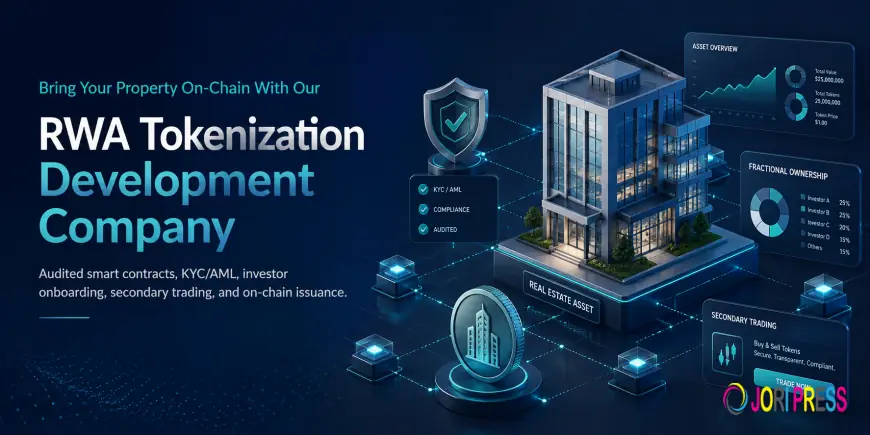
Real-world asset (RWA) tokenization is emerging as one of the most important applications of blockchain technology beyond cryptocurrencies. Instead of limiting blockchain to digitally native assets, tokenization brings ownership or economic claims associated with physical and traditional financial assets onto programmable digital networks. Real estate, government bonds, private credit, commodities, investment funds, artwork, and other assets can be represented through blockchain-based tokens, creating new ways to issue, manage, transfer, and settle value.
The concept is gaining momentum among financial institutions, asset managers, fintech companies, and blockchain businesses. According to RWA.xyz data available on August 28, 2026, distributed tokenized real-world assets had a value of approximately $38.69 billion, while represented asset value was approximately $366.68 billion. The platform also recorded nearly 2.95 million RWA holders, illustrating the expanding scale of the ecosystem.
At the same time, RWA tokenization is not simply about putting an asset on a blockchain. The legal rights attached to the token, custody of the underlying asset, compliance requirements, valuation, investor eligibility, smart-contract architecture, and mechanisms for redemption all determine whether a tokenized asset actually provides meaningful economic value. This guide explains how RWA tokenization works, why businesses and investors are adopting it, its major use cases, risks, and what the future could look like.
What Is RWA Tokenization?
RWA tokenization is the process of creating a blockchain-based digital representation of an asset or an economic claim connected to an asset that exists in the real world.
For example, imagine a commercial property worth $10 million. Instead of representing ownership solely through conventional legal documents and centralized databases, an appropriately structured tokenization model could divide the economic interest into 100,000 digital tokens. Each token could represent a defined fractional interest or contractual claim, subject to the legal structure governing the offering.
The blockchain becomes the infrastructure for recording token ownership and facilitating permitted transfers. Smart contracts can automate functions such as distribution calculations, transfer restrictions, whitelisting, corporate actions, and settlement.
However, an important distinction must be made: the blockchain token does not automatically create ownership of the physical asset. The legal structure must connect the token holder's rights to the underlying asset. This is particularly important for securities, real estate, and other regulated assets.
The U.S. Securities and Exchange Commission stated in January 2026 that a tokenized security is a financial instrument meeting the definition of a security while being represented by a crypto asset, with ownership recorded wholly or partly through crypto networks.
Therefore, RWA tokenization should be viewed as a combination of asset structuring, legal rights, blockchain infrastructure, compliance, and digital ownership management, rather than merely a technical process of creating tokens.
How Does RWA Tokenization Work?
A successful tokenization project generally involves several interconnected stages.
1. Asset Selection and Structuring
The process begins by identifying an asset suitable for tokenization. The issuer evaluates its value, ownership structure, cash flows, liquidity characteristics, legal status, and potential investor demand.
A property producing rental income, for instance, may be suitable because its income can potentially be distributed to token holders according to predefined rules. Similarly, a government bond can be represented through a tokenized fund or another legally structured vehicle.
2. Legal and Regulatory Framework
The next stage is determining exactly what the token represents.
Depending on the jurisdiction and structure, the token could represent direct ownership, an interest in a special-purpose vehicle, a debt claim, fund units, shares, or another contractual right. Compliance requirements may include securities regulations, KYC and AML procedures, investor restrictions, custody requirements, tax considerations, and transfer limitations.
This is one of the most important aspects of RWA tokenization because technological functionality cannot replace legal enforceability. The SEC has emphasized that tokenized securities remain securities and therefore continue to be subject to applicable securities laws.
3. Asset Verification and Custody
The underlying asset must be verified and appropriately held or controlled.
For example, if a token represents gold, there should be credible arrangements establishing the quantity, quality, storage, and ownership of the gold. If the token represents real estate, the property title, valuation, ownership entity, and related documentation need to be verified.
This creates a crucial connection between the on-chain representation and the off-chain asset.
4. Token Creation
Once the legal and operational structure is established, developers create the token using a suitable blockchain network and token standard.
Smart contracts can define:
- Token supply
- Ownership records
- Transfer rules
- Investor eligibility
- Distribution mechanisms
- Redemption procedures
- Compliance restrictions
- Administrative functions
The design depends heavily on the asset class and regulatory requirements.
5. Distribution and Secondary Trading
After issuance, eligible investors can acquire the tokens through an approved platform or marketplace.
Depending on the regulatory structure, tokens may eventually be transferred through secondary markets. This is one of the areas where tokenization could potentially improve liquidity, although creating a token does not automatically guarantee a liquid market.
The Bank for International Settlements notes that tokenization can combine asset information with programmable rules governing transfers, potentially enabling new forms of automated transactions.
Which Assets Can Be Tokenized?
The scope of RWA tokenization is broad because blockchain can represent many types of economic rights.
Real Estate
Real estate is one of the most discussed RWA applications. Properties can potentially be divided into fractional interests, enabling investors to participate without purchasing an entire property.
RWA.xyz reported approximately $226.45 million in distributed tokenized real estate value and $279.85 million in represented value as of August 27, 2026, across 105 assets and 11 countries.
A 2026 BIS working paper analyzing U.S. tokenized real estate found that tokenization tends to emerge in areas with lower property prices, weaker demand, and less liquidity. The research also found that trading in tokenized properties increased following certain natural-disaster-related liquidity shocks, although the liquidity benefit depended on platform mechanisms such as buybacks that can introduce additional solvency risks.
Government Bonds and Treasury Assets
Government debt has become another important area. Tokenized treasury products can potentially provide investors with blockchain-based access to traditional fixed-income exposure while enabling programmable settlement and portfolio management.
This use case is particularly attractive because government securities already have established valuation mechanisms and institutional demand.
Private Credit and Loans
Private credit is another promising category. A loan or pool of loans can be represented through tokens, potentially allowing investors to gain exposure to private credit markets through digital infrastructure.
Tokenization may also improve the administration of complex loan arrangements by automating payments, reporting, ownership records, and other lifecycle events.
Commodities
Gold and other commodities can also be tokenized when appropriate custody and verification systems exist. A token can represent a claim associated with a specified quantity of an underlying commodity.
The critical issue is ensuring that the physical commodity genuinely exists and that the token holder has clearly defined rights to it.
Funds and Private Market Assets
Investment funds, private equity interests, and alternative investment products can benefit from tokenization because traditional private-market processes often involve lengthy onboarding, manual recordkeeping, restricted transfers, and complicated administration.
Tokenization can introduce programmable ownership and potentially more efficient investor servicing.
Why Is RWA Tokenization Important?
The major appeal of RWA tokenization comes from its ability to address structural inefficiencies in traditional asset markets.
Fractional Ownership
Tokenization can divide an economic interest into smaller units. This can lower the minimum investment required for certain assets and potentially expand participation.
For example, an investor who cannot afford an entire commercial property might be able to purchase a smaller interest through a legally compliant tokenized structure.
Greater Transparency
Blockchains can provide a shared transaction history that allows authorized participants to verify ownership and transaction activity.
This does not eliminate the need for audits or trusted institutions, but it can reduce discrepancies between separate records maintained by different intermediaries.
Faster Settlement
Traditional asset transactions can involve brokers, custodians, clearing systems, transfer agents, banks, and other intermediaries.
Tokenized infrastructure can potentially streamline parts of this process. The Bank of England's Sarah Breeden has highlighted the possibility of near-instantaneous settlement, fewer intermediaries, shorter settlement windows, and smart contracts automating processes such as bond coupon payments.
Programmability
One of the most powerful characteristics of tokenization is programmability.
A smart contract can automatically apply rules when predetermined conditions are satisfied. For example, rental income from a tokenized property could be calculated and distributed according to predefined ownership percentages.
This moves blockchain beyond being simply a recordkeeping system toward becoming an automated financial infrastructure layer.
Potential Liquidity Improvements
Many traditional assets are difficult to trade. Real estate, private credit, private equity, and other alternative assets can have long transaction cycles and limited secondary markets.
Tokenization can make ownership digitally transferable, but actual liquidity depends on investor demand, market infrastructure, regulatory permissions, pricing, and the existence of credible counterparties.
Therefore, tokenization can enable liquidity; it does not guarantee liquidity.
RWA Tokenization vs. Traditional Asset Ownership
The difference is primarily in how ownership information, transfer mechanisms, and asset administration are structured.
Traditional markets often rely on centralized databases and multiple intermediaries. A transaction may require separate systems for ownership records, settlement, compliance, custody, and reporting.
A tokenized model can integrate several of these functions into blockchain infrastructure and smart contracts.
However, this does not mean traditional institutions disappear. Custodians, asset managers, legal entities, auditors, regulators, valuation providers, and other trusted participants may remain essential.
The BIS has specifically noted that tokenization can reduce transaction costs and introduce innovative use cases, but sound governance and risk management remain necessary.
Real-World Examples of RWA Tokenization
The market is already moving beyond theoretical experiments.
Tokenization platforms such as Securitize have developed infrastructure for issuing and servicing blockchain-based financial assets. A 2026 SEC filing from Securitize reported that, according to RWA.xyz data as of December 2025, Securitize held a 19% market share across the tokenization space.
Meanwhile, RWA.xyz's August 2026 data shows that Ethereum remained the largest network by distributed RWA value, at approximately $17.5 billion, followed by BNB Chain at about $5.8 billion and Solana at about $4.0 billion.
These developments demonstrate that RWA tokenization is becoming an increasingly multi-chain ecosystem rather than a single-blockchain experiment.
What Are the Risks and Challenges?
Despite its potential, RWA tokenization introduces significant challenges.
Regulatory Uncertainty
Different countries classify tokenized assets differently. A token may constitute a security in one jurisdiction while receiving a different legal treatment elsewhere.
Issuers therefore need jurisdiction-specific legal and compliance strategies.
Asset-Token Disconnect
One of the biggest risks is the gap between an on-chain token and its off-chain asset.
If the token claims to represent a property, gold, or security, investors need confidence that the underlying asset exists, remains properly controlled, and is legally connected to their token rights.
Smart Contract Risk
A coding vulnerability can compromise token ownership, transfers, or distributions. Smart-contract audits, secure development practices, testing, access controls, and ongoing monitoring are therefore essential.
Liquidity Risk
A tokenized asset may be technically transferable but still have few buyers. Illiquid underlying assets can remain illiquid even after tokenization.
Custody and Third-Party Risk
Tokenization frequently depends on custodians, oracles, administrators, bridges, legal entities, and technology providers. The BIS has highlighted these third-party dependencies as potential sources of operational and financial vulnerability.
Valuation Challenges
Assets such as private companies, real estate, and private credit may not have continuously observable market prices. Tokenization does not automatically solve the underlying valuation problem.
What Does the Future of RWA Tokenization Look Like?
The long-term opportunity is substantial, but adoption is likely to develop gradually.
McKinsey estimated that tokenized financial assets could reach approximately $2 trillion in market capitalization by 2030 in its base case, excluding cryptocurrencies and stablecoins, with a potential range of roughly $1 trillion to $4 trillion depending on adoption conditions.
The strongest adoption may come from asset classes where tokenization provides clear economic benefits rather than simply adding blockchain technology for its own sake. Cash and deposits, bonds, funds, loans, and securitized products are among the areas McKinsey expects to develop relatively quickly.
The future may therefore involve a gradual convergence between traditional finance and blockchain infrastructure. Instead of completely replacing banks, custodians, exchanges, and asset managers, tokenization could allow these institutions to operate through more programmable and interoperable infrastructure.
How Businesses Can Approach RWA Tokenization
Companies considering RWA tokenization should begin with the economic and legal problem rather than the blockchain.
The first question should be: What inefficiency does tokenization solve?
If tokenization can reduce administrative costs, expand distribution, simplify settlement, enable compliant fractionalization, or improve asset servicing, then the project has a stronger business case.
A comprehensive implementation typically requires asset assessment, legal structuring, token economics, blockchain selection, smart-contract development, compliance mechanisms, investor onboarding, custody arrangements, marketplace integration, security auditing, and ongoing asset management.
The technology should be designed around the rights and requirements of the underlying asset rather than forcing every asset into the same tokenization model.
Conclusion
RWA tokenization represents a major evolution in how real-world value can interact with blockchain networks. By transforming ownership or economic claims into programmable digital representations, it can create opportunities for fractional ownership, more efficient settlement, transparent recordkeeping, automated asset servicing, and broader access to traditionally difficult-to-access markets. Current market data shows that adoption is already expanding across government debt, credit, real estate, funds, commodities, and other asset classes.
However, successful tokenization requires much more than launching a blockchain token. Legal enforceability, asset custody, compliance, smart-contract security, valuation, investor protection, and secondary-market liquidity are equally important. The most successful projects will be those that combine robust blockchain infrastructure with sound financial and legal structures. For businesses exploring this opportunity, RWA tokenization services can help transform traditional assets into secure, compliant, and scalable digital investment structures, while a professionally developed RWA tokenization solution can provide the technology needed for issuance, ownership management, compliance, trading, and asset administration. Blockchain App Factory also provides best RWA tokenization services, helping businesses build customized and scalable tokenization platforms designed around their asset class, business model, and blockchain requirements.
What's Your Reaction?
 Like
0
Like
0
 Dislike
0
Dislike
0
 Love
0
Love
0
 Funny
0
Funny
0
 Angry
0
Angry
0
 Sad
0
Sad
0
 Wow
0
Wow
0