







































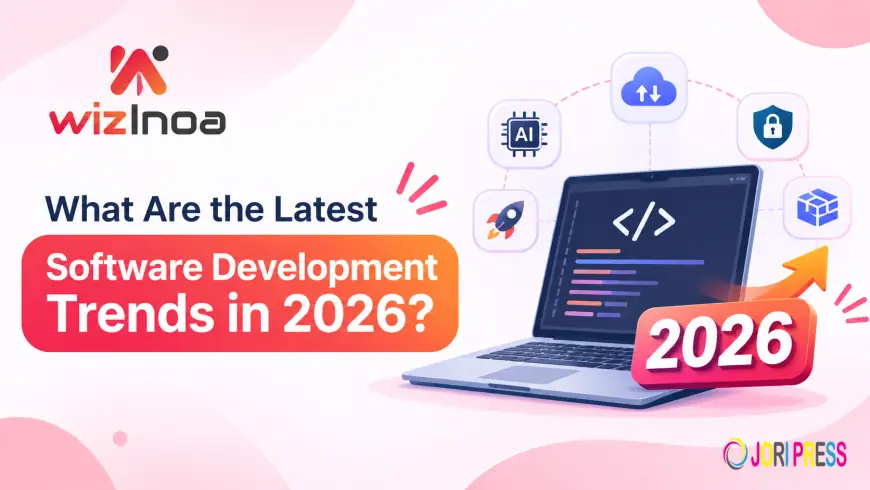
What Are the Latest Software Development Trends in 2026?
Software development is evolving rapidly as businesses adopt new technologies to improve efficiency, security, and digital experiences.

From AI-powered development to cloud-native applications, modern technologies are changing how software is designed, developed, and maintained. Businesses looking for reliable software development company are increasingly exploring these advancements to build scalable and future-ready solutions. Choosing an experienced software development company can help businesses identify the right technologies and implement solutions that match their requirements.
Let's explore the latest software development trends in 2026 and understand how they are changing modern businesses.
1. How Is Artificial Intelligence Changing Software Development?
Artificial Intelligence (AI) is changing software development by helping developers write code, identify errors, automate testing, and complete repetitive tasks more efficiently.
AI-powered development tools can suggest code, generate functions, explain existing code, and assist with debugging. In 2026, AI coding agents are also becoming more capable of handling multiple development tasks with human supervision.
Businesses can benefit from AI-assisted development through faster workflows and improved productivity. However, developers still need to review generated code to ensure its quality, security, and accuracy.
2. What Is Agentic AI and Why Is It Important in 2026?
Agentic AI refers to AI systems that can plan and perform multiple steps towards a specific goal with limited human intervention.
Unlike traditional AI tools that mainly respond to individual instructions, AI agents can interact with tools, analyze information, and execute tasks within defined permissions.
For example, an AI agent in a business application might collect information, process customer requests, and update relevant records.
In software development, AI agents can assist with coding, testing, and debugging. This makes agentic AI an important area of development in 2026, although proper security controls and human oversight remain essential.
3. Why Is Cloud-Native Software Development Becoming Popular?
Cloud-native software development focuses on building applications that use cloud infrastructure and services to improve scalability, flexibility, and reliability.
Technologies such as containers, microservices, and orchestration platforms help development teams deploy and manage applications more efficiently.
For businesses, cloud-native applications offer several benefits:
-
Scalability: Applications can handle changing workloads.
-
Flexibility: Development teams can update individual services.
-
Availability: Applications can be designed for better reliability.
-
Cost management: Businesses can select cloud resources based on their requirements.
As more organizations move towards cloud-based systems, cloud-native development continues to influence modern software architecture.
4. What Is Low-Code and No-Code Development?
Low-code and no-code development allow users to create applications using visual development platforms instead of writing every line of code manually.
Low-code platforms require some programming knowledge for advanced customization, while no-code platforms allow users to build applications through visual interfaces and predefined components.
These approaches can help businesses develop internal tools, automate workflows, and create basic applications faster.
However, complex applications with specialized requirements, advanced integrations, or strict security needs may still require traditional software development.
5. Why Is Cybersecurity Important in Modern Software Development?
Cybersecurity is becoming an essential part of software development because applications handle sensitive business and customer information.
Modern development teams are increasingly following a security-first approach by integrating security checks throughout the development process.
Some important practices include:
-
Secure coding practices
-
Data encryption
-
Authentication and access control
-
Regular vulnerability testing
-
Software dependency monitoring
-
Continuous security updates
DevSecOps is also gaining importance because it integrates security into development and operations instead of treating it as a final step before deployment.
6. How Is Platform Engineering Improving Developer Productivity?
Platform engineering focuses on creating internal tools and platforms that help developers build, test, and deploy software more efficiently.
Instead of making every development team manage infrastructure and deployment processes independently, organizations provide standardized development environments and reusable tools.
This helps reduce repetitive work, improve consistency, and simplify software delivery.
Platform engineering is particularly useful for organizations managing multiple development teams and complex software projects.
7. What Is API-First Development and Why Does It Matter?
API-first development is an approach in which application programming interfaces (APIs) are planned and designed before the individual application components are developed.
APIs allow different software applications and services to communicate with each other.
For example, an e-commerce application may use APIs to connect payment gateways, inventory systems, shipping services, and customer management platforms.
API-first development helps businesses create connected applications, simplify integrations, and support future expansion.
8. Why Is Automated Software Testing Important in 2026?
Automated software testing uses tools and scripts to check whether an application works as expected.
Instead of depending entirely on manual testing, development teams can automate repetitive test cases and identify problems earlier in the development process.
Common types of automated testing include:
-
Unit testing
-
Integration testing
-
Functional testing
-
Regression testing
-
Performance testing
AI-assisted testing and evaluation methods are also gaining attention, particularly for applications that include generative AI features. These methods help teams assess accuracy, reliability, and expected behavior before releasing software.
How Can Businesses Choose the Right Software Development Approach in 2026?
Businesses should choose technologies based on their actual requirements rather than following every new trend.
Before starting a software project, consider the following:
-
Business requirements: Identify the problems the software needs to solve.
-
Scalability: Choose technologies that can support future growth.
-
Security: Make sure the application protects business and customer information.
-
Integration: Check whether the software needs to connect with existing systems.
-
Maintenance: Consider long-term updates, support, and performance.
Working with the best software development company can help businesses evaluate suitable technologies and develop software that supports their operational goals.
Conclusion
The latest software development trends in 2026 show how AI, cloud-native technologies, cybersecurity, automation, and platform engineering are changing the way applications are built.
Businesses do not need to adopt every new technology. Instead, they should focus on solutions that improve their operations, meet customer expectations, and support long-term growth.
Partnering with a reliable custom software development company can help businesses turn their ideas into secure, scalable, and practical software solutions.
What's Your Reaction?
 Like
0
 Dislike
0
 Love
0
 Funny
0
 Angry
0
 Sad
0
 Wow
0