






































What Do AI Consultants Actually Do for Businesses?
Imagine a company spending hours every week answering customer questions, sorting documents, or copying data between systems.

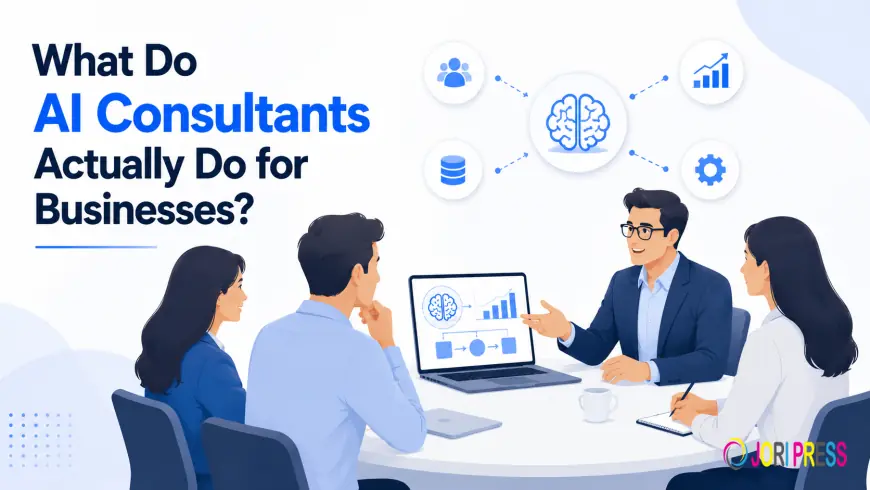
Imagine a company spending hours every week answering customer questions, sorting documents, or copying data between systems. AI sounds useful, but knowing where to start, what to build, and whether the investment will pay off is not always easy.
That is where AI consultants come in. They connect business goals with practical AI solutions, helping companies find useful opportunities, choose suitable technology, manage risks, and move from an idea to a working system.
At Rubixe, the focus is not simply on adding an AI tool. It is on finding where AI can create measurable business value.
What do AI consultants actually do?
Ai consultants help businesses understand where artificial intelligence can solve real problems and how to introduce it responsibly. They study business processes, identify suitable use cases, recommend technology, and support implementation.
Their work often starts with simple questions:
• What problem are we trying to solve?
• Is AI really the best answer?
• Do we have the right data?
• What will success look like?
• How can we protect customer and business information?
A good consultant first understands the business and decides where AI makes sense.
How do AI consultants find the right AI opportunities?
Ai consultants look for tasks that are repetitive, slow, expensive, or difficult for employees to manage at scale. They then estimate whether AI could improve the process without creating new problems.
For example, imagine a logistics company that spends hours reviewing delivery records and answering routine customer questions. A consultant could suggest AI for document processing and customer support, while keeping unusual cases with human staff.
McKinsey reported in 2025 that 88 percent of surveyed organizations used AI regularly in at least one business function. Yet most were still experimenting or running pilots, showing that adoption does not automatically mean business impact.
What happens during an AI consulting project?
Ai consulting usually follows a practical path from discovery to improvement.
-
Business discovery. Understand goals, problems, users, and existing systems.
-
Opportunity assessment. Rank use cases by value, effort, data needs, and risk.
-
Solution planning. Decide whether to use an existing product, build a custom solution, or connect several tools.
-
Pilot development. Test a small version before making a larger investment.
-
Integration and rollout. Connect the solution to existing workflows and introduce it to users.
-
Measurement. Track results such as time saved, cost reduction, accuracy, customer satisfaction, or revenue.
This process helps businesses test ideas before spending heavily.
Where does gen ai consulting fit into the picture?
Gen ai consulting focuses on AI systems that can create or work with content such as text, images, code, summaries, and other information. Consultants help businesses decide where these tools can support employees without creating unnecessary risk.
Common uses include:
|
Business area |
Possible AI use |
|
Marketing |
Content ideas, customer insights, campaign support |
|
Customer service |
Question answering, summaries, support assistance |
|
HR |
Job description support, document search, employee assistance |
|
Finance |
Document review, reporting support, data analysis |
|
Operations |
Workflow support, knowledge search, process automation |
Generative ai consulting services can be useful when employees spend a lot of time searching for information or creating first drafts. Generative ai consulting services can also help teams plan responsible use of AI across different departments.
How do AI consultants handle data, security, and AI risks?
Ai consultants should consider risk planning from the beginning. Important areas include data quality, privacy, security, accuracy, bias, access controls, and human review.
NIST’s AI Risk Management Framework recommends considering trustworthiness throughout the design, development, deployment, use, and evaluation of AI systems. Its generative AI profile also highlights risks that can be specific to generative systems.
In practice, this may mean:
• Limiting which data an AI system can access.
• Checking important AI outputs before they reach customers.
• Keeping records of how systems are used.
• Testing responses for errors and unfair results.
• Setting clear rules for human approval.
These steps reduce risk, but they cannot guarantee that an AI system will always be accurate.
What is the difference between AI consulting and AI implementation?
AI consulting focuses on deciding what to do and why. Implementation focuses on building, connecting, testing, and launching the chosen solution.
For example, a business may want an internal knowledge assistant. A consultant can identify the best use case, review available data, define success measures, and recommend an approach. An implementation team can then build the assistant, connect it to approved company information, test it, and deploy it.
Many ai consulting services combine both activities because strategy without execution may not create value.
When should a business hire AI consultants?
Businesses should consider consultants when they have a clear problem but lack the internal skills, time, or experience to evaluate and implement AI effectively.
They can be especially useful when:
• Several departments want different AI solutions.
• Leaders are unsure which project should come first.
• Existing data is spread across multiple systems.
• The business needs to connect AI with older software.
• Security, privacy, or compliance requirements are important.
• A pilot has worked, but scaling it is difficult.
An ai consulting company in bangalore can help businesses combine local business knowledge with technical expertise. Choosing an ai consulting company in bangalore with both technical and business experience can also simplify implementation.
How should businesses choose an AI consulting partner?
Ask potential partners:
-
Can you explain the expected business outcome in simple terms?
-
How will you measure whether the project works?
-
What data will the solution need?
-
What risks could affect the project?
-
Can you start with a small pilot?
-
How will you support the system after launch?
When choosing an ai consulting company in bangalore, also check whether the team understands your business environment and existing technology.
What should businesses expect from AI consultants?
Ai consultants should make AI easier to understand, not make it sound more complicated. Their value comes from helping businesses decide where AI fits, what should be built, and how success should be measured.
Rubixe helps organizations explore AI opportunities with attention to business goals, technology, people, and risk. If your company is considering AI, starting with one clear business problem can be more useful than trying to automate everything at once.
Frequently asked questions about AI consulting
What is an AI consultant?
An AI consultant helps a business identify useful AI opportunities, choose suitable technology, plan implementation, and manage risks.
Do small businesses need AI consulting?
They can. A consultant can help a small business avoid unnecessary tools and focus on one or two use cases that have a realistic chance of saving time or improving service.
Can AI consultants build AI systems?
Yes. Some consultants only provide strategy, while others offer development, integration, testing, and ongoing support. Businesses should confirm the scope before starting.
Is AI consulting only about generative AI?
No. AI consulting can cover predictive models, machine learning, computer vision, automation, analytics, and generative AI. The right choice depends on the business problem.
Gen ai consulting can be especially helpful when a company wants to explore content generation, knowledge search, or employee assistance. Generative AI consulting services can support that exploration, while broader AI services can cover other approaches too.
What's Your Reaction?
 Like
0
Like
0
 Dislike
0
Dislike
0
 Love
0
Love
0
 Funny
0
Funny
0
 Angry
0
Angry
0
 Sad
0
Sad
0
 Wow
0
Wow
0