


































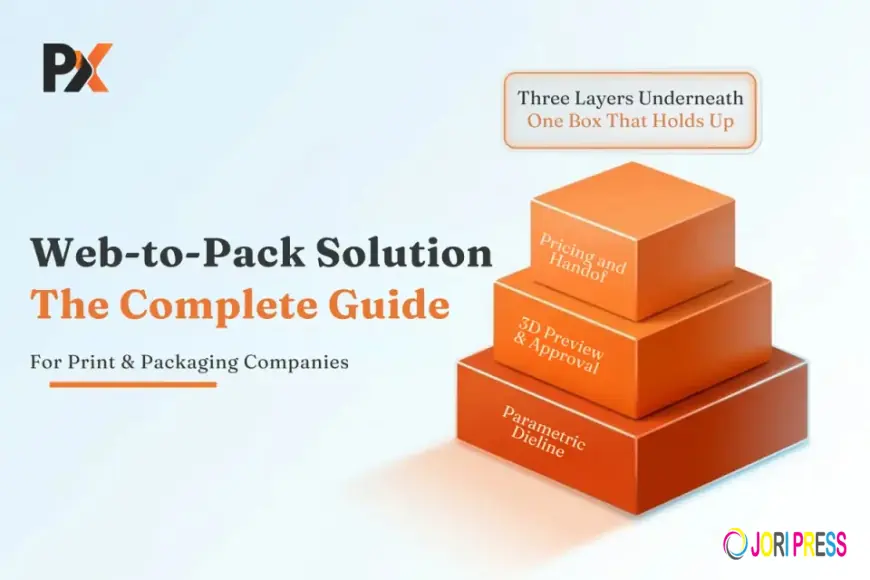
Web-to-Pack Solution: The Complete Guide for Print & Packaging Companies
The packaging industry is becoming increasingly digital as brands look for faster customization, shorter turnaround times, and easier ways to manage packaging orders. Traditional packaging workflows often involve emails, spreadsheets, artwork revisions, and manual approvals, which can slow production.
A web-to-pack solution brings these processes into a centralized online environment, allowing customers to select, customize, proof, order, and manage packaging products through a digital storefront.
What Is a Web-to-Pack Solution?
A web-to-pack solution is an online platform designed specifically for selling and managing customized packaging products.
Instead of relying on manual communication for every order, packaging companies can provide customers with an interactive online experience for products such as:
- Folding cartons
- Boxes and mailers
- Labels and stickers
- Pouches
- Bags
- Sleeves
- Retail packaging
- Custom printed containers
The system can connect online product customization with quoting, artwork, proofing, ordering, and production workflows.
How Does Web-to-Pack Work?
A typical workflow looks like:
Customer → Product Selection → Customization → Pricing → Proof Approval → Order → Production
Customers select a packaging product and enter specifications such as size, material, quantity, printing options, and finishing requirements.
If customization is enabled, they can upload artwork or personalize the packaging online. The system can then generate a preview or digital proof before the order moves into production.
Key Features of a Web-to-Pack Platform
1. Online Packaging Product Designer: A product designer allows customers to customize packaging directly from the browser. Depending on the product, users may modify dimensions, artwork, text, logos, colors, and other design elements.
2. 2D and 3D Visualization: Packaging can be difficult to understand from flat artwork alone. 2D previews and 3D visualization help customers see how the final package may look before placing an order.
3. Automated Quoting: Packaging prices can depend on dimensions, material, quantity, printing method, finishing, and other specifications. A web-to-pack system can calculate pricing dynamically based on configured rules.
4. Artwork Upload and Proofing: Customers can upload print files and review digital proofs online. Automated checks and approval workflows can reduce unnecessary back-and-forth between customers and production teams.
5. Order and Production Management: Once an order is approved, customer specifications and artwork can flow into internal production processes. This reduces manual re-entry and makes order information easier to track.
6. E-Commerce Integration: A web-to-pack platform can work with an existing eCommerce environment, allowing packaging businesses to manage online products, customers, payments, and orders from a connected workflow.
Benefits for Packaging Companies
Faster Order Processing: Automating repetitive tasks can reduce the time spent handling quotes, artwork, approvals, and order information.
Fewer Production Errors: Structured product specifications and digital approval workflows help reduce mistakes caused by incomplete emails, incorrect dimensions, or outdated artwork.
Better Customer Experience: Customers can configure products, view pricing, upload artwork, and approve proofs without relying entirely on sales representatives.
Scalable Customization: Online tools make it easier to handle many customized orders without increasing manual work at the same rate.
Improved Sales Opportunities: Packaging companies can offer self-service ordering to existing customers while also reaching new customers through an online storefront.
Web-to-Pack vs. Traditional Packaging Workflows
Traditional workflows often depend on sales teams, emails, spreadsheets, manual quotes, and repeated artwork exchanges.
A digital workflow centralizes these activities and creates a clearer path from product configuration to production.
This does not necessarily eliminate human involvement. Instead, it allows sales, prepress, and production teams to focus on tasks that require expertise while routine activities become automated.
What Should Companies Consider Before Implementation?
Before selecting a web-to-pack solution, packaging companies should evaluate:
- Product and packaging template flexibility
- Pricing and quotation rules
- Artwork and file requirements
- 2D/3D visualization capabilities
- Customer approval workflows
- eCommerce integration
- Order and production management
- Inventory requirements
- ERP or MIS integration
- Scalability and performance
- Multi-language and multi-currency support
The right platform should fit the company’s existing production process rather than forcing the business into a completely different workflow.
The Future of Web-to-Pack
The next generation of packaging platforms is likely to combine automation, AI-assisted design, real-time pricing, 3D visualization, and deeper integration with production systems.
As brands increasingly demand short runs, personalization, and faster turnaround, digital packaging workflows can become an important part of modern print operations.
Final Thoughts
A web-to-pack solution can transform packaging sales and production by connecting product customization, pricing, artwork, proofing, ordering, and fulfillment in one digital workflow.
For print and packaging companies, the goal is not simply to put products online. It is to create a connected process that makes customized packaging easier for customers to order and easier for production teams to manage.
What's Your Reaction?
 Like
0
Like
0
 Dislike
0
Dislike
0
 Love
0
Love
0
 Funny
0
Funny
0
 Angry
0
Angry
0
 Sad
0
Sad
0
 Wow
0
Wow
0