










































The Complete Guide to B2B Digital Marketing
Learn the complete guide to B2B digital marketing, including SEO, content marketing, lead generation, social media, email marketing, and automation

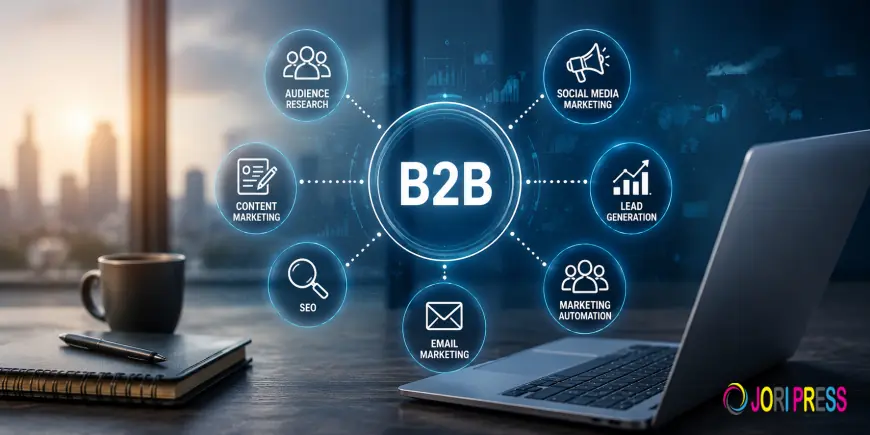
Business-to-business (B2B) digital marketing helps organizations attract, engage, and convert other businesses into customers. Unlike business-to-consumer (B2C) marketing, B2B involves longer sales cycles, multiple decision-makers, and larger investments. Therefore, success depends on building trust, demonstrating expertise, and nurturing relationships throughout the buyer's journey.
Understanding the B2B Marketing Landscape
A successful B2B strategy begins with understanding how business buyers make purchasing decisions. The buyer journey generally includes three stages:
- Awareness: Identifying a business challenge.
- Consideration: Evaluating possible solutions.
- Decision: Selecting the vendor that offers the best value and return on investment.
Businesses should also segment their audience based on industry, company size, job role, business challenges, and purchase intent. Many companies use Account-Based Marketing (ABM), which targets high-value organizations with personalized campaigns. An effective marketing funnel guides prospects through educational content, case studies, product demonstrations, and consultations while clearly communicating the company's value proposition.
Building an Effective B2B Marketing Strategy
A strong digital marketing strategy starts with thorough planning. Market research helps businesses identify customer pain points, industry trends, and buying behavior, while competitor analysis reveals strengths, weaknesses, keyword opportunities, and market positioning.
Creating detailed buyer personas enables marketers to tailor messages for different decision-makers. Marketing objectives should follow the SMART framework—Specific, Measurable, Achievable, Relevant, and Time-bound.
Modern B2B marketing also relies on an omnichannel approach, delivering consistent messaging across websites, search engines, email campaigns, LinkedIn, webinars, and paid advertising. Marketing automation further improves efficiency by managing lead nurturing, email sequences, CRM updates, and follow-ups. Proper budget allocation across SEO, content marketing, PPC, email marketing, and analytics ensures better return on investment (ROI).
Essential B2B Digital Marketing Channels
No single channel can generate sustainable business growth. Successful organizations integrate multiple channels, including:
- Search Engine Optimization (SEO): Improves website visibility through keyword optimization, quality content, and technical improvements, generating long-term organic traffic.
- Content Marketing: Builds credibility through blogs, industry guides, research reports, infographics, and customer success stories that educate potential buyers.
- Pay-Per-Click (PPC): Provides immediate visibility through targeted paid advertisements based on keywords, demographics, and purchase intent.
- Email Marketing: Nurtures leads with personalized newsletters, product updates, and promotional campaigns.
- LinkedIn Marketing: Supports professional networking, thought leadership, lead generation, and targeted advertising.
- Social Media Marketing: Platforms such as Facebook, X, and YouTube increase brand awareness and distribute valuable content.
- Webinar Marketing: Demonstrates expertise through live presentations and interactive Q&A sessions.
- Video Marketing: Uses tutorials, product demonstrations, testimonials, and interviews to explain complex topics in an engaging way.
Businesses should balance organic marketing for long-term visibility with paid marketing for immediate traffic and lead generation.
Creating High-Converting Content
Content plays a central role in B2B lead generation. A well-planned content strategy often includes pillar pages supported by related topic clusters, improving both SEO performance and user experience.
High-performing content formats include:
- Case studies
- Whitepapers
- eBooks
- Optimized landing pages
- Lead magnets such as templates, checklists, calculators, and industry reports
Every content piece should include a clear call-to-action (CTA), encouraging users to request consultations, download resources, register for webinars, schedule demonstrations, or contact the sales team. Instead of focusing only on product features, businesses should address customer challenges and provide educational, solution-oriented content that builds trust and drives conversions. By leveraging the expertise of Digital Factory 24, businesses can create SEO-driven content strategies that consistently attract qualified leads and strengthen their online presence.
Measuring Marketing Performance
Continuous measurement is essential for improving marketing effectiveness. Analytics platforms help organizations monitor website traffic, user engagement, traffic sources, conversion paths, and landing page performance.
Integrating analytics with a Customer Relationship Management (CRM) system connects marketing efforts to actual sales outcomes, improving collaboration between marketing and sales teams.
Businesses should also implement:
- Conversion tracking
- Lead scoring
- Attribution modeling
- ROI measurement
Marketing automation simplifies lead nurturing, audience segmentation, campaign scheduling, and customer communication. By integrating AI solutions, businesses can improve predictive analysis, identify high-value prospects, automate customer interactions, and optimize campaigns based on real-time insights. Real-time dashboards allow marketers to monitor performance and make faster data-driven decisions.
Future Trends in B2B Digital Marketing
Technology continues to reshape B2B marketing. Artificial Intelligence (AI) is improving customer segmentation, campaign optimization, predictive analytics, and workflow automation.
Organizations are also preparing for Generative Engine Optimization (GEO) and Answer Engine Optimization (AEO) to improve visibility in AI-powered search results and voice search platforms.
Other emerging trends include:
- Predictive analytics for forecasting customer behavior
- Greater reliance on first-party customer data due to privacy regulations
- Personalized marketing experiences based on user behavior
- AI-assisted content creation
- Conversational marketing using chatbots and AI assistants for instant customer engagement
These innovations enable businesses to deliver more personalized, scalable, and data-driven marketing strategies while improving customer experience and lead generation...
What's Your Reaction?
 Like
0
Like
0
 Dislike
0
Dislike
0
 Love
0
Love
0
 Funny
0
Funny
0
 Angry
0
Angry
0
 Sad
0
Sad
0
 Wow
0
Wow
0