



































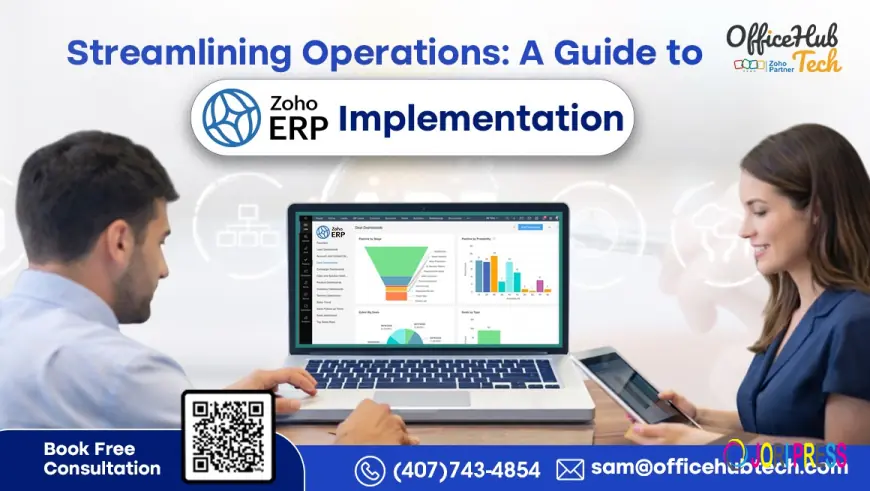
Streamlining Operations: A Guide to Zoho ERP Implementation
Learn how Zoho ERP streamlines finance, supply chain, CRM, and AI workflows with expert implementation strategies for growing enterprises.

Why Operational Streamlining Is No Longer Optional
As organizations grow, complexity often builds up gradually and goes unnoticed. Different teams start using separate tools—finance may depend on an independent accounting system, procurement might rely on spreadsheets, and sales teams work within a CRM that doesn’t fully integrate with financial data. Over time, this lack of connectivity leads to fragmented information, slower reporting, increased errors, and decisions based on incomplete insights.
Enterprise Resource Planning (ERP) systems were created to solve this issue by unifying business processes. Modern cloud-based solutions like Zoho ERP go a step further by bringing operations, financial management, and automation together within a single, cohesive system. The goal is not just to digitize processes, but to create alignment across the organization.
When implemented effectively, Zoho ERP serves as the central foundation of business operations. It connects financial data with project activities, aligns inventory management with procurement planning, and ensures workforce information is integrated with payroll and compliance. This results in improved transparency, faster processes, and more informed, data-driven decisions.
Ultimately, operational streamlining goes beyond adopting new software. It involves transforming the organization into a unified system where all departments work in sync, rather than operating in isolated silos.
The Structural Framework of Zoho ERP
Financial Control and Compliance Systems
Financial operations form the core of any ERP system. Zoho ERP brings together applications like Zoho Books and Zoho Billing to establish a centralized financial ecosystem. Functions such as accounts payable and receivable, tax calculations, and multi-entity consolidation are managed within a unified accounting structure.
Regulatory requirements—ranging from regional tax laws and e-invoicing standards to statutory reporting—are built directly into everyday workflows. Bank reconciliations can be automated across various banks and currencies, while budget monitoring is accessible in real time. This gives finance teams a comprehensive view of cash flow, expenses, and revenue without relying on disconnected reports.
As a result, reconciliation errors are minimized, financial closing processes become faster, and audit readiness along with compliance standards improve significantly.
Inventory, Procurement, and Supply Chain Alignment
Poor inventory management can lead to significant operational losses. Zoho Inventory streamlines stock control, purchasing, and order fulfillment into a single, coordinated system. For example, purchase orders can automatically update inventory levels, and predefined reorder points help avoid stock shortages.
Features like batch tracking, serial number management, and warehouse-level monitoring provide full visibility into inventory movement. Integration with billing ensures that order fulfillment and invoicing remain aligned.
This level of coordination improves cost efficiency and enhances transparency across procurement processes.
Workforce and Payroll Management
With Zoho People and Zoho Payroll, employee management becomes part of the broader ERP system. Key processes such as attendance tracking, leave management, payroll processing, and statutory deductions are handled within a unified framework.
This reduces manual effort, simplifies compliance reporting, and enables leadership to evaluate workforce costs alongside overall business performance.
Commerce, Billing, and Revenue Management
Revenue generation typically involves multiple stages—from proposals and order confirmation to billing, subscriptions, and collections. Zoho ERP integrates these steps into a streamlined process.
When Zoho CRM is connected to the ERP system, sales opportunities can be converted directly into invoices. Subscription billing can handle recurring payments automatically, and customer transactions update financial records in real time. This integration shortens the order-to-cash cycle and improves revenue visibility and predictability.
Strategic Readiness Before Implementation
Process Mapping and Operational Assessment
ERP implementation starts well before any system is set up. Organizations need to carry out detailed process mapping to understand how their operations currently function. Every workflow—from lead generation to final payment—should be carefully documented.
This evaluation helps uncover inefficiencies, redundancies, and unnecessary approval layers. It also highlights areas that need improvement rather than simply being transferred into the new system. Without this step, there’s a risk of automating ineffective processes instead of fixing them.
Governance, Ownership, and Change Management
A successful ERP rollout depends on strong leadership support and clearly defined responsibilities. Key stakeholders and department heads must align on performance indicators, system guidelines, and escalation frameworks.
Equally important is managing change effectively. Clear communication, training, and a phased adoption plan help reduce resistance. Employees should understand the purpose of the transformation and how it will positively impact their day-to-day work.
Phased Deployment and Risk Control
Instead of implementing all modules at once, many organizations prefer a step-by-step rollout. Initial phases may focus on core areas like finance and CRM, followed by supply chain functions and advanced analytics.
This gradual approach minimizes disruption, allows room for feedback, and enables continuous improvement throughout the implementation process.
Technical Deployment and System Setup
Cloud Infrastructure and Security Architecture
Zoho ERP is built on a cloud-based platform that incorporates strong security measures such as data encryption, multi-factor authentication, and role-based access controls. This ensures that sensitive information—especially financial and HR data—is accessible only to authorized users based on defined permissions.
By operating in the cloud, businesses can avoid maintaining on-premise servers while benefiting from greater flexibility and scalability.
Data Migration, Cleansing, and Master Data Management
Transitioning from legacy systems like SAP, Infor, or Acumatica requires a well-structured approach. Existing data must be cleaned, standardized, and thoroughly validated before being migrated into the new system.
Establishing strong master data management practices is essential to prevent duplication and maintain consistency in naming and data structures. Without proper governance, the reliability of reports and insights can quickly decline.
Customization Using Zoho Creator and Extended Applications
Since every organization has its own operational needs, customization plays a key role in ERP success. Zoho Creator allows businesses to build tailored applications using a low-code approach, extending the core ERP functionality.
Custom solutions—such as equipment rental tracking, warranty management, solar project planning, or legal case handling—can be developed to fit specific requirements while remaining fully integrated within the ERP environment.
Enterprise Integrations and Workflow Coordination
CRM, Finance, and Productivity Integrations
Integrating Zoho CRM with the ERP system helps align sales pipeline insights with financial reporting. Connections with tools like QuickBooks support hybrid accounting setups, while integrations with platforms such as Microsoft Dynamics 365, HubSpot, Pipedrive, and Gmail enable smooth tracking of leads and communication.
This connected environment is enabled through Zoho 3rd party integration capabilities, allowing secure and organized data flow across external systems. As a result, information silos are reduced, and visibility across departments improves significantly.
Industry-Specific and Vertical Application Integrations
In addition to standard CRM and accounting tools, Zoho ERP can connect with specialized industry software and proposal management platforms. Using structured APIs, critical data—such as project documents, bills of materials, change requests, and operational details—can sync directly with ERP modules.
This level of integration ensures that approvals, procurement processes, inventory allocation, and billing updates happen automatically based on real-time activities, reducing duplication and strengthening coordination across teams.
API Connectivity, Webhooks, and Workflow Automation
With the use of REST APIs and webhooks, systems can communicate instantly and exchange data in real time. Tools like n8n enable the automation of complex workflows—for example, initiating procurement approvals when stock levels drop below a defined limit or sending milestone updates to clients.
Such automation minimizes manual effort, reduces administrative workload, and creates smoother, more efficient operational processes.
AI-Driven ERP: Evolving from Automation to Intelligence
Zia AI and Predictive Capabilities
Zia, Zoho’s built-in intelligence engine, plays a key role in enhancing ERP systems with advanced AI capabilities. By embedding artificial intelligence directly into business workflows, it shifts ERP from basic automation to a more predictive and insight-driven model.
Zia continuously evaluates transaction data, financial activity, procurement trends, and operational metrics to forecast revenue patterns, identify irregularities, and highlight inefficiencies before they become critical issues. Its contextual recommendations support better budgeting decisions, more accurate demand planning, and proactive risk management.
As part of an AI-enabled ERP environment, these predictive capabilities allow leadership teams to move beyond reactive decision-making toward a more forward-looking, strategic approach—improving agility, financial oversight, and long-term stability.
AI Agents for Project-Oriented Operations
AI-driven agents can actively oversee workflows, monitor timelines, identify delays, and adjust resource allocation based on real-time insights. By recognizing patterns in operations, these systems help ensure smoother execution, minimize disruptions, and improve overall efficiency.
They also enable seamless synchronization of data across CRM, finance, inventory, and project management systems. This unified flow of information reduces inconsistencies, enhances accuracy, and supports more informed decision-making across departments.
Real-Time Analytics and Executive Dashboards
Real-time analytics give leaders instant access to key performance indicators across the organization. Executive dashboards bring together important metrics—such as profitability, resource usage, vendor performance, revenue patterns, and cash flow—into a single, organized interface.
These dynamic visual tools convert raw data into meaningful insights, helping organizations make quicker strategic decisions, improve forecasting precision, and manage performance proactively using continuously updated information.
Industry-Focused ERP Deployment Approaches
1. Zoho ERP for Manufacturing:
Manufacturing organizations depend on ERP systems to manage Material Requirements Planning (MRP), bill of materials (BOM), production timelines, and shop-floor operations. Integrated modules support accurate demand forecasting, efficient raw material planning, and real-time tracking of production activities, helping maintain smooth operations and control costs.
2. Zoho ERP for Retail & Distribution:
Retailers and distributors benefit from synchronized inventory across multiple sales channels, along with streamlined warehouse and logistics management. ERP integration links point-of-sale systems, procurement, and order fulfillment processes, ensuring better stock visibility and higher order accuracy.
3. Zoho ERP for Solar & Project-Based Businesses:
Solar companies and project-driven industries require structured project monitoring, milestone-based invoicing, and compliance tracking. ERP systems centralize project schedules, vendor coordination, and financial management within a unified platform.
4. Zoho ERP for Legal & Professional Services:
Legal and professional service firms use ERP to manage case workflows, ensure trust accounting compliance, automate billing, and control documentation. This integration aligns financial processes with case management, improving transparency while maintaining regulatory standards.
5. Zoho ERP for Nonprofits:
Nonprofit organizations need robust systems for fund accounting, donor tracking, grant management, and program budgeting. Zoho ERP provides centralized financial oversight, supports compliance, and enables impact measurement. Dashboards offer clear visibility into donations, expenses, and operational performance, ensuring accountability and supporting mission-focused growth.
Adoption, Optimization, and Scalability
A successful ERP journey goes beyond initial deployment—it requires effective adoption. Training should be practical and tailored to specific roles. Finance teams must become proficient in managing ledgers, compliance settings, and reporting structures, while operations teams should focus on procurement processes, inventory control, and approval workflows.
Continuous improvement is essential. Regular system reviews, performance tracking, and workflow enhancements help organizations refine efficiency over time. As business needs evolve, the ERP system must adapt to support new goals and processes.
Cloud-based ERP systems naturally support scalability. As companies expand into new markets, add services, or handle higher transaction volumes, configurations can be adjusted without major infrastructure changes, enabling steady and sustainable growth.
Evaluating ROI and Business Outcomes
The value of Zoho ERP implementation is reflected in measurable operational gains. Businesses often see lower inventory holding costs, faster billing cycles through automation, improved cash flow visibility, and reduced reliance on manual data handling.
Beyond cost savings, advanced analytics provide clear performance insights. Real-time dashboards and reporting tools allow leaders to monitor margins, resource utilization, procurement efficiency, and revenue trends with accuracy.
ERP effectiveness is demonstrated through stronger profitability, improved operational metrics, faster processes, and increased organizational agility.
Conclusion
Zoho ERP has emerged as a leading enterprise resource planning solution in India by offering a cloud-based, AI-enabled platform that brings together fragmented business functions into a unified system. Its real strength lies in integrating finance, supply chain, HR, CRM, and analytics into a single, scalable framework that evolves with business growth.
Organizations looking for structured implementation, advanced integrations, and intelligent automation can gain significant value by working with experienced Zoho consultants, developers, and implementation partners across regions such as India, the USA, UAE, and KSA. Office Hub Tech provides end-to-end ERP services, including legacy system modernization, AVSI integrations, AI-driven workflow automation, and ongoing optimization—helping businesses transform operational complexity into measurable efficiency.
What's Your Reaction?
 Like
0
Like
0
 Dislike
0
Dislike
0
 Love
0
Love
0
 Funny
0
Funny
0
 Angry
0
Angry
0
 Sad
0
Sad
0
 Wow
0
Wow
0