





































Steam Turbine Market Growth Hinges on Plant Upgrades and Industrial Heat
Explore the Steam Turbine Market forecast to 2034, including plant upgrades, industrial cogeneration, leading turbine types, and demand trends in Asia-Pacific.
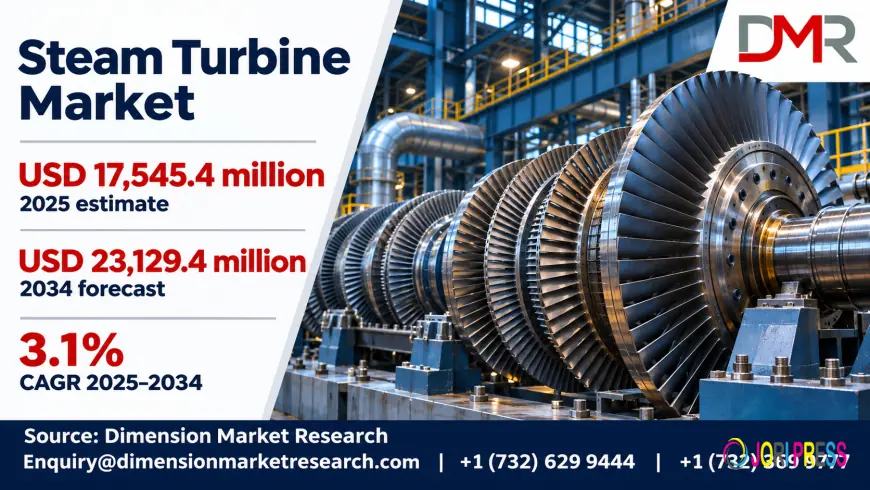
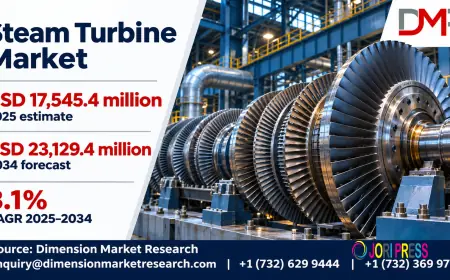
The Steam Turbine Market serves power producers and industrial operators that need dependable electricity, usable process heat, or both. According to Dimension Market Research, the global market was estimated at USD 17,545.4 million in 2025 and is projected to reach USD 23,129.4 million by 2034, with a compound annual growth rate of 3.1% from 2025 to 2034.
Demand comes from new power projects and investments in existing facilities. Nuclear and thermal power plants use steam turbines for large-scale electricity generation. Industrial sites can use the same technology to generate electricity while supplying heat to production processes. That flexibility helps explain why turbine demand spans plant modernization, industrial energy efficiency, and waste-to-energy projects.
What Is the Steam Turbine Market?
A steam turbine converts energy from pressurized steam into rotational motion that can drive a generator. The market covers equipment used in utility power plants, manufacturing facilities, district heating networks, and waste-to-energy installations. The report analyzes demand by capacity, turbine type, design, and fuel or heat source.
A facility’s steam requirements influence its equipment choice. A power station can use a condensing turbine to maximize electricity output. A factory that needs heat as well as power can use a back-pressure turbine and route its exhaust steam to production equipment. In pulp and paper manufacturing, for example, mills can use processing residues to generate steam for electricity and mill operations.
Plant Modernization Creates Demand for Equipment and Services
Modernizing an existing turbine can involve upgrading blades, adding sensors, and adopting predictive maintenance software. These investments can help operators improve efficiency and spot changes in equipment condition before they interrupt production. For turbine suppliers, this creates opportunities to combine component sales with monitoring, maintenance, and overhaul services.
The economics of an upgrade depend on the facility’s remaining operating life. A plant owner weighing a retrofit can compare the cost of new components and controls with the expected value of efficiency gains and fewer outages. Emissions requirements and planned coal retirements can shorten the time available to recover that investment. Gas turbines, storage, and decentralized power systems also compete for projects where buyers prioritize flexible output or faster installation.
Which Steam Turbine Segments Lead Demand?
The report identifies the 121 to 350 MW capacity band as the expected leader. Equipment in this range can serve regional grids and industrial sites, giving manufacturers opportunities across utility and on-site generation projects. Turbines in this band can also be used in modernization programs at existing facilities.
Condensing turbines are expected to lead by type because of their use in utility-scale electricity generation, including nuclear, biomass, and combined-cycle facilities. The report also expects reaction-type turbines to lead by design, citing their efficiency across a range of operating loads and their suitability for large thermal and nuclear installations. For suppliers, capacity and turbine type offer two ways to assess where a product portfolio fits the project pipeline.
Asia-Pacific Leads the Steam Turbine Market
Asia-Pacific was projected to account for about 66.3% of global revenue in 2025 and is expected to record the fastest growth through 2034. Existing thermal and nuclear power fleets underpin demand, while industrial expansion supports investment in captive generation. China and India contribute demand through thermal plant modernization. In Southeast Asia, markets such as Indonesia and Vietnam offer opportunities tied to industrial power, biomass, and waste-to-energy projects.
Europe illustrates how the application mix can differ by region. District heating, industrial cogeneration, municipal waste-to-energy projects, and nuclear plant upgrades contribute to turbine demand. For suppliers, these applications call for different capabilities. A project that supplies heat to a district network has different operating requirements from a project designed primarily to generate electricity.
Competition Extends Beyond the Equipment Sale
The report covers companies including Siemens Energy, Mitsubishi Power, Bharat Heavy Electricals Limited (BHEL), and Triveni Turbine Ltd. Suppliers compete on turbine efficiency, operating flexibility, control system integration, and long-term service. For procurement teams, that makes replacement component availability, diagnostic support, and scheduled overhaul capabilities relevant alongside equipment specifications and upfront cost.
Industrial Cogeneration Offers a Route to Growth
Industrial cogeneration is an opportunity in markets where factories, agribusinesses, and processing plants need dependable power and a steady supply of heat. Facilities that can use biomass residues or recover heat from an existing process may already have a source of steam generation. For project developers, the business case depends in part on whether the site can consistently use both the electricity and the heat the installation provides.
Frequently Asked Questions
1. How large is the Steam Turbine Market?
The global market was estimated at USD 17,545.4 million in 2025 and is projected to reach USD 23,129.4 million by 2034.
2. What is the projected Steam Turbine Market CAGR?
The report projects a global CAGR of 3.1% from 2025 to 2034.
3. Which turbine type is expected to lead the market?
Condensing steam turbines are expected to lead by type, supported by their use in utility-scale power generation.
4. Which region leads the Steam Turbine Market?
Asia-Pacific was projected to hold the largest revenue share in 2025, at about 66.3%.
5. What is driving demand for steam turbines?
Demand is supported by plant modernization, nuclear power investment, and industrial applications that require both electricity and process heat.
Conclusion
Through 2034, the Steam Turbine Market offers opportunities in modernizing existing power plants and developing new installations that supply electricity and useful heat. For equipment manufacturers and service providers, the most relevant opportunities depend on the site’s steam requirements, the remaining life of installed equipment, and the local pipeline of power and industrial projects.
What's Your Reaction?
 Like
0
 Dislike
0
 Love
0
 Funny
0
 Angry
0
 Sad
0
 Wow
0