








































Smart Grid Data Analytics Market Size, Share & Forecast 2035
Smart Grid Data Analytics Market is projected to grow from USD 3.9 billion in 2026 to USD 8.6 billion by 2035 at a CAGR of 9.0%.
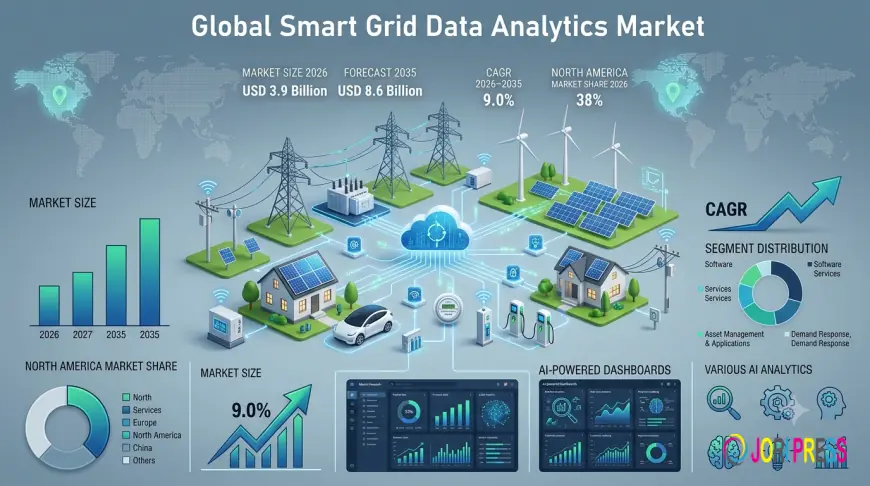
The Global Smart Grid Data Analytics Market is entering a significant growth phase as utilities increasingly rely on advanced analytics to transform large volumes of grid-generated information into actionable operational intelligence. The market is projected to reach USD 3.9 billion in 2026 and expand at a compound annual growth rate (CAGR) of 9.0%, reaching approximately USD 8.6 billion by 2035. Rising smart meter penetration, renewable energy integration, electric vehicle adoption, distributed energy resources, and modernization of aging electricity infrastructure are generating enormous datasets that require sophisticated analytical platforms.
Smart grid data analytics combines data from advanced metering infrastructure, distribution networks, substations, sensors, customer systems, weather inputs, distributed generation assets, and operational technologies. Utilities can analyze this information to improve load forecasting, detect outages, identify electricity losses, predict equipment failures, optimize voltage levels, manage demand, and strengthen customer engagement. Artificial intelligence, machine learning, cloud computing, edge analytics, and real-time visualization are increasingly becoming important components of modern grid analytics environments.
The transition from conventional centralized electricity systems toward intelligent, distributed, and increasingly renewable power networks is expanding the strategic importance of analytics. Grid operators must manage variable solar and wind generation while simultaneously responding to changing consumption patterns and growing electricity demand from electric vehicles and data-intensive industries. Advanced analytics enables utilities to convert complex operational data into forecasts, alerts, optimization recommendations, and automated decisions, improving reliability while reducing operating costs.
Market Overview
The Smart Grid Data Analytics Market encompasses software platforms, analytical tools, cloud services, professional services, and related technologies designed to collect, process, visualize, and interpret data generated across electricity networks. These solutions enable utilities to understand grid conditions more accurately and make faster decisions across generation, transmission, distribution, and customer operations.
The market's expansion is closely associated with the digital transformation of the energy sector. Traditional utility systems were primarily designed around one-way electricity flows from large generating stations to customers. Modern power networks are becoming multidirectional as rooftop solar installations, battery storage, electric vehicles, microgrids, and other distributed energy resources contribute electricity and flexibility to the grid.
This transformation increases both the volume and complexity of electricity network data. Smart meters can continuously generate consumption information, while sensors installed across substations, transformers, feeders, and transmission lines provide operational measurements. Analytics platforms integrate these datasets to create a more comprehensive view of grid performance.
The USD 3.9 billion market size expected in 2026 demonstrates the growing commercial importance of data-driven utility operations. With the market projected to reach USD 8.6 billion by 2035, analytics is increasingly shifting from a supplementary utility technology toward a fundamental component of intelligent grid management.
Key Findings
Several important findings illustrate the development of the global Smart Grid Data Analytics Market:
-
The global market is projected to reach USD 3.9 billion in 2026.
-
Market value is expected to increase to approximately USD 8.6 billion by 2035.
-
The market is forecast to expand at a 9.0% CAGR during the 2026–2035 period.
-
North America is expected to account for approximately 38% of global market revenue in 2026.
-
Artificial intelligence and machine learning are becoming increasingly important for predictive maintenance, demand forecasting, anomaly detection, and grid optimization.
-
Smart meters, distributed energy resources, renewable generation, and EV charging infrastructure are substantially increasing the amount of utility data available for analysis.
-
Cloud-based analytics platforms are gaining importance because utilities require scalable processing capacity and centralized access to large datasets.
-
Cybersecurity analytics is becoming increasingly important as electricity networks become more connected and digitally dependent.
Market Dynamics
The Smart Grid Data Analytics Market is influenced by the convergence of energy transition objectives, infrastructure modernization, digitalization, regulatory requirements, and changing electricity consumption patterns.
Utilities increasingly need real-time visibility into electricity networks because traditional planning and monitoring methods cannot efficiently manage highly distributed power systems. Analytics platforms allow operators to identify emerging network constraints and respond before they result in outages or significant equipment damage.
At the same time, utility investment decisions are influenced by cybersecurity concerns, integration complexity, legacy infrastructure, capital requirements, and data governance challenges. Consequently, market development depends not only on analytical innovation but also on the ability of technology providers to integrate their platforms securely with existing utility environments.
Growth Drivers
Rising Deployment of Smart Meters and Grid Sensors
The expansion of advanced metering infrastructure represents one of the strongest drivers for smart grid analytics. Smart meters provide granular electricity consumption information that can support demand forecasting, billing analysis, customer segmentation, demand response programs, and electricity theft identification.
Utilities are also deploying sensors across substations, transformers, transmission infrastructure, feeders, and distribution networks. As connected devices multiply, utilities require advanced analytics systems capable of processing high-volume data streams and identifying operational patterns.
Growing Integration of Renewable Energy
Solar and wind generation introduce greater variability into electricity networks. Unlike conventional power plants, renewable output depends heavily on environmental conditions and can fluctuate considerably over short periods.
Smart grid data analytics helps utilities forecast renewable generation, evaluate network capacity, coordinate storage assets, and balance electricity supply with demand. Predictive analytics can combine historical generation data, weather conditions, consumption behavior, and grid measurements to improve renewable integration.
Modernization of Aging Electricity Infrastructure
Aging transformers, substations, transmission lines, and distribution assets create reliability and maintenance challenges. Utilities traditionally relied on scheduled maintenance, which can result in unnecessary servicing or unexpected equipment failures.
Predictive analytics enables condition-based maintenance by analyzing equipment performance, sensor readings, operational history, temperature, loading conditions, and failure patterns. Utilities can therefore prioritize maintenance based on actual asset risk rather than fixed schedules.
Rapid Expansion of Electric Vehicles
Increasing electric vehicle adoption creates new electricity demand patterns. Large concentrations of EV charging can increase peak loads and place additional pressure on local distribution infrastructure.
Grid analytics enables utilities to identify charging patterns, forecast demand, assess transformer loading, optimize charging schedules, and determine where network reinforcement may be required. As vehicle-to-grid technologies evolve, analytics could also help coordinate EV batteries as distributed flexibility resources.
Market Challenges
Cybersecurity and Data Privacy Concerns
Digitalization creates greater connectivity across electricity infrastructure, increasing the potential attack surface for utilities. Smart meters, connected sensors, cloud platforms, communication networks, and operational systems must be protected against unauthorized access and cyber threats.
Analytics platforms handling sensitive grid and customer information require robust authentication, encryption, access controls, monitoring, and data governance frameworks. Maintaining cybersecurity while enabling extensive data accessibility remains an important industry challenge.
Integration with Legacy Utility Infrastructure
Many utilities continue to operate equipment and software installed decades ago. Integrating modern analytics platforms with legacy supervisory control systems, meter management platforms, asset databases, and enterprise applications can be technically complex.
Data may exist in incompatible formats or isolated operational silos. Technology providers must therefore offer flexible integration architectures capable of connecting modern cloud and AI technologies with existing utility infrastructure.
High Initial Implementation Requirements
Advanced analytics projects may require investment in smart meters, sensors, communication infrastructure, software platforms, cloud resources, cybersecurity systems, and workforce training. Smaller utilities can face financial and technical constraints when implementing comprehensive analytics programs.
However, scalable cloud deployments and modular analytics solutions are gradually reducing entry barriers by allowing utilities to implement capabilities incrementally.
Key Market Trends
AI and Machine Learning Integration
Artificial intelligence is becoming increasingly embedded within smart grid analytics platforms. Machine learning algorithms can analyze historical and real-time data to detect patterns that traditional rules-based systems may overlook.
Applications include predictive maintenance, load forecasting, electricity theft detection, outage prediction, renewable generation forecasting, fault identification, and network optimization.
AI-based systems are also progressing toward prescriptive analytics, where platforms not only predict events but recommend operational responses.
Growth of Real-Time and Edge Analytics
Utilities increasingly require immediate information rather than relying exclusively on centralized batch processing. Edge analytics processes information close to smart meters, substations, sensors, and other grid devices.
This approach can reduce latency and network bandwidth requirements while allowing faster responses to equipment anomalies or changing network conditions. Combining edge intelligence with centralized cloud analytics is likely to become increasingly important for next-generation electricity networks.
Expansion of Cloud-Based Grid Analytics
Cloud computing offers utilities scalable storage and computing resources for processing rapidly expanding grid datasets. Cloud platforms can also simplify software updates, enable remote collaboration, and support integration across geographically distributed utility operations.
Hybrid cloud architectures are particularly relevant because utilities often need to retain sensitive operational workloads within controlled environments while using cloud resources for computationally intensive analytical processes.
Digital Twins for Grid Optimization
Digital twins are emerging as an important analytical approach for electricity networks. A digital twin creates a virtual representation of physical grid assets or systems using operational and historical information.
Utilities can use these models to simulate equipment behavior, assess network changes, identify potential failures, and evaluate investment scenarios before implementing them physically.
Market Segmentation Overview
The Smart Grid Data Analytics Market can be evaluated across several major dimensions, including component, deployment model, application, and end user.
By Component
The market includes software solutions and services. Software platforms provide capabilities such as visualization, forecasting, asset analytics, meter analytics, network optimization, and operational intelligence. Services include implementation, integration, consulting, maintenance, and technical support.
By Deployment
Solutions can be deployed through on-premise, cloud, or hybrid environments. Cloud deployment is becoming increasingly attractive because of its scalability and ability to process large volumes of information. Hybrid environments remain important where utilities require additional control over sensitive operational data.
By Application
Major application areas include:
-
Advanced metering analytics
-
Demand forecasting
-
Grid optimization
-
Predictive asset maintenance
-
Outage management
-
Energy theft detection
-
Renewable energy integration
-
Distribution network analytics
-
Customer analytics
-
Demand response optimization
Among these applications, predictive asset management and grid optimization are becoming strategically important as utilities attempt to improve reliability while managing increasingly complex networks.
By End User
Electric utilities represent the principal end-user group, including transmission operators, distribution utilities, integrated power companies, municipal utilities, and other grid organizations. Renewable energy operators and distributed energy ecosystem participants can also utilize analytics to improve electricity forecasting and network coordination.
Regional Analysis
North America Leads the Smart Grid Data Analytics Market
North America is expected to command approximately 38% of the global Smart Grid Data Analytics Market in 2026, establishing the region as the leading contributor to global revenue. Advanced electricity infrastructure, extensive smart meter penetration, utility digitalization, and substantial federal and state-level modernization initiatives support regional adoption.
Utilities across North America are increasing investments in AI-powered analytics to manage renewable energy integration, aging transmission and distribution assets, extreme weather risks, and growing EV adoption. The expansion of distributed solar generation and battery storage further increases the need for real-time network intelligence.
Regulatory frameworks emphasizing grid resilience, reliability, cybersecurity, and decarbonization also encourage advanced analytics deployment. In addition, the presence of established technology companies and specialized energy software providers supports continuous innovation.
Cybersecurity is becoming especially important as utilities connect additional grid assets to digital platforms. Consequently, analytics solutions capable of combining operational intelligence with security monitoring are gaining strategic significance.
Europe
Europe represents an important market due to extensive renewable energy deployment, smart meter programs, cross-border electricity networks, and ambitious energy transition initiatives. Large-scale integration of wind and solar generation is increasing demand for advanced forecasting and network optimization capabilities.
Utilities are also investing in flexibility management, distributed energy resource coordination, battery storage optimization, and EV charging analytics. Digital grid technologies are expected to remain central to regional electricity modernization.
Asia Pacific
Asia Pacific presents substantial long-term growth opportunities due to urbanization, increasing electricity consumption, renewable energy investment, and large-scale infrastructure development. Countries across the region are expanding smart metering systems and modernizing transmission and distribution networks.
Rapid growth in solar generation, electric mobility, industrial electricity demand, and smart city infrastructure is expected to increase requirements for scalable analytics platforms.
Latin America
Latin America is gradually adopting smart grid analytics as utilities modernize distribution networks and attempt to reduce electricity losses. Advanced metering, renewable energy integration, outage management, and electricity theft detection represent important applications.
Middle East and Africa
The Middle East and Africa are emerging markets for smart grid technologies. Smart city initiatives, renewable energy development, grid modernization programs, and increasing electricity demand are creating opportunities for analytics providers.
Competitive Landscape
The competitive environment within the Smart Grid Data Analytics Market is characterized by a combination of global technology companies, energy automation specialists, enterprise software providers, cloud platform vendors, and specialized utility analytics developers.
Competition increasingly centers on AI capabilities, scalability, cybersecurity, interoperability, real-time processing, cloud integration, predictive accuracy, and ease of deployment. Vendors capable of integrating meter data, operational technology information, asset databases, customer systems, weather information, and distributed energy resources into unified analytical environments can achieve stronger competitive positioning.
Partnerships are also becoming important. Utilities increasingly require integrated ecosystems involving cloud infrastructure, communications technologies, grid hardware, software platforms, cybersecurity capabilities, and implementation services.
As the market matures, competitive differentiation is expected to shift beyond basic dashboards toward autonomous and prescriptive capabilities that can recommend or execute operational decisions.
Future Market Outlook
The outlook for the Global Smart Grid Data Analytics Market remains favorable, with market revenue projected to increase from USD 3.9 billion in 2026 to USD 8.6 billion by 2035 at a CAGR of 9.0%.
Future electricity systems will generate significantly more information as smart meters, sensors, electric vehicles, batteries, distributed solar systems, connected substations, and intelligent grid devices become increasingly common. Managing this information effectively will be critical for ensuring grid stability.
Artificial intelligence is expected to play a particularly important role. Future analytics platforms are likely to move from descriptive analysis toward predictive, prescriptive, and increasingly autonomous decision-making.
Integration between smart grid analytics and distributed energy resource management systems will also become increasingly significant. Utilities will need platforms capable of coordinating millions of distributed assets while maintaining electricity quality and network reliability.
Cybersecurity analytics, digital twins, edge intelligence, cloud-native architectures, and automated grid management are consequently expected to shape technology development through 2035.
Frequently Asked Questions
1. What is the size of the Global Smart Grid Data Analytics Market?
The Global Smart Grid Data Analytics Market is projected to reach USD 3.9 billion in 2026 and increase to approximately USD 8.6 billion by 2035.
2. What is the expected growth rate of the Smart Grid Data Analytics Market?
The market is projected to expand at a compound annual growth rate of 9.0% from 2026 to 2035, supported by grid digitalization, renewable integration, smart metering, and AI adoption.
3. Which region leads the Smart Grid Data Analytics Market?
North America is expected to lead with approximately 38% of global market share in 2026, supported by advanced grid infrastructure, smart meter penetration, modernization programs, and utility technology investments.
4. What factors are driving Smart Grid Data Analytics Market growth?
Major growth drivers include smart meter deployment, renewable energy integration, aging grid infrastructure, EV adoption, predictive maintenance requirements, cloud transformation, and growing demand for real-time electricity network intelligence.
5. What technologies are shaping the future of smart grid data analytics?
Artificial intelligence, machine learning, edge analytics, cloud computing, digital twins, IoT sensors, predictive analytics, and cybersecurity technologies are expected to play increasingly important roles in smart grid operations.
Summary of Key Insights
The Global Smart Grid Data Analytics Market is becoming a critical component of electricity infrastructure modernization as utilities transition toward digital, decentralized, and renewable-heavy power networks. The market is projected to grow from USD 3.9 billion in 2026 to USD 8.6 billion by 2035, registering a 9.0% CAGR.
North America is expected to remain the leading regional market with approximately 38% share in 2026, supported by advanced infrastructure, extensive smart meter deployment, AI adoption, regulatory support, and grid resilience investments.
Looking ahead, the combination of AI, predictive maintenance, real-time analytics, digital twins, cloud computing, edge intelligence, renewable energy integration, and EV growth is expected to redefine how utilities monitor and operate electricity networks. As power systems become more complex, smart grid data analytics will increasingly function as the intelligence layer connecting physical electricity infrastructure with automated, data-driven decision-making.
What's Your Reaction?
 Like
0
Like
0
 Dislike
0
Dislike
0
 Love
0
Love
0
 Funny
0
Funny
0
 Angry
0
Angry
0
 Sad
0
Sad
0
 Wow
0
Wow
0