




































Risk-Based Monitoring (RBM) in Clinical Trials: How Sponsors Can Improve Quality and Reduce Risk
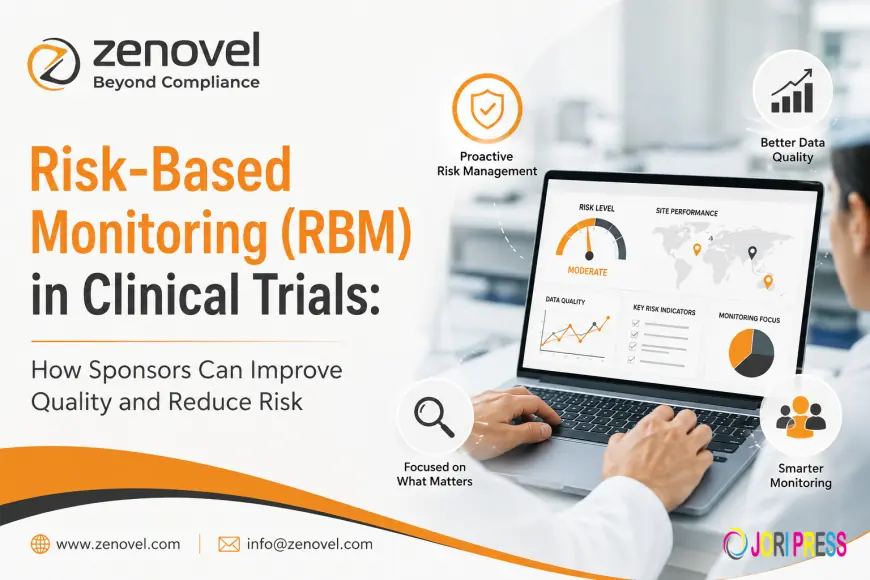
Historically, “monitoring” in the industry involved CRAs traveling to sites to meticulously verify data against source documents. While thorough, this approach was slow, costly, and often ineffective at identifying significant issues. A monitor focusing solely on 100% source data verification may confirm individual data points, like a blood pressure reading, but could overlook broader issues, such as patterns of consent process deviations within the same dataset.
Risk-based monitoring (RBM) addresses the imbalance in oversight by focusing on high-risk areas to ensure patient safety and data integrity. Although introduced in FDA guidance in 2013, its adoption has increased, and by 2026, it has become a requirement for regulatory inspections, emphasizing the need for documented and defensible practices within the risk-based quality management (RBQM) framework.
Why RBM Matters More
ICH E6(R3) establishes a risk-based quality management (RBQM) approach as a core expectation for sponsors in clinical trials. It requires a documented system that clearly tracks oversight decisions throughout the trial lifecycle, moving beyond merely having a monitoring plan. Inspectors seek specific decision-making details related to risk signals, which many sponsors struggle to provide. Despite having necessary tools like dashboards and key risk indicators, there is often a lack of a coherent, documented narrative demonstrating how risks are managed from detection to action. This disparity highlights ongoing challenges in RBQM implementations.
The core components of RBM:
- Quality factors:
The key error in implementing RBM is attempting to monitor too many aspects. Effective RBM necessitates prioritization by focusing on a limited number of critical data points that could jeopardize patient safety or trial outcomes. A risk assessment identifying numerous “critical” factors indicates inadequacy in the assessment process.
- Centralized monitoring:
Centralized statistical monitoring allows for the review of aggregated data in near real time to identify outliers, trends, and inconsistencies. This process enables targeted on-site visits, eliminating the need for sponsors to guess which sites require attention, thus focusing resources on data-flagged issues.
- Quality tolerance limits (QTL):
In developing a QTL framework, it’s more effective to implement a limited number of focused guardrails for prompt investigation rather than an extensive list that is seldom reviewed. It’s important to set realistic expectations, acknowledging that some breaches may occur with small sample sizes, which should not be regarded as failures. Overreacting to early breaches can undermine credibility for genuine issues later on.
- Key risk indicator (KRI) and statistical data monitoring
Recent analysis of large trial datasets indicates that while statistical monitoring signals and key risk indicator alerts often emerge on similar timelines, the real differentiator among organizations is durability. This refers to whether resolved issues remain solved or if repeated signals occur due to unaddressed underlying root causes.
Here sponsors get rattled on:
- Lagging indicators often highlight issues after they have escalated, as many results in RBM frameworks appear post-incident, such as protocol deviations or missed visit windows. These deviations typically stem from human errors related to training rather than operational failures. By the time operational issues are evident, it is often too late for intervention. To combat this, sponsors are proactively incorporating readiness checks into site training, instead of relying on delayed data to address already existing problems.
- Vendor oversight must move beyond trust, especially as RBM relies more on interconnected technology stacks like CTMS, EDC, and eTMF. The increasing number of vendors handling trial data necessitates thorough vendor qualification, audits, service-level agreements, and quality agreements. A comprehensive cybersecurity approach is essential, addressing GDPR, HIPAA, and data transfer regulations to mitigate compliance and security risks associated with cloud and mobile connections.
- Regional variation is crucial for RBM in clinical trials, as risk profiles vary significantly across different regions. A KRI threshold suitable for Western Europe may not apply effectively in other markets due to diverse infrastructure and data collection practices. Effective RBM requires proactive, region-specific risk planning based on current data instead of a one-size-fits-all global template, ensuring relevance as trials become global.
Good execution looks like this:
The effectiveness of sponsors in inspections is attributed not to superior technology, but to strong documentation practices. They maintain clear records detailing the reasons for risk flags, decision-makers, and outcomes. Regulators prioritize traceability over specific metrics or algorithms, emphasizing the importance of explaining decision-making processes. Therefore, incorporating good documentation habits into quality management systems is advised for future compliance.
- Keeping the critical-to-quality factor list concise and updating it throughout the trial is essential, rather than only at the study’s initiation.
- Treat centralized statistical monitoring as the main detection tool, while considering on-site visits as a focused response rather than the standard approach.
- Documenting decisions is essential; every QTL breach or KRI alert must include a detailed explanation of the investigation and resolution.
- Integrate vendor oversight and cybersecurity review directly into the RBM plan instead of treating them as separate workstreams.
- Calibrate risk thresholds regionally rather than applying a universal standard across all sites.
In hindsight, RBM is now an established concept in clinical trials, with the focus shifting to its execution in 2026. The key challenge for sponsors is to implement RBM as a repeatable, defensible system that meets regulatory scrutiny by demonstrating effective monitoring actions. Successful sponsors integrate RBM into daily trial operations rather than treating it as a static guideline.
At Zenovel, our services also focus on helping sponsors implement RBM approaches that reduce deviations across clinical trials. We deliver effective monitoring that safeguards the well-being of trial subjects while protecting the integrity of study data. We’ve become a trusted RBM services provider for sponsors around the world.
Our consultants are available around the clock, so sponsor questions and concerns are addressed promptly, wherever a trial is running. And in an environment that keeps shifting new regulatory expectations, new technologies, and new regional requirements, we make sure sponsor organizations stay adaptable rather than caught off guard.
Our experts support the full RBM lifecycle: risk assessment, risk control, review reporting, centralized monitoring, QTLs, and on-site monitoring.
What's Your Reaction?
 Like
0
Like
0
 Dislike
0
Dislike
0
 Love
0
Love
0
 Funny
0
Funny
0
 Angry
0
Angry
0
 Sad
0
Sad
0
 Wow
0
Wow
0