































Real-World Asset Tokenization: How RWA Platforms Bring Assets On-Chain with Developcoins

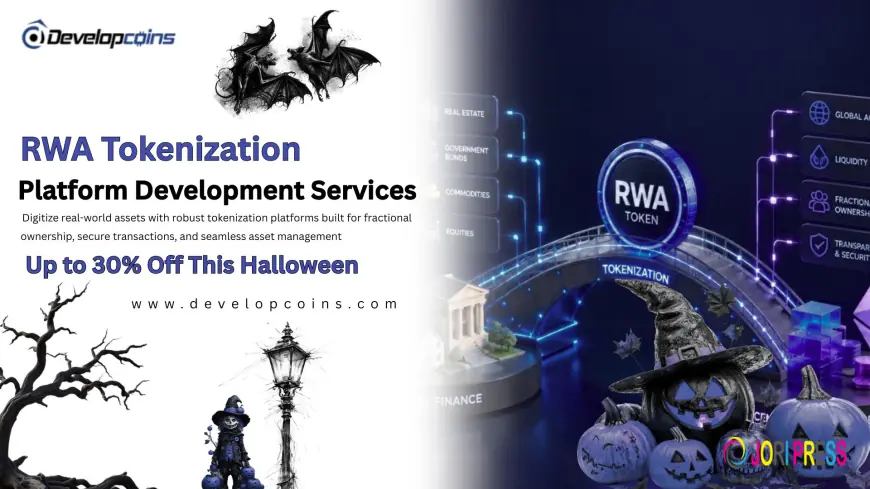
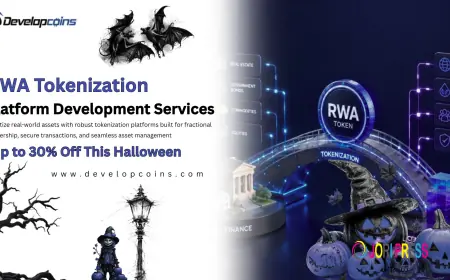
Real-world asset (RWA) tokenization is turning real estate, gold, private credit, and other assets into digital tokens that can be owned, traded, and managed on-chain. This Halloween, Developcoins, a trusted RWA tokenization development company, is offering up to 30% OFF RWA Tokenization Platform Development, a limited-time chance to launch a secure, compliant platform at a special price. In this guide, we explain how RWA tokenization works, which assets can be tokenized, how platforms operate, and what compliance and risks to plan for.
What Is Real-World Asset Tokenization?
Real-world asset tokenization is the process of representing ownership of a physical or financial asset as a digital token on a blockchain. Each token is a verifiable claim on the underlying asset, or on a share of it.
This changes how assets are owned and traded. A property worth millions can be split into many small tokens, so more investors can take part. Ownership records live on a shared ledger, and smart contracts handle transfers and payouts automatically. The result is faster settlement, lower paperwork, and more transparency than traditional systems offer.
What Types of Real-World Assets Can Be Tokenized?
Many asset classes can be tokenized, as long as their value and ownership can be clearly documented:
-
Real estate: residential, commercial, and rental properties
-
Gold and precious metals: vault-held metals represented as tokens
-
Private credit and loans: lending pools and credit instruments
-
Treasuries and bonds: government and corporate debt
-
Commodities: oil, agricultural goods, and other raw materials
-
Invoices and receivables: business payments awaiting settlement
-
Equities and funds: shares and fund units in tokenized form
Assets with clear valuation and simple legal ownership are usually easiest to tokenize first.
How Does Real-World Asset Tokenization Work?
Tokenization follows a structured process:
-
Asset selection and valuation: choose the asset and get an independent valuation.
-
Legal structuring: set up the legal entity or structure that holds the asset, so each token has an enforceable claim behind it.
-
Token design: decide token type, supply, and the rights each token carries, such as ownership share or income.
-
Smart contract development: build and audit contracts for issuance, transfers, and redemption.
-
Compliance setup: add KYC/AML checks and investor eligibility rules.
-
Issuance and distribution: mint tokens and offer them to eligible investors.
-
Ongoing management: handle payouts, reporting, and redemption.
How an RWA Tokenization Platform Works
An RWA tokenization platform brings these steps into one system. A complete platform usually includes:
-
Investor onboarding: KYC/AML verification and whitelisting
-
Token issuance engine: smart contracts that mint and manage tokens
-
Transfer rules: restrictions that stop tokens moving to ineligible holders
-
Custody and oracle integration: links to asset custody and reliable price or reserve data
-
Marketplace or trading dashboard: for primary offerings and secondary trading
-
Admin and investor portals: for asset managers and token holders
-
Redemption and payout logic: to return value to holders
Platforms are often built on established chains such as Ethereum, Polygon, or Solana, using permissioned token standards like ERC-3643 to enforce compliance on-chain.
Compliance and Legal Requirements for RWA Tokenization
Most tokenized assets are treated as securities, so compliance is part of the build from day one. Key areas include:
-
KYC/AML: verify investor identity and screen against risk lists
-
Investor eligibility: limit who can buy, based on jurisdiction and investor type
-
Transfer restrictions: enforce lock-ups and approved-holder rules in the smart contract
-
Legal structure: make sure token holders have a clear, enforceable claim on the asset
-
Reporting and disclosures: meet requirements set by regulators in each target market
Rules differ by country, so the legal setup should be confirmed with qualified legal counsel before launch.
Key Challenges and Risks of Tokenized Assets
-
Regulatory uncertainty: rules are still evolving and vary by jurisdiction
-
Smart contract risk: weak code or poor transfer logic can create legal and financial exposure
-
Valuation and data accuracy: token value depends on trustworthy asset valuation and oracle data
-
Liquidity limits: a token is only as liquid as its market, and new platforms can start thin
-
Custody and redemption risk: holders need confidence they can redeem value from the underlying asset
-
Operational complexity: legal, technical, and custody pieces must all work together
Careful design, independent security audits, and clear legal structuring reduce these risks significantly.
Why Choose Developcoins for RWA Tokenization Development?
Developcoins builds end-to-end RWA Tokenization Platform Development Company, from token design and smart contract development to compliance modules, investor portals, and multi-chain deployment. With our 10+ years of blockchain expertise, 250+ developers, and projects delivered across 30+ countries, our team builds platforms that are secure, scalable, and ready for regulated markets. We also support security audits and post-launch maintenance.
Halloween Offer: Get up to 30% OFF RWA Tokenization Platform Development for a limited time.
What's Your Reaction?
 Like
0
Like
0
 Dislike
0
Dislike
0
 Love
0
Love
0
 Funny
0
Funny
0
 Angry
0
Angry
0
 Sad
0
Sad
0
 Wow
0
Wow
0