









































PK-Stat Review in Bioequivalence Studies: Key Statistical Considerations for Regulatory Submissions
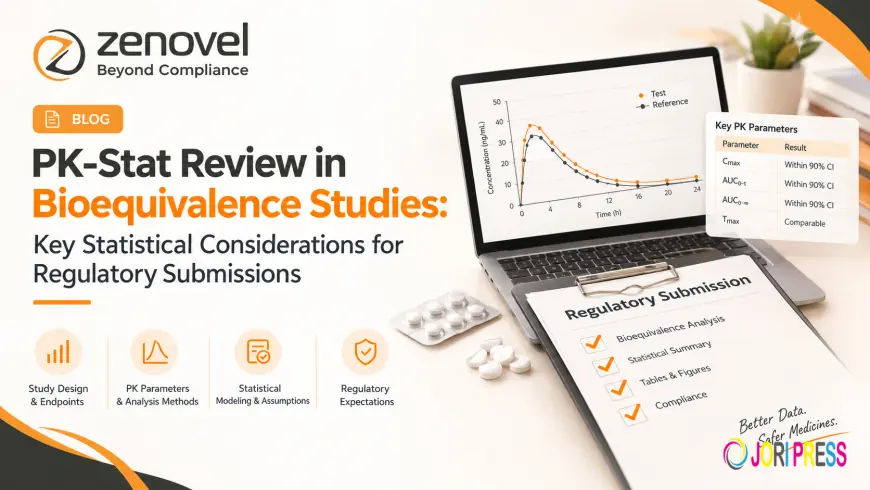
Bioequivalence (BE) studies encompass a complex blend of pharmacokinetics, biostatistics, and regulatory science. Despite performing well clinically, a generic or modified formulation may be rejected if the pharmacokinetic-statistical (PK-stat) analysis does not align with regulatory standards. Consequently, a thorough and well-documented PK-stat review serves as a critical checkpoint in the BE submission process for sponsors and CROs.
This blog discusses key statistical considerations for bioequivalence submissions, highlights common deficiencies, and explains how Zenovel's structured PK-stat services or review process in its regulatory affairs services can help sponsors prevent costly delays in submissions.at review: Methodology Scrutiny
BE determinations rely on a strict statistical framework, with minimal room for error. Issues such as miscalculated confidence intervals, inappropriate outlier handling, or insufficient sample sizes can lead to regulatory setbacks like Complete Response Letters or Refuse-to-File decisions. As BE conclusions hinge on statistical analysis rather than extensive clinical judgment, there is a strong emphasis on internal consistency and methodological transparency in the review process.
PK Parameters and Log-Transformation
Regulatory guidance from the FDA, EMA, and WHO emphasizes the necessity of analyzing primary pharmacokinetic parameters, specifically Cmax and AUC, on a logarithmic scale. This log-transformation is essential due to the multiplicative nature of pharmacokinetic variability and is widely accepted in regulatory practices. Submissions that neglect log-transformation or do not adequately justify its omission often face review queries.
The 90% Confidence Interval and the 80–125% Acceptance Range
The BE criterion mandates that the 90% confidence interval for the geometric least-squares means ratio (test/reference) for Cmax and AUC must lie between 80.00% and 125.00%. This criterion is a stringent symmetric interval on the log scale, requiring reviewers to assess both the point estimate's compliance and the confidence interval's appropriateness in terms of variability, sample size, and statistical model accuracy as per protocol.
ANOVA and Study Design Alignment
The ANOVA model used in a study must match the design, typically a two-period, two-sequence crossover, with increasing use of replicate designs for variable drugs. It should incorporate effects from sequence, period, treatment, and subject-within-sequence. Deviations from standard crossover models require clear statistical justification. Reviewers often highlight cases where the ANOVA does not align with the study design or where effects are inconsistently specified.
Sample Size and Statistical Power
Sample size determinations should be justified prospectively, considering the intra-subject coefficient of variation (CV), a clinically meaningful difference, and a statistical power of 80% or more. Retrospective power calculations are not acceptable, and reviewers will verify the CV against existing literature or previous studies. Underpowered studies reporting point estimates close to 100% are commonly noted in regulatory deficiency letters.
Handling of Highly Variable Drugs (HVDs)
Drugs with an intra-subject CV over 30% often struggle to meet standard average bioequivalence criteria, even if they are therapeutically interchangeable. Both the FDA and EMA permit reference-scaled average bioequivalence (RSABE) methods that expand acceptance criteria based on the CV. Correctly applying or not applying RSABE and justifying it within the regulatory context commonly leads to disagreements between sponsors and reviewers.
Narrow Therapeutic Index (NTI) Drugs
NTI drugs face stringent acceptance criteria, typically 90.00–111.11% for AUC, due to significant clinical impacts from minor exposure variations. Submissions for NTI compounds necessitate careful demonstration of both average bioequivalence and within-subject variability as per regulatory guidelines.
Outlier Management and Data Exclusions
Exclusions of subjects or data points must be pre-specified in the statistical analysis plan or justified with sensitivity analyses to ensure conclusions are not reliant on such exclusions. Undocumented data exclusions can attract regulatory scrutiny, even if the bioequivalence outcome seems favorable.
Partial AUC and Additional Endpoints
In modified-release formulations, particularly for CNS-active drugs, regulators may demand a partial AUC analysis alongside standard Cmax and AUC0-t/AUC0-inf endpoints. The statistical handling of partial AUC, including acceptance criteria and truncation time justification, should be predetermined and conform to current regulatory guidance for the drug class.
Recurring statistical issues in BE submissions lead to high rates of regulatory queries and rejections.
- Untransformed or inconsistently transformed PK parameters
- ANOVA models misaligned with the stated crossover or replicate design
- Retrospective, rather than prospective, sample size justification
- Undocumented or inadequately justified subject/data exclusions
- Incorrect or unjustified application of RSABE for highly variable drugs can lead to inconsistent reporting among the statistical analysis plan, the clinical study report, and other related documents.
Preventable issues can be identified through a thorough PK-stat review conducted prior to submission, rather than being revealed in a regulatory deficiency letter.
Zenovel Supports PK-Stat Review and Regulatory Readiness by:
- Independent PK-stat audits involve a structured review of ANOVA models, confidence interval derivations, and acceptance criteria. This process aligns with the current guidance from FDA, EMA, and WHO and is conducted prior to submission to identify inconsistencies before they are flagged by regulators.
- AI-powered regulatory affairs support uses technology to cross-check statistical outputs against the Statistical Analysis Plan (SAP), protocol, and clinical study report, effectively identifying discrepancies that manual reviews might overlook.
- Computer System Validation (CSV) services ensure the validation of statistical software environments, such as SAS and Phoenix WinNonlin, for generating PK-stat outputs. This process guarantees data integrity and compliance with audit trails for GxP-regulated submissions.
- On-demand statistical and regulatory expertise provides scalable support for sponsors in navigating RSABE justifications, NTI drug criteria, or partial AUC requirements, eliminating the need to maintain this specialized knowledge in-house.
- End-to-end digital oversight utilizes digital tools from study data lock to final submission package assembly, minimizing manual transcription errors among datasets, statistical outputs, and regulatory documents.
Zenovel integrates statistical review, software validation, and regulatory strategy into a unified process, enabling sponsors to identify and address PK-stat vulnerabilities before submissions reach regulatory reviewers. This minimizes the risk of deficiency letters related to preventable statistical or documentation problems.
Practical Takeaways for Sponsors
- Confirm the application and documentation of log transformation for Cmax and AUC parameters in line with current guidance.
- Align the ANOVA model with the actual study design and justify any deviations. Justify sample size prospectively using a referenced intra-subject CV estimate.
- Pre-specify data exclusion criteria in the SAP and support post hoc exclusions with sensitivity analyses.
- Ensure the proper acceptance criteria framework (standard, RSABE, or NTI) is applied and justified for the evaluated drug.
- Validate the statistical software environment producing PK-stat outputs with comprehensive audit trail documentation.
In BE submissions, statistical analysis is central to the regulatory argument, not merely supplementary. Sponsors who approach PK-stat review with rigor, seeing it as an audited process rather than just data processing, yield stronger submissions and encounter fewer deficiencies. Zenovel enhances bioequivalence and pharmacokinetic-stat programs by integrating statistical audit expertise, validated analytical systems, and AI-supported regulatory review to help sponsors produce robust PK-stat packages from the outset.
What's Your Reaction?
 Like
0
Like
0
 Dislike
0
Dislike
0
 Love
0
Love
0
 Funny
0
Funny
0
 Angry
0
Angry
0
 Sad
0
Sad
0
 Wow
0
Wow
0