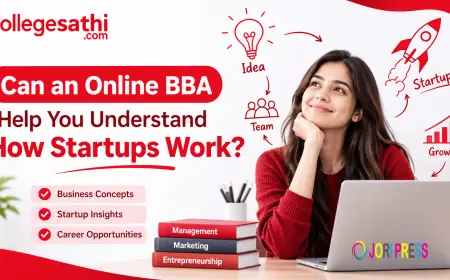



































Can an Online BBA Help You Understand How Startups Work?
An Online BBA helps aspiring entrepreneurs understand essential business concepts such as marketing, finance, management, and entrepreneurship. It builds a foundation for managing startups, making business decisions, and developing practical skills while offering flexible learning and affordability. However, real-world experience, networking, and hands-on projects remain essential for startup success.
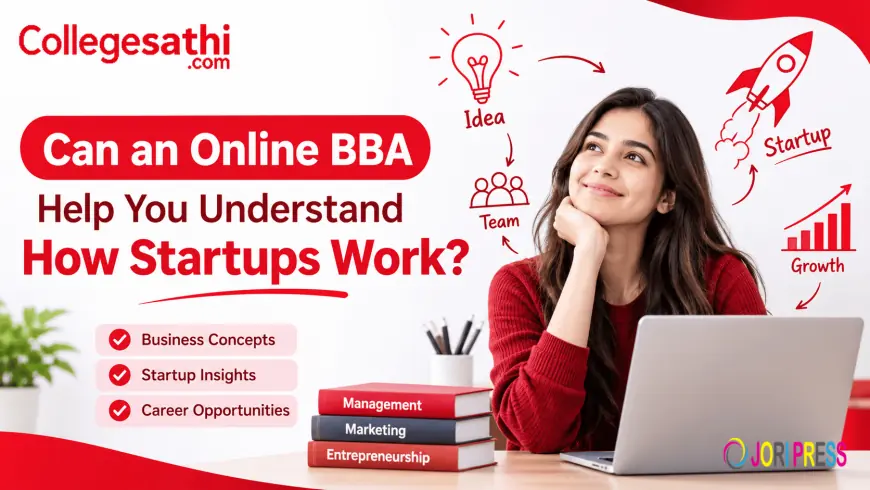
Most people who dream of starting a business ask the same thing: do I need a degree for this? You don't. But knowing how money, people, and customers fit together makes a big difference, and that is where an Online BBA can help.
This blog explains what you can learn from an online BBA about how startups work, where the course falls short, and how to decide if it suits you.
What Is an Online BBA?
A Bachelor of Business Administration (BBA) is a three-year undergraduate degree in business and management. The online version covers the same subjects, but you study through video lectures, digital notes, live classes, and online exams instead of attending a campus every day.
An online BBA is a good fit for:
- Students who finished Class 12 and want a business degree without relocating
- Working people who can't leave their jobs
- Young founders already running a small venture
- Anyone in a smaller city who wants access to good faculty
If you are comparing universities and approved programs, a platform like CollegeSathi can help you see the options in one place before you decide.
How Startups Actually Work (In Plain Words)
A startup is a young company trying to solve a problem in a new or better way. Behind the fancy pitch decks, almost every startup has the same moving parts:
- An idea or problem worth solving
- A product or service that solves it
- Customers willing to pay
- Money to run things until revenue comes in
- A team that can build, sell, and manage
Most startups don't fail because the idea was bad. They fail because the founders ran out of cash, misjudged the market, or couldn't manage the team. Those are management problems, and management is exactly what a BBA teaches.
Subjects in an Online BBA That Connect to Startup Life
You won't find a subject called "How to Run a Startup" in every syllabus. Still, many regular BBA subjects map directly onto startup work.
Principles of Management
This is where you learn planning, organizing, and leading people. A founder spends most of the day making decisions with incomplete information. This subject gives you frameworks to think through them.
Marketing Management
A startup with a great product and no buyers is just an expensive hobby. Marketing teaches you how to find your target customer, position your product, set a price, and build a brand. Digital marketing modules are especially useful today, since most startups reach customers online.
Financial Accounting and Financial Management
Many first-time founders can't read a balance sheet. In an online BBA program, you learn how to track income and expenses, understand profit versus cash flow, and plan a budget. These skills matter a lot when you are talking to investors or deciding whether you can afford your next hire.
Business Economics
You learn about demand, supply, competition, and pricing. This helps you judge whether a market is big enough for your idea and how competitors might react.
Human Resource Management
Hiring the wrong person early on can hurt a small team badly. HR subjects cover recruitment, motivation, and conflict handling, all things a founder deals with from the first employee onward.
Entrepreneurship and Business Communication
Many universities include an entrepreneurship paper. It covers idea validation, business plans, funding sources, and the basics of business law. Communication skills help you pitch, negotiate, and write professional emails.
Benefits of Learning Startup Basics Through an Online Program
Learning business theory is one thing. Here is why the online format has its own advantages.
You Can Learn and Build at the Same Time
This is probably the biggest plus. Because an online program is flexible, you can study in the evening and work on your own project during the day. When a lecture covers pricing, you can test it on your own product the next week. That back-and-forth makes the learning stick.
Lower Cost
Campus fees, hostel rent, and daily travel add up. Online degrees usually cost less, so you have more money left to put into your actual business idea.
Access to Digital Tools
Online learning gets you comfortable with tools founders use anyway: video meetings, shared documents, project trackers, and online payments. You pick these up without even trying.
Self-Discipline
Nobody reminds you to attend an online class. You have to manage your own time. That habit is very close to what running a startup demands.
A Broad View of Business
Startups need people who understand a bit of everything: sales, money, operations, and people. A BBA gives you a general base, so you can talk to a designer, an accountant, and a salesperson in a way each of them understands.
What an Online BBA Can't Do for You
It's worth being honest here. A degree has limits.
- It won't give you real-world experience. Reading about customer complaints is not the same as handling one at 10 pm.
- It won't guarantee a successful startup. Plenty of successful founders never finished college, and plenty of graduates never start anything.
- Networking is harder online. On a campus, you meet future co-founders over chai. Online, you have to make more effort to connect with classmates and mentors.
- Quality varies. Not every university offers the same standard of teaching or support.
So treat the degree as a base, not a shortcut. The real learning comes when you apply the ideas.
How to Get More Out of Your Online BBA If You Want to Do a Startup
A few habits can turn a regular degree into a practical one.
Pick a small project early. Start something tiny, like selling products on social media, offering a freelance service, or running a campus newsletter. Even earning a few thousand rupees teaches you things a textbook can't.
Use case studies seriously. When your course discusses a real company, ask why it succeeded or failed. Then compare it to a startup you follow.
Join online communities. Look for founder groups, startup forums, and LinkedIn communities. Ask questions and read other people's stories.
Find a mentor. Even one conversation a month with someone who has run a business helps. Many founders are happy to talk to students who show genuine curiosity.
Do internships if possible. Working at an early-stage company, even for a few weeks, shows you how things run when there's no big budget or fixed process.
Build side skills. Learn basic Excel, simple design, content writing, or social media marketing. They pair well with your BBA.
How to Choose the Right Online BBA Program
Before you enroll, check these things:
- Recognition: Make sure the university is approved by UGC and the program is valid for jobs and higher studies.
- Syllabus: Look for subjects like entrepreneurship, digital marketing, and finance, not only theory-heavy papers.
- Learning support: Are there recorded lectures, doubt-clearing sessions, and responsive faculty?
- Exam pattern: Know whether exams are online or at a center, and how often they happen.
- Fees: Compare total fees, not just the first-year amount.
- Placement or career help: Some universities offer job support or startup cells. That is a nice bonus.
Reading through CollegeSathi and similar guidance sites can save time when comparing universities, but always confirm the final details on the official university website.
Who Should Go for an Online BBA?
An online BBA makes sense if you:
- Want a structured way to learn business basics
- Plan to start something in the next few years
- Need flexibility because of work or location
- Prefer to keep costs lower
It may not be the best choice if you need constant classroom interaction, or if you are certain you want to join a company in a field that requires a campus placement drive.
Final Thoughts
So, can an online BBA help you understand how startups work? Yes, but with a condition. It gives you the vocabulary, frameworks, and confidence to understand how a business runs. What it can't do is replace the experience of actually trying, failing, and trying again.
If you combine your online program with a small real project, a mentor, and some curiosity, you will learn faster than most people who only read about startups. Think of the degree as your map and your own venture as the journey.
Frequently Asked Questions (FAQs)
1. Is an online BBA valid for starting a business?
No degree is legally required to start a business in India. An online BBA simply gives you the knowledge to run it better. Just make sure the university is UGC-approved so the degree is accepted for jobs and further studies.
2. What subjects in an online BBA are most useful for startups?
Marketing, financial management, entrepreneurship, human resource management, and business economics are the most useful. Business communication also helps with pitching and negotiation.
3. Can I run my own startup while doing an online BBA?
Yes. Since classes are flexible, many students manage both. It also helps because you can use what you learn directly in your business.
4. Is an online BBA as good as a regular BBA?
If the university is recognized and the program is approved, the degree holds similar value. The main difference is the learning style. Regular BBA offers more campus networking, while the online format offers more flexibility and lower costs.
5. What can I do after an online BBA if I don't start a startup?
You can work in marketing, sales, HR, operations, or finance roles. Many graduates also go on to an MBA, or join an early-stage company to gain experience first.
6. How do I choose a good online BBA program?
Check UGC recognition, the syllabus, faculty support, exam format, and total fees. Comparing a few universities on a guidance platform like CollegeSathi and then verifying details on the official university site is a sensible approach.
What's Your Reaction?
 Like
0
 Dislike
0
 Love
0
 Funny
0
 Angry
0
 Sad
0
 Wow
0