































OIG Screening: The Compliance Practice Every Healthcare Organization Cannot Afford to Ignore
Healthcare compliance has become more complex than ever. Between changing regulations, increased government oversight, and growing concerns about healthcare fraud, organizations are expected to maintain stronger compliance programs than at any point in the past decade.
One of the most important yet often overlooked components of a successful compliance strategy is OIG Screening.
For hospitals, physician groups, pharmacies, home healthcare providers, medical device companies, and healthcare staffing agencies, OIG screening serves as a critical safeguard against regulatory violations, financial penalties, and reputational damage.
The reality is simple: a single excluded individual or vendor can expose an organization to significant compliance risks. That is why healthcare organizations across the United States continue to make OIG screening a core part of their compliance programs.
In this guide, we'll explore what OIG screening is, why it matters, common challenges organizations face, and how Venops helps healthcare providers simplify and strengthen their compliance efforts.
What Is OIG Screening?
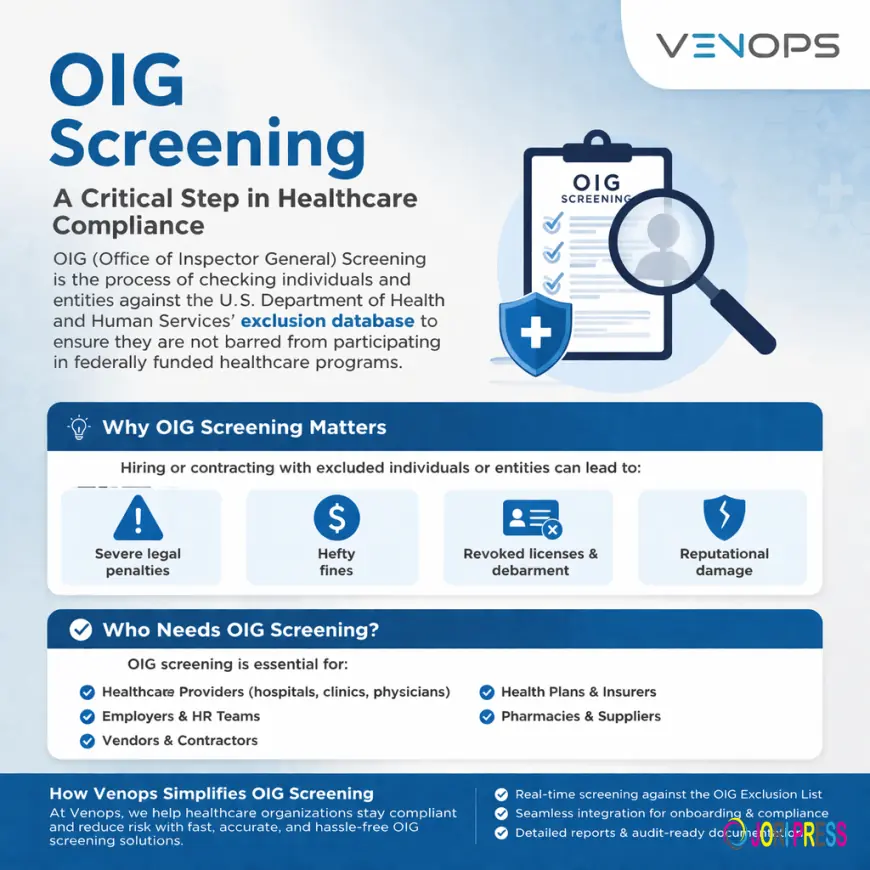
OIG Screening is the process of checking employees, physicians, contractors, vendors, and business partners against exclusion databases maintained by healthcare regulatory authorities.
The most recognized database is the List of Excluded Individuals and Entities (LEIE), maintained by the Office of Inspector General (OIG). Individuals or entities appearing on this list are prohibited from participating in federally funded healthcare programs such as Medicare, Medicaid, and TRICARE.
Healthcare organizations that receive reimbursement from federal healthcare programs must take reasonable steps to ensure they are not employing or doing business with excluded individuals or organizations.
Why OIG Screening Is So Important
Many healthcare leaders assume that exclusion screening is only necessary during the hiring process. In reality, compliance experts recommend ongoing screening because exclusion status can change at any time.
An employee, physician, contractor, or vendor who was eligible yesterday may become excluded tomorrow due to legal, licensing, or regulatory actions.
Protecting Federal Healthcare Funds
The primary purpose of OIG screening is to protect taxpayer-funded healthcare programs from fraud, abuse, and misconduct.
Federal agencies use exclusion programs to prevent individuals with serious violations from benefiting from government healthcare funds.
Reducing Financial Risk
Organizations that employ or contract with excluded parties may face civil monetary penalties, repayment obligations, and other enforcement actions. Penalties can become substantial depending on the duration and scope of the violation.
Maintaining Organizational Reputation
Healthcare organizations depend heavily on patient trust. Compliance failures can damage relationships with patients, business partners, and regulatory agencies.
Supporting Audit Readiness
Regular screening and documented compliance efforts demonstrate due diligence during audits and regulatory reviews.
Who Should Be Screened?
An effective OIG screening program should extend beyond physicians and clinical staff.
Organizations should consider screening:
- Employees
- Physicians
- Nurses
- Contractors
- Temporary staff
- Vendors
- Suppliers
- Consultants
- Billing companies
- Third-party service providers
Many compliance failures occur because organizations focus only on employees while overlooking vendors and contractors who also interact with federally funded healthcare programs.
Common Reasons Individuals Become Excluded
The OIG may exclude individuals or entities for several reasons, including:
- Medicare fraud
- Medicaid fraud
- Healthcare-related criminal offenses
- Patient abuse or neglect
- License suspension or revocation
- Illegal distribution of controlled substances
- Financial misconduct involving federal healthcare programs
These exclusions help protect both patients and public healthcare funds from potential harm.
Why Monthly OIG Screening Is Considered Best Practice
Industry experts widely recognize monthly screening as the standard for healthcare compliance.
Waiting until annual audits or employee reviews can leave organizations exposed to months of unnecessary risk.
Monthly monitoring helps organizations:
- Identify exclusions quickly
- Maintain compliance records
- Reduce audit risks
- Demonstrate due diligence
- Strengthen internal controls
For large healthcare systems, manually performing monthly screenings can consume significant administrative resources. This is one reason automated solutions have become increasingly popular.
The Challenges of Manual OIG Screening
Many organizations initially attempt to manage exclusion screening internally using spreadsheets and manual searches.
However, this approach often creates several challenges:
Time-Consuming Processes
Screening hundreds or thousands of names every month requires significant staff time.
False Positives
Name-based matching frequently generates potential matches that require investigation and verification.
Multiple Databases
Organizations often need to review not only federal exclusion lists but also state sanctions databases and additional regulatory sources.
Documentation Burden
Maintaining complete screening records is just as important as performing the screening itself. Missing documentation can create problems during audits.
How Venops Simplifies OIG Screening
Venops has been helping healthcare organizations manage exclusion and sanctions screening since 2014. The company's compliance platform was designed specifically to reduce administrative burden while improving screening accuracy.
Automated Monthly Screening
One of Venops' most valuable features is its Autopilot™ monthly screening system.
Once names are entered into the system, they are automatically re-screened against updated exclusion and sanctions databases every month. This helps organizations maintain continuous compliance without repetitive manual effort.
Comprehensive Screening Coverage
Venops goes beyond standard OIG checks by screening against multiple federal and state sources, including:
- OIG LEIE
- GSA SAM
- State exclusion databases
- OFAC sanctions lists
- TRICARE exclusions
- FDA debarment lists
- Medicare opt-out records
- Additional sanction authorities
This broad coverage helps healthcare organizations identify risks that may be missed by limited screening programs.
Vendor Screening
Vendor compliance is becoming increasingly important in healthcare risk management.
Venops includes vendor and entity screening capabilities that help organizations evaluate suppliers, contractors, and third-party partners.
Match Investigation and Resolution
A major challenge in exclusion screening is resolving false positives.
Venops includes professional clearance investigations to help determine whether a potential match is a true exclusion or simply a name similarity. This feature helps reduce compliance uncertainty and saves valuable staff time.
Secure Record Retention
All screening reports and compliance records are stored securely and remain accessible for future audits and reviews.
This provides organizations with a complete history of their compliance efforts whenever documentation is needed.
The Future of OIG Compliance
Healthcare compliance continues to evolve as regulators adopt more sophisticated monitoring tools and data analytics.
Organizations are increasingly moving toward:
- Automated screening systems
- Continuous monitoring programs
- Vendor compliance management
- Integrated compliance platforms
- Data-driven risk assessments
Healthcare providers that invest in proactive compliance programs today will be better positioned to navigate future regulatory expectations.
Conclusion
OIG Screening is no longer just a compliance checkbox—it is a critical risk management strategy for modern healthcare organizations.
Regular screening helps protect federal healthcare funds, reduce regulatory risk, strengthen patient trust, and support long-term organizational success.
As compliance requirements continue to grow, relying on manual processes becomes increasingly difficult. Automated solutions like Venops provide healthcare organizations with the tools needed to manage exclusion screening efficiently, accurately, and consistently.
With automated monthly screening, vendor monitoring, sanctions checks, record retention, and compliance reporting, Venops helps organizations stay focused on delivering quality care while maintaining confidence in their compliance programs.
Frequently Asked Questions
1. What is OIG Screening?
OIG Screening is the process of checking employees, vendors, contractors, and healthcare providers against exclusion databases to ensure they are eligible to participate in federal healthcare programs.
2. How often should OIG screening be performed?
Most compliance professionals recommend monthly screening to identify new exclusions quickly and maintain compliance records.
3. Why is OIG screening important?
It helps organizations avoid penalties, protect federal healthcare funds, reduce compliance risks, and maintain audit readiness.
4. Does OIG screening apply to vendors?
Yes. Vendors, suppliers, contractors, and third-party service providers should be included in a comprehensive screening program.
5. How does Venops help with OIG screening?
Venops offers automated monthly screening, vendor screening, sanctions monitoring, professional match investigations, secure record retention, and compliance reporting tools.
What's Your Reaction?
 Like
0
Like
0
 Dislike
0
Dislike
0
 Love
0
Love
0
 Funny
0
Funny
0
 Angry
0
Angry
0
 Sad
0
Sad
0
 Wow
0
Wow
0