






































Music Theory for Beginners: Start Learning Music the Right Way
Learn music theory for beginners with simple lessons on notes, scales, chords, rhythm, harmony, and notation. Build a strong musical foundation.

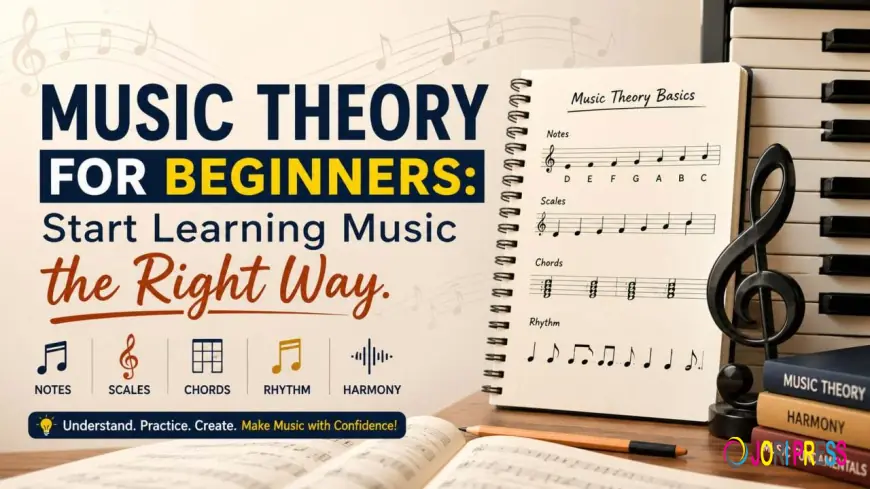
Learning music can feel confusing when you first encounter notes, scales, chords, keys, rhythm, and notation. The good news is that you do not need to master everything at once. Understanding a few fundamental concepts can give you a strong foundation and make learning an instrument much easier.
This guide to music theory for beginners explains the essential building blocks of music in a simple and practical way. Whether you are learning piano, guitar, singing, composition, or another instrument, these concepts can help you understand how music is structured and why certain notes and chords work together.
What Is Music Theory?
Music theory is the study of the principles and structures used to create, understand, perform, and communicate music. It explains how elements such as notes, rhythm, scales, chords, melody, harmony, and musical notation work together.
Think of music theory as a language. You can enjoy a song without knowing its grammar, but understanding the grammar allows you to communicate musical ideas more clearly.
For beginners, music theory is not about memorizing hundreds of rules. It is about understanding patterns and using them to make better musical decisions.
Why Should Beginners Learn Music Theory?
One of the biggest advantages of learning music theory for beginners is that it helps connect what you hear with what you play.
A basic understanding of theory can help you:
-
Read sheet music more confidently
-
Understand musical notes and scales
-
Build and recognize chords
-
Improve your sense of rhythm
-
Understand how melody and harmony interact
-
Learn songs more efficiently
-
Create your own musical ideas
-
Communicate better with other musicians
Theory is especially useful when you want to move beyond simply copying songs and start understanding how music works.
Start With Musical Notes
The first concept beginners should understand is the musical alphabet.
In Western music, the basic note names are:
A, B, C, D, E, F, and G
After G, the sequence starts again at A.
On a piano, these notes correspond to specific keys. On guitar and other instruments, the same musical notes appear in different positions.
You will also encounter sharp (#) and flat (♭) notes. These symbols indicate notes that are raised or lowered by a semitone.
Understanding note names is an essential first step because scales, chords, melodies, and keys are all built from notes.
Understanding Rhythm and Beats
Music is not only about which notes you play; it is also about when you play them.
Rhythm organizes sounds and silences over time. A beat is the regular pulse that helps give music its sense of movement.
You may hear musicians talk about tempo, which refers to how fast or slow the beat is. Tempo is commonly measured in beats per minute (BPM).
Another important concept is time signature. A common example is 4/4 time, where four beats are grouped into each measure.
Beginners should practice counting simple rhythms aloud while playing. This develops timing and makes more complex musical patterns easier to understand later.
Learn Scales and Keys
A scale is an organized sequence of notes. Scales provide the foundation for melodies, chords, and many musical compositions.
The major scale is one of the most important scales to learn. Its pattern of whole steps and half steps creates the familiar major sound.
For example, the C major scale contains:
C – D – E – F – G – A – B – C
It contains no sharps or flats, which makes it particularly useful for beginners.
A musical key tells you which group of notes and chords primarily belongs to a piece of music. Understanding keys can help you predict which chords are likely to work together.
At Musical Colors, beginners can approach these concepts progressively rather than trying to memorize every scale immediately.
Understand Chords and Harmony
A chord is created when multiple notes are played together. Chords provide harmonic support for melodies and are essential in many styles of music.
One of the first chord types beginners encounter is the major triad, which contains three notes: the root, third, and fifth.
For example:
C major = C – E – G
A minor triad also contains three notes but has a different interval structure:
A minor = A – C – E
Learning basic major and minor chords can help you understand the harmonic structure behind countless songs.
Harmony refers to how different notes and chords interact. Once you understand basic harmony, you can begin recognizing chord progressions and understanding why certain combinations create tension or resolution.
Learn Musical Intervals
An interval is the distance between two notes. Intervals are important because they help explain the relationship between notes.
For example, the distance from C to D is a major second, while C to E is a major third.
You do not need to memorize every interval immediately. Start by learning to recognize simple distances by ear and on your instrument.
Interval training can eventually improve your ability to recognize melodies, build chords, and understand harmony.
How to Read Musical Notation
Musical notation is a written system for representing music. Beginners may initially find the staff, clefs, note values, and other symbols intimidating, but these elements become easier with regular practice.
The staff consists of five horizontal lines and four spaces. Notes are placed on or between these lines to represent different pitches.
The treble clef is commonly used for higher-pitched instruments and notes, while the bass clef is commonly used for lower-pitched musical ranges.
Start by learning a small number of notes at a time. Combining reading exercises with actual playing can make the process more practical and memorable.
A Practical Way to Learn Music Theory
A common mistake beginners make is trying to learn too much theory before applying it.
Instead, follow a gradual approach:
1. Learn the Musical Alphabet
Become comfortable identifying A through G and recognizing them on your instrument.
2. Understand Rhythm
Practice beats, note values, rests, counting, and simple time signatures.
3. Study Major Scales
Start with C major and gradually explore other major scales.
4. Learn Basic Chords
Understand major and minor triads and practice common chord shapes.
5. Study Intervals
Learn how the distance between notes affects melody and harmony.
6. Practice Reading Music
Begin with simple exercises and gradually increase the difficulty.
7. Apply Theory to Songs
Analyze songs you already enjoy. Identify their key, chords, rhythm, and melodic patterns.
This approach makes music theory for beginners more practical because every concept is connected to something you can actually hear and play.
How Long Does It Take to Learn Music Theory?
There is no fixed timeline for learning music theory. Basic concepts can be understood within weeks if you practice consistently, while advanced harmony, composition, and analysis can take years to develop.
The important factor is consistency.
Even 15–30 minutes of focused practice several times a week can produce meaningful progress. Combining theoretical study with instrument practice is generally more effective than studying theory only through definitions.
Musical Colors emphasizes the value of learning concepts through practical musical application, because theory becomes more useful when you can hear and use what you are studying.
Common Mistakes Beginners Should Avoid
Beginners often make a few predictable mistakes when learning theory.
Trying to memorize everything: Understanding relationships is more valuable than memorizing isolated facts.
Ignoring rhythm: Many learners focus heavily on notes and chords while neglecting timing.
Learning theory without playing: Theory becomes much easier to remember when you immediately apply it.
Moving too quickly: Build a strong foundation before jumping into advanced harmony.
Avoiding ear training: Your ears are as important as your theoretical knowledge.
A balanced approach involving theory, practice, listening, and ear training can produce stronger musical understanding.
Frequently Asked Questions
1. What should I learn first in music theory?
Start with musical notes, rhythm, scales, intervals, and basic chords. Once these foundations are comfortable, move toward keys, chord progressions, harmony, and notation.
2. Is music theory difficult for beginners?
Music theory for beginners does not have to be difficult. The subject can seem complicated when too many concepts are introduced at once. Learning one concept at a time and applying it to an instrument makes the process easier.
3. Can I learn music theory without playing an instrument?
Yes. You can study theoretical concepts without an instrument, but having access to a piano, keyboard, guitar, or another instrument can make concepts such as scales, intervals, and chords much easier to understand.
4. How important is music theory for learning an instrument?
You can learn songs without formal theory, but understanding music theory can help you recognize patterns, understand chords, read music, transpose songs, and create your own musical ideas.
5. What is the best way to practice music theory?
The most effective approach is to combine short theory lessons with practical exercises. Learn a concept, play it on your instrument, listen for it in real songs, and then use it to create something of your own. Musical Colors can also be used as a learning resource while building this structured approach.
Final Thoughts
Learning music does not require you to understand every theoretical concept from the beginning. Start with the fundamentals and gradually connect notes, rhythm, scales, chords, intervals, melody, and harmony.
The real purpose of music theory for beginners is not to put restrictions on creativity. It gives you a clearer understanding of the musical choices you are already making and helps you communicate, practice, compose, and perform with greater confidence.
With consistent practice and real musical application, theory can become less about memorization and more about understanding the patterns that make music work.
What's Your Reaction?
 Like
0
Like
0
 Dislike
0
Dislike
0
 Love
0
Love
0
 Funny
0
Funny
0
 Angry
0
Angry
0
 Sad
0
Sad
0
 Wow
0
Wow
0