

































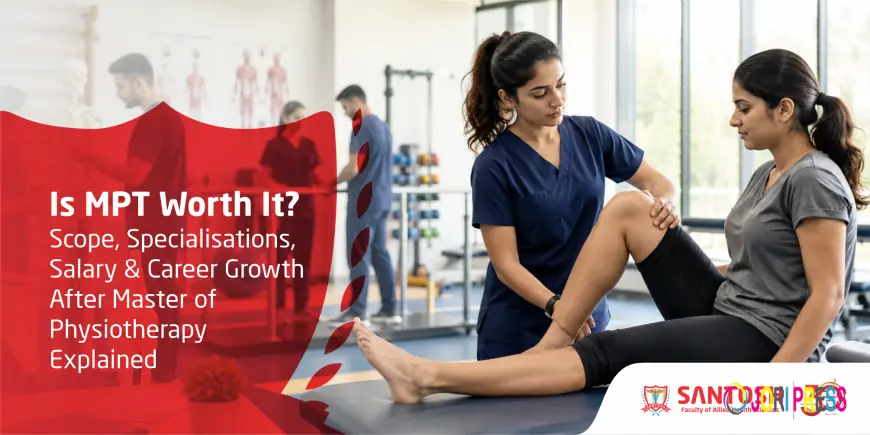
Is MPT Worth It?
Is MPT Worth It?
1. What is a Master of Physiotherapy (MPT)?
When a physiotherapist stops seeing patients as conditions to treat and starts seeing them as complex human beings requiring precision-based, evidence-driven rehabilitation — that is the shift that postgraduate training in physiotherapy is designed to bring about. The Master of Physiotherapy (MPT) is a 2-year postgraduate programme that equips BPT graduates with advanced clinical expertise, research capabilities, and specialisation in specific domains of physiotherapy practice.
While a BPT graduate can competently manage a wide range of cases, an MPT-qualified physiotherapist brings specialist-level knowledge to the table — whether it is in neurological rehabilitation after a stroke, musculoskeletal management of complex sports injuries, or cardiopulmonary recovery following cardiac surgery. In an increasingly specialised healthcare environment, this depth of expertise is both rare and highly valued.
At Santosh College of Physiotherapy, Santosh Deemed to be University, Ghaziabad, the MPT programme is offered in three specialisations aligned with the highest-demand clinical areas: Orthopedic Physiotherapy, Neurological Physiotherapy and Cardiopulmonary Physiotherapy. If you are looking for MPT colleges in Ghaziabad or the best postgraduate physiotherapy programmes in Delhi NCR, this guide has what you need.
2. Why Pursue MPT After BPT?
A large number of BPT graduates consider whether a master's degree is worth the time and investment. The answer, for those serious about building a distinguished physiotherapy career, is almost always yes. Here is why:
- Specialist clinical identity: An MPT degree signals that you have chosen to go deeper into a specific domain — orthopedic, neurological, or cardiopulmonary — rather than remaining a generalist. Hospitals and rehabilitation centres actively seek specialist physiotherapists for senior roles.
- Higher salary ceiling: Postgraduate-qualified physiotherapists typically earn significantly more than BPT-only practitioners. Specialisation in high-complexity areas like neuro rehab or cardiac physiotherapy commands premium compensation.
- Academic and research opportunities: MPT opens doors to faculty positions in physiotherapy colleges, research roles in healthcare institutions and PhD pathways — for those interested in contributing to the science of rehabilitation.
- Recognition under NCAHP: With the National Commission for Allied and Healthcare Professions (NCAHP) formalising professional standards across India, postgraduate qualifications are increasingly relevant for senior regulatory and academic designations.
3. Course Overview at a Glance
|
Course Detail |
Information |
|
Course Name |
Master of Physiotherapy (MPT) |
|
Offered By |
Santosh College of Physiotherapy, Santosh Deemed to be University, Ghaziabad |
|
Programme Level |
Postgraduate (Allied Health Sciences) |
|
Specialisations |
Orthopedic Physiotherapy | Neurological Physiotherapy | Cardiopulmonary Physiotherapy |
|
Duration |
2 Years (full-time) |
|
Regulatory Body |
National Commission for Allied and Healthcare Professions (NCAHP) |
|
Affiliation |
Atal Bihari Vajpayee Medical University (ABVMU), Lucknow |
|
Eligibility |
BPT from a recognised university, eligible for NCAHP registration |
|
Annual Fee (Cardiopulmonary) |
Rs. 1,55,500/- |
|
Annual Fee (Neurological & Orthopedic) |
Rs. 1,95,500/- |
|
Mode of Study |
Regular / Full-Time |
|
Admission Mode |
University notified process per ABVMU guidelines |
|
Admission Portal |
|
4. Eligibility Criteria
|
Eligibility Parameter |
Requirement |
|
Minimum Education |
Bachelor of Physiotherapy (BPT) from a recognised university / institution |
|
Internship Completion |
Must have completed the required internship / training as part of BPT |
|
NCAHP Registration |
Eligible for registration under the National Commission for Allied and Healthcare Professions (NCAHP) |
|
Minimum Marks |
As notified by ABVMU for the relevant academic year |
|
Relaxation |
As per applicable Government norms for reserved categories |
Note: Candidates are advised to verify current eligibility requirements at .in or in before applying.
5. MPT Specialisations — A Detailed Breakdown
One of the most important decisions an MPT applicant makes is choosing the right specialisation. Each of the three specialisations at Santosh College of Physiotherapy addresses a distinct clinical domain — with its own patient population, treatment philosophy and career trajectory.
| Specialization | Year 1 | Year 2 |
|---|---|---|
| Musculoskeletal Physiotherapy | Rehabilitation, manual therapy, exercise prescription, and ortho rehabilitation | Assessment, diagnosis, gait and posture analysis, and treatment planning |
| Neurological Physiotherapy | Neurological assessment, movement analysis, gait evaluation, and clinical reasoning | Neuro-rehabilitation, gait training, functional recovery, and advanced management |
| Cardiopulmonary Physiotherapy | Cardiopulmonary assessment, outcome measures, diagnostic interpretation & clinical evaluation | Cardiac and pulmonary rehabilitation, exercise prescription, and respiratory care |
6. What Makes Santosh College of Physiotherapy the Right Choice for MPT?
Choosing the right institution for a postgraduate qualification matters even more than at the undergraduate level — because it shapes your clinical identity, research exposure and professional network for the rest of your career. For students searching for the best MPT college in Ghaziabad or physiotherapy PG programmes in Delhi NCR, here is what Santosh offers:
900+ Bedded Teaching Hospital with High Patient Footfall
MPT students at Santosh train in one of Delhi NCR's largest teaching hospitals — encountering the full clinical spectrum of neurological, musculoskeletal and cardiopulmonary patients. This breadth and volume of clinical exposure during postgraduate training is genuinely rare among physiotherapy institutions in the region.
Advanced Laboratories Specific to Each Specialisation
The department is equipped with treadmill-based gait analysis systems, advanced electrotherapy modalities, cardiopulmonary monitoring equipment, neuro-rehabilitation tools and simulation environments — supporting the hands-on depth that MPT training demands.
Research-Oriented Academic Environment
With a SIRO-certified central research facility and experienced, research-active faculty, Santosh provides MPT students with genuine research exposure. Whether it is clinical trials, evidence reviews, or dissertation work, postgraduate students are supported in building scholarly outputs that strengthen their professional profile.
Experienced and Dedicated Faculty
Faculty members bring a blend of clinical experience and academic rigour that benefits postgraduate students significantly.
NCAHP and ABVMU Alignment
The MPT programme is fully aligned with NCAHP regulatory guidelines and affiliated to ABVMU — ensuring that your postgraduate degree meets the evolving professional standards being formalised for physiotherapy practice across India.
Rankings and Recognition
Santosh Deemed to be University holds a Platinum Band by R World Institutional Ranking, and was ranked 10th among the top 30 private physiotherapy institutes in India by Outlook 2025. These recognitions reflect institutional quality that validates your choice of institution to future employers and academic peers.
7. Career Opportunities After MPT
An MPT degree opens doors across clinical practice, academia, research, leadership and international healthcare — well beyond what BPT alone can offer. Here is a comprehensive picture of what MPT graduates can pursue:
|
Career Role |
Setting / Context |
|
Specialist Clinical Physiotherapist |
Hospitals, rehab centres, specialty units |
|
Senior Physiotherapist / Team Lead |
Multi-specialty hospitals and clinical departments |
|
Physiotherapy Faculty / Lecturer |
Physiotherapy colleges and allied health institutions |
|
Clinical Researcher |
Healthcare research organisations, academic medical centres |
|
Rehabilitation Programme Director |
Rehab centres, NGOs, government health programmes |
|
Sports and Performance Physiotherapist |
Professional sports teams, fitness chains, Olympic associations |
|
Community Health Specialist |
Primary healthcare, social care, disability services |
|
PhD / Doctoral Research |
Academic medical institutions, research fellowships |
|
International Healthcare Roles |
UK, Australia, Canada, Middle East, Southeast Asia |
8. Salary Prospects for MPT Graduates in India
Postgraduate-qualified physiotherapists consistently command higher salaries than BPT-level practitioners — particularly in specialisations such as neuro rehab, cardiopulmonary care and sports medicine. Here is a realistic overview of MPT salary trajectories in India:
|
Experience Level |
Average Monthly Salary (India) |
|
Fresher MPT (0–1 year) |
Rs. 25,000 – Rs. 40,000 |
|
Mid-Level Specialist (2–4 years) |
Rs. 45,000 – Rs. 75,000 |
|
Senior Specialist (5+ years) |
Rs. 80,000 – Rs. 1,20,000+ |
|
Faculty / Academic Role |
Rs. 50,000 – Rs. 1,00,000+ |
|
International (UK / Australia / Middle East) |
Significantly higher — varies by country and setting |
Figures are indicative. Actual salaries vary by hospital tier, city, specialisation and individual experience. NCR-based MPT professionals in specialised roles typically earn toward the upper end of these ranges. Those in academic roles or independent consultancy may follow different income trajectories.
Frequently Asked Questions (FAQs)
Q1. Can I do MPT directly after BPT without work experience?
Yes. There is no mandatory work experience requirement for MPT admission. However, you must have completed the BPT internship and met the eligibility criteria as per NCAHP and ABVMU norms.
Q2. Which MPT specialisation has the highest career demand?
All three specialisations — Orthopedic, Neurological and Cardiopulmonary — are in high demand, but the nature of that demand varies. Orthopedic is the most broadly applicable. Neurological commands high respect for clinical complexity. Cardiopulmonary has growing urgency given India's rising cardiac disease burden. The right choice depends on your clinical interests.
Q3. What is the fee for MPT at Santosh College of Physiotherapy?
The annual fee for MPT (Neurological and Orthopedic) is Rs. 1,95,500/- and for MPT (Cardiopulmonary) is Rs. 1,55,500/-. For the current fee structure, contact admissioncell@santosh.ac.in or call +91 120 4933350 / 60 / 70.
Q4. Can MPT graduates pursue a PhD?
Yes. An MPT degree qualifies graduates for doctoral research in physiotherapy and allied health sciences at institutions offering PhD programmes in these disciplines.
Q6. Is MPT recognised for academic / teaching positions?
Yes. MPT is the minimum qualification required for assistant professor or lecturer positions in most physiotherapy colleges across India. If you are interested in an academic career in physiotherapy education, an MPT is an essential step.
Q7. How do I apply for the MPT programme at Santosh?
Visit .in or contact the Admission Help Desk at +91 78385 54401 / 04 / 10 / 86 or email admissioncell@santosh.ac.in. The Admission Cell is located at 4th Floor, No. 1, Santosh Nagar, Pratap Vihar, Ghaziabad (Delhi NCR).
What's Your Reaction?
 Like
0
Like
0
 Dislike
0
Dislike
0
 Love
0
Love
0
 Funny
0
Funny
0
 Angry
0
Angry
0
 Sad
0
Sad
0
 Wow
0
Wow
0