




































IPL Maintenance: Keeping Skin Smooth After Your Initial Course
Learn what to expect during IPL maintenance, how to plan touch-ups, track regrowth, and care for skin after the initial course. Follow device-specific guidance.
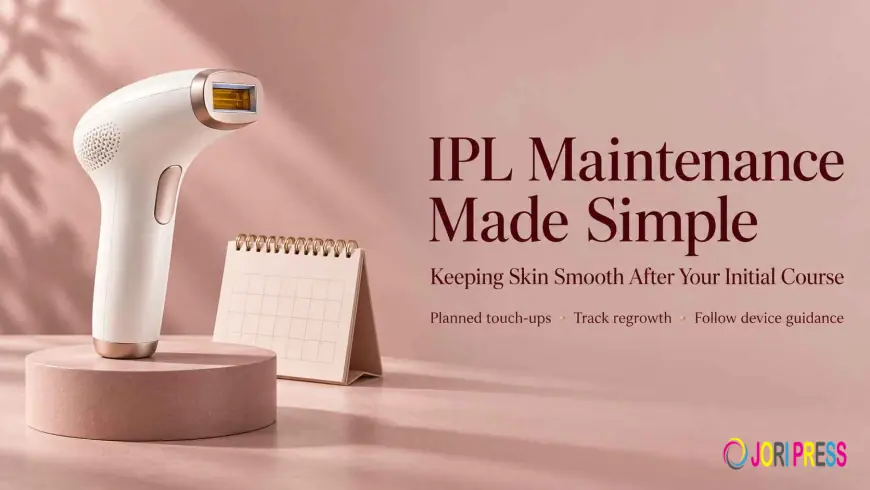
Completing an initial IPL treatment course can mark a shift from frequent sessions to a more manageable maintenance routine. Understanding this stage helps set realistic expectations about regrowth, touch-ups, and long-term care.
However, eight weeks is not a universal finishing point. Initial programs differ between devices, and individual responses vary. Maintenance should begin according to the specific model’s instructions and treatment progress, rather than automatically starting when the calendar reaches week eight.
For consumers comparing a hair removal device in Pakistan, maintenance requirements deserve attention before purchase. A useful device should provide clear guidance on the initial course, follow-up sessions, compatibility, and situations that require reassessment.
What Does IPL Maintenance Mode Mean?
In hair reduction, “maintenance mode” generally describes the follow-up stage after an initial treatment program. It does not necessarily mean the handset has a separate electronic setting called maintenance.
The initial course uses repeated sessions to address hairs at different stages of growth. Follow-up treatments aim to sustain the achieved reduction as regrowth appears or as the manufacturer’s schedule requires.
Some home IPL systems explicitly separate an initial phase from a touch-up phase. Those instructions are model-specific and should not be transferred to unrelated equipment.
Maintenance therefore concerns treatment planning. It should not be confused with changing the device to an acne or skin-rejuvenation function.
Why Can Hair Return After the Initial Course?
Hair follicles do not grow simultaneously. Some actively produce hair while others transition or rest, which helps explain why light-based reduction requires multiple treatments.
IPL uses filtered light absorbed by pigment in suitable hair. The resulting heat affects follicles, but treatment does not guarantee complete permanent removal of every hair. Long-lasting reduction and occasional regrowth can coexist.
Hormonal changes can also influence the appearance of new visible hairs over time. IPL addresses suitable hair rather than treating an underlying hormonal condition.
A few returning hairs do not automatically mean earlier progress has disappeared. The important comparison is with the original growth pattern, including density and grooming frequency.
What Changes Might Be Noticeable During Maintenance?
The maintenance stage should be assessed through practical observations rather than a promise of permanently hair-free skin.
Suitable users may notice longer intervals between shaving, fewer hairs in previously dense areas, or uneven regrowth that needs occasional attention. However, response can differ between body areas.
A useful record compares:
| Observation | What it helps assess |
|---|---|
| Time between shaving sessions | Whether grooming has become less frequent |
| Regrowth at the same interval after shaving | Changes under comparable conditions |
| Photographs with consistent lighting | Differences in visible density |
| Session dates and treated areas | Adherence to the prescribed routine |
| Skin reactions | Whether treatment requires review |
IPL hair removal before-and-after photographs are less informative when lighting, angles, or time since shaving differ substantially.
How Often Should Maintenance Treatments Be Scheduled?
There is no single interval suitable for every IPL hair removal device.
Some manufacturers prescribe regular touch-ups, while other instructions may depend on regrowth or the stage of the program. The manual should establish the interval and any permitted adjustments.
A person should not copy another brand’s monthly schedule or assume that professional laser appointment intervals apply to a household handset. Treatment parameters and supporting evidence differ.
More frequent use is not a reliable shortcut. Exceeding the specified treatment schedule does not necessarily improve results or accelerate progress.
If regrowth appears sooner than expected, the appropriate response is to review the instructions and seek support—not automatically add sessions.
Recheck Suitability Before Touch-Ups
Compatibility is not a one-time purchase decision. Skin condition, tanning, medications, and other circumstances can change between sessions.
For IPL hair removal for South Asian skin, the model’s permitted skin-tone range remains essential. Pakistani consumers have varied skin tones, and ethnicity alone cannot establish suitability.
Melanin in surrounding skin can absorb treatment energy, increasing the possibility of burns or pigmentation changes when treatment is unsuitable.
Before a maintenance session, users should review:
- Recent tanning or sun exposure.
- New medications or changes in medical circumstances.
- Irritation, broken skin, or an active skin problem.
- The device’s approved treatment areas.
- Any requirement to repeat patch testing.
A cooling feature does not override these restrictions. Uncertain eligibility should be resolved before further exposure.
How Should Skin Be Prepared Between Sessions?
Preparation should continue according to the manual even when treatments become less frequent.
Many light-based hair-reduction programs use shaving before treatment. Waxing, threading, or plucking can remove the hair targeted by the procedure, so permitted grooming methods and timing should be checked carefully.
The treatment area should also meet the manufacturer’s requirements concerning cleanliness, dryness, and skincare products.
Aftercare remains relevant during maintenance. Sun-protection instructions and restrictions on irritating products or activities should not be abandoned simply because the initial course is complete.
Previously uneventful sessions do not guarantee that every future session will be suitable under different conditions.
What Happens If a Maintenance Session Is Missed?
A missed touch-up does not automatically require restarting the entire initial program.
The correct response depends on the equipment’s instructions, the length of the interruption, and the amount of regrowth. Manufacturer support can clarify how to resume.
Doubling treatment frequency, delivering extra passes, or increasing intensity to “catch up” should not be assumed appropriate.
A practical approach is to record the missed session, review current compatibility, and resume only within the documented guidance. If the interruption is substantial, reassessment may be more useful than following an old schedule without checking.
Do Rejuvenation and Acne Modes Help Maintain Hair Reduction?
Additional functions should be evaluated separately.
Someone considering an IPL skin rejuvenation device should not assume that its rejuvenation setting replaces hair-reduction touch-ups. Each mode may involve different targets, parameters, eligibility criteria, and schedules.
Likewise, an IPL device for acne and hair removal should not be used as though both functions deliver interchangeable treatments.
The American Academy of Dermatology’s acne guidelines found insufficient evidence to develop recommendations for several procedures, including laser and light-based devices. An acne mode should therefore not be presented as a guaranteed solution or an enhancement to hair-reduction maintenance.
A multifunctional IPL device needs clear instructions for each advertised application.
When Does Regrowth Need Professional Assessment?
Occasional regrowth differs from a progressive increase in density or an unexpected spread of coarse hair.
A dermatologist should assess concerning changes, particularly when growth increases in treated or neighboring areas. Paradoxical hypertrichosis—an increase in hair growth associated with laser or IPL treatment—is an uncommon recognized complication.
Treatment should also stop if significant pain, blistering, burns, or unexpected pigmentation changes occur. Light-based cosmetic equipment can cause scarring and eye injuries as well as skin reactions.
Persistent disappointment despite following the prescribed program deserves review rather than indefinite exposure.
Building a Manageable Long-Term Routine
For anyone comparing a hair removal device in Pakistan, maintenance is best understood as informed follow-up care. It combines an appropriate schedule, consistent progress records, and repeated checks that treatment remains suitable.
GlowPro is one local option whose published guidance can be evaluated against these requirements. Whether choosing dedicated hair-reduction equipment or an IPL skin rejuvenation device, a sustainable routine depends on realistic expectations rather than a fixed promise of permanent smoothness.
FAQs
1. Does everyone begin IPL maintenance after eight weeks?
No. Initial treatment programs and individual responses differ. The specific device’s instructions should determine when the maintenance stage begins.
2. Does returning hair mean IPL failed?
Not necessarily. Some regrowth can occur after successful reduction. Changes in density and grooming frequency provide a more useful comparison than the presence of isolated hairs.
3. Can maintenance sessions be performed whenever stubble appears?
Only if that approach matches the manufacturer’s guidance. Visible stubble does not automatically justify another treatment before the permitted interval.
4. Should a higher intensity be used during maintenance?
Not automatically. Settings should follow the manual and current compatibility requirements. Stronger treatment should not be treated as a routine maintenance upgrade.
5. Can maintenance stop once the skin looks smooth?
Requirements vary. Some users need ongoing touch-ups to sustain reduction. The manufacturer’s instructions and individual response should guide the decision.
What's Your Reaction?
 Like
0
 Dislike
0
 Love
0
 Funny
0
 Angry
0
 Sad
0
 Wow
0