






































IP Camera in Delhi, Noida & NCR Which One Do You Actually Need?
Secureye outdoor network cameras with HD video, motion detection, night vision, and remote viewing. Ideal for 24/7 security at home, office, or any property.

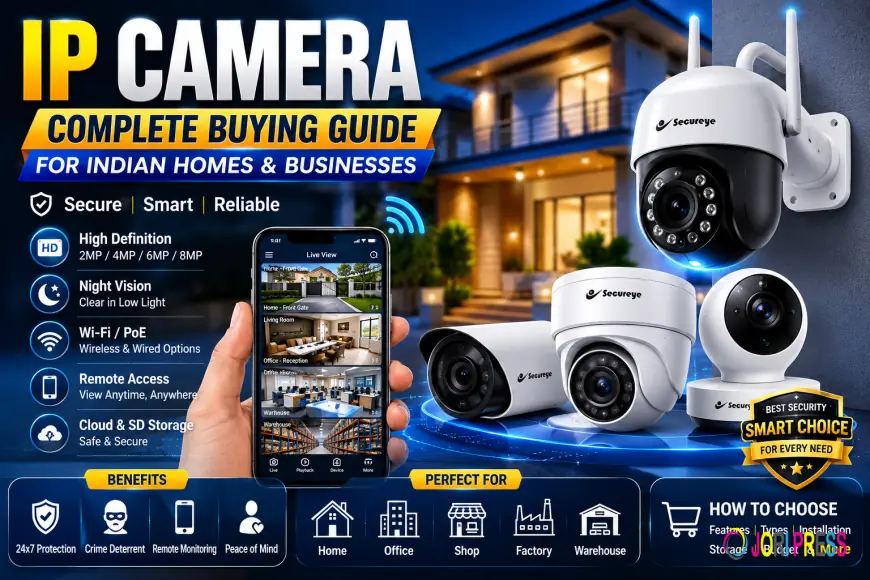
Walk into any electronics market in Delhi's Nehru Place, Noida's Sector 18, or Gurgaon's Sadar Bazar and you will find IP cameras from dozens of brands stacked on shelves all looking roughly similar, all claiming to be the best. The prices vary wildly. The specifications are confusing. And the person selling them often knows just enough to make the wrong recommendation sound convincing.
This guide cuts through that confusion. It is written for Indian buyers homeowners, factory managers, school administrators, warehouse operators, and small business owners who want to understand what an IP camera actually is, what the numbers on the box mean, and how to make a purchase they will not regret in six months.
What Is an IP Camera?
An IP camera Internet Protocol camera is a digital surveillance camera that captures video, compresses it inside the camera itself, and sends that compressed digital video over a network cable or Wi-Fi to a recording device or your smartphone. The word "Internet Protocol" refers to the communication standard used the same standard your laptop uses to connect to a website or send an email.
This is fundamentally different from a traditional CCTV camera, which sends an unprocessed analog video signal over a thick coaxial cable to a DVR box. An IP camera does the processing inside itself, sends clean digital data, and can be accessed from anywhere your phone, your laptop, your office desktop as long as the camera or its recorder is connected to the internet.
The practical result of this difference: IP cameras deliver sharper images, enable remote monitoring from anywhere in the world, support smart features like motion alerts and AI detection, and scale easily as your security needs grow. A traditional CCTV system does none of these things reliably.
How an IP Camera System Works
An IP camera system has four main components working together.
The camera captures video, processes it internally, compresses it using H.265 codec, and sends it over your network. The PoE switch or PoE NVR receives the camera's data and, in the case of PoE (Power over Ethernet), also sends power to the camera through the same single CAT6 cable eliminating the need for a separate power socket at every camera location. The NVR (Network Video Recorder) stores all camera footage on an internal hard drive. The mobile app or web interface gives you access to live and recorded footage from anywhere with an internet connection.
In smaller systems a home, a small shop, a single-floor office a PoE NVR with built-in ports handles everything. You plug cameras into the NVR, connect the NVR to your router, and the system is running. In larger deployments, cameras connect to a PoE switch that connects to a standalone NVR.
Why IP Cameras Are Replacing Traditional CCTV Across India
The shift is happening for practical reasons, not just technical ones.
Resolution is the most obvious reason. A standard analog CCTV camera maxes out at 720p 1280 × 720 pixels. An entry-level IP camera starts at 2MP Full HD (1920 × 1080) and goes up to 8MP 4K (3840 × 2160). The difference in actual footage quality is not subtle. Footage from an analog camera often cannot clearly identify a face beyond 3–4 metres. Footage from a 4MP IP camera can identify a face clearly at 15+ metres. For a business using camera footage to investigate a theft, verify a delivery, or dispute a claim this difference is everything.
Remote access is the second reason. Analog CCTV was designed to be watched in a security room on-site. An IP camera system is designed to be accessed from anywhere. A factory owner in Faridabad can check their production floor from a phone while travelling to Mumbai. A school principal in Greater Noida can watch the campus gate during an emergency from the comfort of their office in another building. A retail chain owner in Delhi can monitor all four of their branches from one app simultaneously.
Smart features are the third reason. IP cameras support motion detection, AI-based human and vehicle detection, line crossing alerts, and crowd detection features that turn a passive recording device into an active security tool. When a motion alert fires on your phone at 2 AM from your warehouse in Noida, you know before a guard even notices.
IP Camera vs Traditional CCTV Full Comparison
|
Feature |
IP Camera |
Analog CCTV |
|
Resolution |
2MP to 8MP (Full HD to 4K) |
720p or below |
|
Remote Access |
Yes smartphone from anywhere |
Very limited |
|
Night Vision |
IR up to 80m + colour night options |
Basic IR only |
|
Smart Alerts |
AI motion, human/vehicle detection |
None or basic |
|
Cabling |
CAT6 Ethernet lighter, multi-purpose |
Coaxial RG59 heavy, single-purpose |
|
Scalability |
Add cameras via network switch easily |
Limited by DVR channels and cable runs |
|
Storage |
NVR + HDD, expandable |
DVR, fixed capacity |
|
Data Security |
Encrypted digital stream |
Open analog signal |
|
Maintenance |
Firmware updates remotely |
Manual |
|
Long-Term Value |
High future-proof |
Low becoming obsolete |
The honest answer: for any new installation in India today, IP cameras are the right choice for virtually every application. The only genuine argument for analog CCTV is a lower upfront cost and even that gap has narrowed significantly as IP camera prices have dropped.
Understanding IP Camera Resolution Which MP Do You Need?
MP stands for megapixels. It is the single most important specification because it determines how much detail your camera captures and how far away it can clearly identify a face, a number plate, or an object.
2MP (Full HD 1080p) is the entry point. Clear, reliable, adequate for general indoor monitoring corridors, small shops, office interiors, home rooms. Falls short when you need to identify a face beyond 8 metres or read a vehicle registration plate.
4MP (1440p) captures exactly twice the detail of 2MP. One 4MP camera can effectively cover the same area as two 2MP cameras. This is the most practical choice for business entrances, warehouses, schools, and most outdoor applications. It is the resolution where price, performance, and storage consumption balance best for commercial use.
5MP gives higher facial clarity than 4MP and is often chosen for corporate offices, hotels, and locations where identification at medium distance is critical a reception area, a bank counter, a server room door.
6MP is designed for wide-area coverage. A single 6MP camera on a high mount can cover a large factory floor or an open outdoor area without losing detail at the frame edges. It is common in Faridabad's industrial belt and Manesar's manufacturing complexes.
8MP (4K Ultra HD) is evidence-grade. It captures detail that holds up in legal proceedings clear face identification at 25+ metres, readable number plates at distance, legible text on documents. Banks, jewellery showrooms, government facilities, and pharmaceutical plants use 8MP as their standard.
Types of IP Cameras
Bullet cameras are the most visible type cylindrical, forward-facing, usually mounted outdoors on walls or poles. Their visible presence acts as a deterrent. They typically have longer IR night vision ranges (50–80 metres) suited for outdoor perimeters, gates, and parking lots.
Dome cameras are discreet ceiling-mounted cameras with a rounded housing. The lens direction is not obvious to people in the room, making them harder to avoid or tamper with. They are the standard choice for indoor environments corridors, reception areas, retail floors, hospital waiting rooms.
PTZ cameras (Pan-Tilt-Zoom) are motorised cameras that can rotate, tilt, and zoom remotely. A 30× optical zoom PTZ camera can follow a person or vehicle across a large area one PTZ can replace 4–6 fixed cameras in a warehouse or campus setting. Common in Noida's IT parks and large industrial campuses.
Wireless IP cameras connect via Wi-Fi rather than Ethernet cable. Practical for homes, small offices, and any location where running a cable is not possible. Not recommended for large commercial installations where 24/7 reliability is critical.
Varifocal cameras have motorised zoom lenses (typically 2.8–12mm) that can be adjusted remotely after installation. Useful when the ideal field of view is uncertain at the time of installation parking lots, entrance gates, open areas.
AI cameras have a dedicated AI processor that performs video analytics on the camera itself human/vehicle classification, line crossing detection, crowd counting without depending on cloud processing.
Key Features That Matter in Real Use
WDR (Wide Dynamic Range) is essential for any camera facing a bright background a sunlit gate, a window, headlights at night. Without WDR, either the background washes out or the subject becomes a silhouette. With 120dB WDR, both are exposed correctly in the same frame. Non-negotiable for entrance cameras across Delhi-NCR.
IR Night Vision Range determines how far a camera sees in darkness. 30-metre IR is adequate for small gates and indoor areas. 50–80 metre IR is needed for large outdoor perimeters, parking lots, and industrial premises. All Secureye outdoor cameras include IR night vision.
PoE Support means one CAT6 cable carries both power and data to the camera. This simplifies installation significantly no separate power socket needed at each camera location. Secureye PoE NVRs have built-in PoE ports for plug-and-play camera connection.
H.265 Compression stores the same quality video in roughly half the space of older H.264. This doubles your effective storage capacity on the same hard drive. All Secureye cameras support H.265.
IP66 Weatherproofing is mandatory for any outdoor camera in India. IP66 means completely sealed against dust and resistant to powerful water jets it handles Indian monsoons, summer heat at 45°C+, and dusty winter conditions reliably.
ONVIF Compatibility ensures the camera works with any standard NVR you are not locked into one brand's ecosystem. All Secureye cameras are ONVIF-compliant.
Who Uses IP Cameras Across Delhi-NCR
Housing societies in Dwarka, Indirapuram, and Noida Extension use 4MP bullet cameras at gates for vehicle number plate capture, 2MP dome cameras in lifts and corridors, and PTZ cameras covering large parking compounds.
Factories in Faridabad and Manesar use face-detection AI cameras at entry points, PTZ cameras across production floors, and 6MP cameras at loading docks where wide-area detail is needed simultaneously.
IT companies in Noida Sector 62 and Gurgaon Cyber City use face biometric integrated with IP dome cameras for combined attendance and access control one device marks attendance and opens the door.
Retail chains across South Delhi, Lajpat Nagar, and Saket use 4MP cameras at cash counters and entry points, with AI loitering alerts at high-value display areas.
Schools in Greater Noida West and Rohini use 2MP dome cameras in corridors, 4MP bullet cameras at gates, and wide-angle cameras in assembly halls with motion alerts activated after school hours for after-dark intrusion detection.
Hospitals in Noida Sector 62 and Rohini use discreet dome cameras in corridors and waiting areas with encrypted feeds, high-resolution cameras at pharmacy storage, and PTZ for parking.
How to Choose the Right IP Camera System
Step 1 Map your locations. Walk every area that needs coverage. List each camera point, the distance to the farthest subject you need to identify, the lighting conditions, and whether it is indoors or outdoors.
Step 2 Match resolution to identification need. Face at 5 metres 2MP. Face at 15 metres or number plates 4MP. Face at 25 metres or evidence-grade footage 8MP.
Step 3 Choose camera type. Outdoor perimeter bullet. Indoor ceiling dome. Large open area PTZ. Home without cabling wireless.
Step 4 Calculate storage. Approximate rule: 4 cameras at 4MP, H.265, 15fps, 24/7 recording = 1TB per week. A 2TB drive gives 14 days. Choose NVR size one step above current camera count to leave room for expansion.
Step 5 Plan your network. Use CAT6 cable for all wired runs. Maximum 100 metres per cable run. Use a PoE NVR for small systems. Add a PoE switch for larger deployments.
Step 6 Verify compliance if required. Government and banking installations need STQC-certified cameras. Secureye cameras meet STQC and BIS compliance requirements.
Frequently Asked Questions
Do IP cameras need internet to record? No. IP cameras record to a local NVR without internet. Internet is only needed for remote access on your phone or laptop from outside the premises. Cameras continue recording normally during internet outages.
What is the difference between an NVR and a DVR? A DVR works with analog CCTV cameras via coaxial cable. An NVR works with IP cameras via Ethernet. If you are installing IP cameras, you need an NVR. The two systems are not interchangeable.
Can I mix different camera resolutions on one NVR? Yes. Most NVRs support cameras of different resolutions on the same system. This is recommended use 4MP or higher at critical points and 2MP for general areas to balance quality with storage.
How many days of footage does a 2TB hard drive store? With 4 cameras at 4MP, recording at 15fps using H.265, a 2TB drive stores approximately 14 days of continuous footage. Higher resolution or frame rate reduces this. More cameras reduce it proportionally.
What is PoE and do I need it? PoE (Power over Ethernet) sends both power and network data over one CAT6 cable to the camera. It eliminates the need for a separate power socket at every camera location. Secureye PoE NVRs have built-in PoE ports recommended for all wired installations.
Are IP cameras safe from hacking? When properly configured, yes. Always change the default password on first setup. Keep firmware updated. Use HTTPS for remote access. For commercial installations, put cameras on a network segment separate from general office Wi-Fi.
Which cable should I use for IP cameras? Always use CAT6 cables. They support Gigabit speeds and full PoE power at runs up to 100 metres. Do not use old CAT5 or coaxial cable for IP camera installations.
Why Secureye for IP Camera Systems
What separates a reliable IP camera system from one that causes problems within a year is not usually the camera specification it is the sensor quality behind those specs, the compression reliability, the firmware support, and critically, what happens when something goes wrong.
Secureye IP cameras are engineered and assembled in India designed for Indian voltage conditions, Indian climate extremes (45°C summers, heavy monsoons, dusty winters), and Indian infrastructure realities. They carry STQC and BIS compliance certifications. They are backed by a PAN-India authorised dealer and service network spanning Delhi, Noida, Gurgaon, Faridabad, Ghaziabad, Greater Noida, and every major city and tier-2 town across India.
A 1-year manufacturer warranty on every product. Firmware updates throughout the product's life. Technical support via toll-free at 1800-1022-366. And the assurance that comes from a brand with 20+ years supplying security solutions to Indian homes, businesses, institutions, and government agencies.
Toll-Free: 1800-1022-366 Mobile: 94009-40039 Email: info@secureye.com
The most common question buyers ask when starting with IP cameras is: "Is 2MP enough?" The honest answer is for a lot of situations, yes. For others, no. And the difference between the right answer and the wrong one is understanding exactly what 2MP footage looks like in practice and what it cannot do.
A 2MP IP camera captures video at Full HD resolution 1920 × 1080 pixels. This is the same resolution as a standard HD television channel. It is sharp, clear, and produces footage that is significantly better than any analog CCTV camera you may be replacing. You can identify a person's face clearly at distances up to 6–8 metres. You can read signage, see what someone is carrying, and track movement across a monitored area.
What 2MP does not do well: identify a face clearly beyond 8–10 metres. Read a vehicle number plate from across a parking lot. Provide enough detail to zoom into a recording and still have a usable image. For those requirements, 4MP or above is the correct choice.
Where 2MP IP Cameras Work Perfectly
The majority of indoor surveillance scenarios in Indian homes, offices, and small businesses fall comfortably within 2MP capability.
A small retail shop in Lajpat Nagar or Sector 18 Noida needs to see who is at the entrance, monitor the cashier counter, and keep an eye on the storage area. The distances involved are typically 3–6 metres. A 2MP camera covers all of this without any compromise in useful image quality.
A corridor in a residential society in Dwarka or Indirapuram, a stairwell in an office building in Connaught Place, the inside of a lift, a reception desk, a school classroom, a hospital waiting room all of these are environments where the subject is close, the area is contained, and 2MP delivers everything you need.
For home installations monitoring your front door from inside, watching the drawing room while you are at work, keeping an eye on the baby's room 2MP wireless IP cameras are the standard choice. They are affordable, easy to install, and the app access is simple enough that anyone in the family can use it.
2MP IP Camera Specifications to Look For
When comparing 2MP cameras, resolution is the starting point not the end. These are the specifications that determine real-world performance.
-
Sensor size A larger CMOS sensor collects more light. Better low-light performance means usable footage in dim corridors and poorly lit rooms without needing IR to kick in during the day
-
IR night vision range 20 to 30 metres is standard for indoor 2MP cameras. Outdoor 2MP cameras should have at least 30–40 metres of IR range
-
WDR Needed for any camera facing a window or a bright background. Without WDR, subjects near a bright light source become silhouettes
-
H.265 support Ensures your 2MP footage takes up minimum storage. A 2MP camera on H.265 uses roughly half the storage of a 2MP camera on H.264
-
PoE or 12V adapter PoE is cleaner for permanent installations; 12V adapter is common for simple home setups
-
IP66 rating Required for any outdoor 2MP camera installation
How Much Storage Does a 2MP IP Camera Use?
At 2MP resolution, 15fps, with H.265 compression, a single camera uses approximately 8–10 GB per day of continuous recording. For a 4-camera system recording 24/7, that is roughly 320–400 GB per week. A 1TB hard drive gives you approximately 15–18 days of retention from a 4-camera 2MP system.
This low storage consumption is one of the genuine practical advantages of 2MP cameras. For small businesses with tight storage budgets or for locations where only a short retention window is needed, 2MP cameras are a storage-efficient solution.
When to Upgrade from 2MP to 4MP
If any of these apply to your installation, choose 4MP instead of 2MP:
-
The camera needs to clearly identify faces or read number plates beyond 8 metres
-
The camera covers a wide outdoor area like a parking lot, a gate, or a building perimeter
-
You need to digitally zoom into recorded footage and still have usable detail
-
The location is an entrance, a loading dock, or any point where identification is security-critical
-
Evidence-quality footage is a requirement for legal, compliance, or insurance purposes
For everything else general indoor monitoring, small shop coverage, home rooms, corridors 2MP is a practical, cost-effective, reliable choice.
Is 2MP good enough for a small shop? For a small shop where the camera is covering an area within 5–8 metres cashier counter, entrance, stockroom 2MP is absolutely adequate. You will clearly see faces, movement, and activity. If you need to monitor from across a large showroom floor or identify people at the entrance from a distance, consider 4MP for those specific cameras.
How far can a 2MP camera see clearly? At 2MP with a standard 3.6mm lens, you can identify a face clearly up to approximately 6–8 metres. Beyond that, faces become less distinct. For longer distances, 4MP or higher is recommended.
Can 2MP cameras record in colour at night? Standard 2MP cameras with IR LEDs record in black and white at night. Secureye's 2MP Starlight series cameras can capture colour footage in very low light using their ultra-sensitive sensors. For full-colour night vision, Secureye's Dual Light 2MP cameras add white LEDs that activate when motion is detected.
How many 2MP cameras can I connect to a 1TB drive? Approximately 4 cameras recording continuously at 15fps on H.265 for 15–18 days. If you record at lower frame rates or use motion-triggered recording only, retention extends significantly.
If there is one resolution that experienced security installers across Delhi-NCR recommend most consistently for commercial applications, it is 4MP. Not 2MP because businesses usually need more coverage and detail than 2MP provides at anything beyond close range. Not 8MP because that level of resolution adds storage and cost that most businesses do not need at every camera location. 4MP is where the balance is
A 4MP IP camera records at 2560 × 1440 pixels exactly twice the pixel count of a 2MP Full HD camera. That doubling of pixels translates directly into real-world capability: you can identify a face clearly at 12–15 metres instead of 6–8 metres. One 4MP camera can effectively cover the same area as two 2MP cameras from the same mounting point. You can zoom into recorded footage and still have usable detail. Number plate reading at gate distances becomes reliable.
Why 4MP Has Become the Commercial Standard
A factory in Noida's Phase 2 industrial area with 150 workers needs cameras at entry gates that can clearly capture every face entering and leaving. A 2MP camera at that gate will show people arriving but will not give you reliable face identification from the distance a gate camera typically operates. A 4MP camera will.
A warehouse in Kundli Industrial Area needs cameras covering loading docks where trucks enter and exit. You need to read vehicle number plates, see what is being loaded and unloaded, and have clear footage if a discrepancy arises. A 4MP camera with a varifocal lens delivers all of this. A 2MP camera does not.
A corporate office campus in Gurgaon's Cyber City needs lobby cameras that can capture visitor faces clearly from the reception desk across a wide open atrium. The distances involved in a large lobby 10 to 15 metres put 2MP at its limit. 4MP handles it comfortably.
In each of these situations, 4MP is not a luxury over 2MP. It is the resolution that makes the camera actually useful for what it is being asked to do.
4MP vs 2MP What the Difference Actually Looks Like
The mathematical relationship is straightforward: 4MP captures 4 million pixels per frame vs 2MP's 2 million. But what does that mean in practice?
At 4MP, a camera with a 3.6mm lens covering a typical gate or entrance can clearly identify a person's face at 12–15 metres. At 2MP with the same lens, that clear identification range drops to 6–8 metres. In a warehouse, factory gate, or school entrance where the camera might be mounted 3–4 metres high and the entrance is 8–12 metres wide this difference is the margin between a camera that provides usable identification and one that does not.
Digital zoom is the other practical difference. When you zoom into 4MP recorded footage in a video player or NVR interface, you have twice as many pixels to work with as a 2MP recording. The detail you can extract from a zoomed-in 4MP frame is significantly better. When footage is used to investigate an incident identifying a vehicle, confirming whether someone was carrying something, reading a label that extra detail matters.
Where 4MP IP Cameras Are the Right Choice
Across Delhi-NCR, 4MP cameras are the standard recommendation for:
Entrance gates at housing societies in Dwarka, Rohini, Noida Extension, and Gurgaon sectors where the camera needs to capture both faces and vehicle number plates reliably from distances of 8–15 metres.
Loading docks and warehouse entrances in Faridabad's industrial areas, Kundli, and Manesar where vehicle identification and cargo monitoring both matter and footage may be used for inventory dispute resolution.
School gates and campus perimeters in Greater Noida West, Indirapuram, and South Delhi where the camera is the first and most critical layer of campus security.
Large retail floors in malls and standalone stores across NCR where AI analytics are used for queue monitoring, loitering detection, and loss prevention, all of which require clear face visibility across larger floor areas than 2MP handles well.
Office building lobbies and reception areas where visitor identification is a daily security requirement in Noida Sector 62, Gurgaon Cyber City, and similar corporate environments.
4MP Camera Types and When to Use Each
A 4MP bullet camera is the standard outdoor choice weather-sealed, long IR range (typically 40–60 metres), forward-facing. Ideal for gates, perimeters, parking lot coverage, and any outdoor application.
A 4MP dome camera is the indoor standard discreet, tamper-resistant, ceiling-mounted with a wide-angle view. Used in lobbies, corridors, retail floors, and any indoor area where aesthetics and coverage angle matter.
A 4MP varifocal camera (with a motorised 2.8–12mm lens) gives you the flexibility to adjust the zoom level remotely after installation. Essential for locations where you are not certain of the ideal coverage distance at installation time or where requirements may change.
A 4MP AI camera adds a dedicated AI processing chip that runs human and vehicle detection on the camera itself, sending intelligent alerts rather than just recording. Increasingly the standard choice in commercial applications where real-time alerts matter.
Storage Calculation for 4MP Cameras
At 4MP, 15fps, H.265 compression, one camera uses approximately 15–18 GB per day of continuous recording. For a 4-camera system recording 24/7:
-
1TB drive = approximately 13–16 days of footage
-
2TB drive = approximately 26–32 days of footage
-
4TB drive = approximately 52–60 days of footage
For most small to medium businesses, a 4-channel PoE NVR with a 2TB drive is the practical starting configuration, giving 4 cameras and approximately 30 days of retention.
Is 4MP worth the extra cost over 2MP? For any camera covering distances beyond 8 metres, monitoring an entrance, or needing to provide identification-quality footage yes, absolutely. The storage difference is modest (roughly 60–70% more than 2MP on H.265), and the capability difference is significant. For a camera in a small enclosed indoor space where the subject is always within 5 metres, 2MP may be adequate.
Can 4MP cameras read number plates? Yes, reliably at gate distances (5–15 metres) when the camera is properly positioned (low angle, facing the plate directly) and has adequate lighting or WDR. For longer distances or high-speed vehicles, a dedicated 4K ANPR camera is more appropriate.
How far can a 4MP camera see clearly? With a standard 3.6mm lens, clear face identification at 12–15 metres. With a varifocal lens set to a narrower field of view, effective identification range extends to 20–25 metres. IR night vision on outdoor 4MP cameras typically reaches 40–60 metres.
Will 4MP cameras work with my existing NVR? If your NVR is ONVIF-compatible and has sufficient channel bandwidth, yes. Older 4-channel DVRs designed for analog CCTV will not work you need an NVR. Secureye NVRs are designed to work with Secureye 4MP cameras out of the box, with full feature support including AI analytics and remote access.
The 5MP IP camera sits in an interesting position in the market not as widely discussed as 2MP or 4MP, but chosen by buyers who have a specific requirement: more detail than 4MP can reliably deliver, without jumping all the way to 8MP and its associated storage and cost implications.
A 5MP camera records at 2592 × 1944 pixels. This is 25% more detail than 4MP and more than 2.5 times the detail of a standard 2MP Full HD camera. The additional pixels mean sharper face identification at medium distances, better digital zoom capability in post-recording review, and more detail at the edges of wide-angle shots.
The environments where 5MP earns its place are specific: corporate reception areas where visitor identification from a distance is a daily requirement, hotel corridors and lobbies where the footage may need to support insurance or legal claims, server rooms and data centre access points where footage is a compliance requirement, ATM vestibules and bank branch interiors where absolute clarity is non-negotiable.
Where 5MP Makes a Genuine Difference Over 4MP
In most everyday commercial applications, the difference between 4MP and 5MP footage is noticeable but not dramatic. The scenarios where it becomes genuinely meaningful are those where footage is likely to be reviewed closely for investigation, for compliance, or for legal purposes.
A corporate office in Noida's Sector 132 with 400 employees and daily visitor traffic needs lobby cameras that can serve double duty: real-time security monitoring and post-event investigation when needed. At 4MP, the lobby camera captures faces clearly up to 12–15 metres. At 5MP, that range and clarity extends further, and the detail available when zooming into recorded footage is measurably better.
A hotel in Gurgaon's Golf Course Road corridor needs corridor cameras that may need to show months after installation exactly who was in which corridor at what time. The footage may be reviewed by management, by legal teams, or by police. In that context, the additional clarity of 5MP over 4MP is not a technical footnote. It is the difference between footage that clearly supports a claim and footage that leaves room for ambiguity.
5MP Camera Specifications
A 5MP camera should be evaluated on the same factors as any IP camera, with these resolutions-specific considerations:
At 5MP, a camera uses approximately 20–25 GB per day of continuous recording at 15fps with H.265. For a 4-camera system, a 2TB hard drive provides approximately 18–22 days of retention. Storage planning is slightly more demanding than 4MP but significantly less demanding than 8MP.
The lens choice becomes more important at 5MP. A fixed 3.6mm lens on a 5MP camera gives you wider coverage useful for large indoor areas. A varifocal 2.8–12mm lens on a 5MP camera gives you adjustable focus that can be tuned after installation, which matters when precise coverage is important.
Is 5MP significantly better than 4MP? At the same viewing distance, 5MP provides approximately 25% more detail. In typical monitoring use, the difference is noticeable on close review of footage. In high-stakes environments where footage is likely to be examined carefully the additional clarity is worth the modest extra cost and storage.
Who should choose 5MP over 4MP? Corporate offices needing high visitor identification clarity, hotels and hospitality venues, bank branches, pharmaceutical companies with compliance requirements, and anyone who anticipates footage being reviewed carefully for legal or regulatory purposes.
How far can a 5MP camera identify a face? With a standard 3.6mm lens, reliable face identification at 15–18 metres. With a varifocal lens at tighter zoom, this extends to 20–25 metres. Night vision range on outdoor 5MP cameras typically reaches 40–60 metres IR.
There is a specific surveillance problem that 6MP cameras are designed to solve, and it comes up most often in large open spaces: how do you cover a wide area with a single camera and still have enough detail at the edges to identify what is happening?
A factory floor in Faridabad's industrial belt. A large warehouse in Kundli. An open parking structure in a mall in Noida. A college campus ground in Greater Noida. These are spaces where a 2MP or even a 4MP camera mounted at a central high point gives you wide coverage but when you zoom in to the edges of that coverage area, the detail falls apart.
A 6MP camera records at 3072 × 2048 pixels 50% more detail than 4MP. When mounted high with a wide-angle lens to cover a large floor or open area, that extra pixel density means the edges of the frame retain enough detail to be useful. You can identify a person at the far end of a large warehouse floor. You can read a vehicle's number plate at a multi-lane gate. You can review footage from a factory floor incident and have enough detail across the full frame to reconstruct what happened where.
Industries Where 6MP IP Cameras Are the Standard Choice
Large manufacturing plants and factory floors across Faridabad, Manesar, and Noida's industrial sectors use 6MP cameras on high ceiling mounts to cover entire production bays. One camera placed correctly can cover what would require two or three 4MP cameras reducing total camera count, cabling cost, and NVR channel usage.
Warehouses and logistics hubs in Kundli, Ghaziabad's Sahibabad area, and along NH-48 in Gurgaon use 6MP cameras at loading dock monitoring points, where the camera needs to simultaneously cover the full width of a dock area and provide detail on individual boxes, vehicle number plates, and worker faces.
Multi-lane entrance gates in large industrial parks and residential communities use 6MP cameras to cover multiple vehicle lanes simultaneously while retaining enough detail for number plate reading across all lanes.
Large open retail spaces hypermarkets, furniture showrooms, large format stores use 6MP cameras to cover wide floor areas from ceiling mounts without the need for as many camera positions.
What is the advantage of 6MP over 4MP in a warehouse? At 6MP, a single camera covers 50% more pixels than a 4MP camera. On a high ceiling mount covering a large warehouse floor, this means the same camera provides usable detail at greater distances and at the edges of the frame allowing you to cover a larger area with fewer cameras while maintaining identification quality throughout.
How much storage does a 6MP camera use? At 15fps, H.265 compression, continuous recording, approximately 25–30 GB per day per camera. A 4-camera 6MP system on a 4TB drive gives approximately 30–35 days of retention.
Is 6MP suitable for outdoor use? Yes. Outdoor 6MP cameras with IP66 weatherproofing are available. For large outdoor areas industrial yards, large parking structures, open perimeters 6MP provides excellent wide-area detail. IR night vision on outdoor 6MP cameras typically reaches 40–60 metres.
There is a threshold in surveillance footage quality where the image shifts from "useful record" to "definitive evidence." Below that threshold, footage shows that something happened and roughly who was involved. Above it, footage shows exactly what happened, precisely who was involved, and leaves no room for doubt.
An 8MP 4K IP camera operates well above that threshold.
At 3840 × 2160 pixels, a 4K IP camera captures four times the detail of a 2MP Full HD camera. In practical terms: you can identify a face clearly at 25+ metres. You can read a vehicle number plate from across a large parking lot. You can zoom into a recorded frame and still have enough pixels to read text on a document, identify a badge number, or confirm exactly what someone was carrying.
This is not surveillance for general monitoring. It is surveillance for situations where the footage itself is the evidence and where the clarity of that evidence determines outcomes.
Where 8MP 4K IP Cameras Are the Professional Standard
Banks and ATM installations across Delhi, Noida, and Gurgaon use 8MP cameras at ATM vestibules and branch interiors. The RBI's guidelines on bank surveillance quality, combined with the evidentiary requirements when footage is used in fraud investigations, make 4K the standard at any location where financial transactions occur.
Jewellery showrooms in Karol Bagh, Chandni Chowk, and across NCR use 8MP cameras at display counters and vaults. When a high-value dispute arises and in a jewellery business, the value at stake is always significant the footage needs to be definitive. An 8MP camera provides footage that is.
Government facilities and critical infrastructure secure office complexes, data centres, border areas, strategic installations use 8MP cameras both for the resolution and for the STQC-certified encryption that Secureye's 8MP cameras provide, satisfying government procurement requirements.
Pharmaceutical manufacturing plants with strict GMP (Good Manufacturing Practice) compliance requirements use 8MP cameras to document production processes footage that may be reviewed by regulatory auditors and must show clearly what happened at each stage of production.
High-value warehouses and logistics hubs storing electronics, pharmaceuticals, or other high-value goods use 8MP cameras at entry/exit points and critical storage areas. When a high-value discrepancy arises, 4K footage that can read pallet labels, confirm exact container contents, and identify every individual involved in a loading or unloading event is the difference between a resolved and an unresolved claim.
The Storage Reality of 8MP 4K Cameras
4K footage is large. At 8MP, 15fps, H.265 compression, one camera uses approximately 40–50 GB per day of continuous recording. For a 4-camera 8MP system recording 24/7:
-
2TB drive = approximately 9–11 days
-
4TB drive = approximately 18–22 days
-
8TB drive = approximately 36–44 days
For most 4K deployments, a 4TB or 8TB drive per NVR is the practical minimum for useful retention. Secureye NVRs support drives up to 10TB per bay.
One important note: not every camera in a system needs to be 8MP. The most cost-effective approach for most businesses is to use 8MP at the critical points entrance gates, cash counters, vault access, dock entry and 4MP or 2MP for general monitoring areas. This gives you 4K clarity where it matters most while keeping storage and cost manageable overall.
What Makes an 8MP Camera Actually Good
At 8MP, the resolution specification is consistent across products. What is not consistent is the quality of the sensor, the lens, the compression algorithm, and the low-light performance all of which determine whether that 8MP resolution is genuinely useful in real conditions.
A high-quality 8MP sensor with a large aperture lens will produce sharp, detailed 4K footage in low light. A cheap 8MP sensor will produce technically 4K footage that is noisy and blurry in anything less than perfect lighting. The specification sheet looks identical. The footage does not.
Low-light performance is particularly important for 8MP cameras used at entrances and gates where the lighting changes dramatically between day and evening. WDR capability at 120dB or above is essential for any 8MP camera facing a lit background during evening hours. IR night vision range of 40–60 metres minimum for outdoor 8MP cameras.
Is 8MP really necessary for a business? Not for every camera in a business but for specific, high-stakes locations, yes. ATM vestibules, cash counters, vault access points, entrance gates where number plate reading is required, and any location where footage will be used as primary legal evidence. For general monitoring elsewhere in the same premises, 4MP is the better balance.
How much storage does a 4K system need? A 4-camera 8MP system recording 24/7 at H.265 needs approximately 4TB for 20–25 days of footage. For 30-day retention, plan for 6–8TB. Use surveillance-grade hard drives (Seagate SkyHawk or WD Purple equivalent) standard desktop drives are not designed for continuous write cycles.
Can 8MP cameras read number plates? Yes, very reliably at gate distances. An 8MP camera can read number plates clearly at 20–30 metres in good lighting. At night with IR or white-light supplementation, reliable reading at 15–20 metres. For dedicated ANPR on high-speed roads or very long distances, a specialised ANPR camera is recommended.
Will an 8MP camera work on an existing NVR? Only if the NVR supports 4K resolution on that channel. Many older NVRs designed for 2MP or 4MP cameras will not correctly process 8MP streams. Verify NVR compatibility before purchasing 4K cameras. Secureye NVRs are designed to support 4K cameras with full H.265 processing.
Do 8MP cameras have AI features? Yes. Secureye's 8MP AI cameras include human and vehicle detection, line crossing alerts, and intrusion detection running on an onboard AI processor the same smart features available on lower-resolution models, with the added benefit of 4K clarity in the detected footage.
visit our site:-secureye.com/products/ip-camera
What's Your Reaction?
 Like
0
Like
0
 Dislike
0
Dislike
0
 Love
0
Love
0
 Funny
0
Funny
0
 Angry
0
Angry
0
 Sad
0
Sad
0
 Wow
0
Wow
0