








































Inside NorAI, Every Feature Powering This Quranic Arabic Learning App
A full breakdown of NorAI's Quranic Arabic learning features, from its 20 level curriculum to scholar reviewed content and offline access.

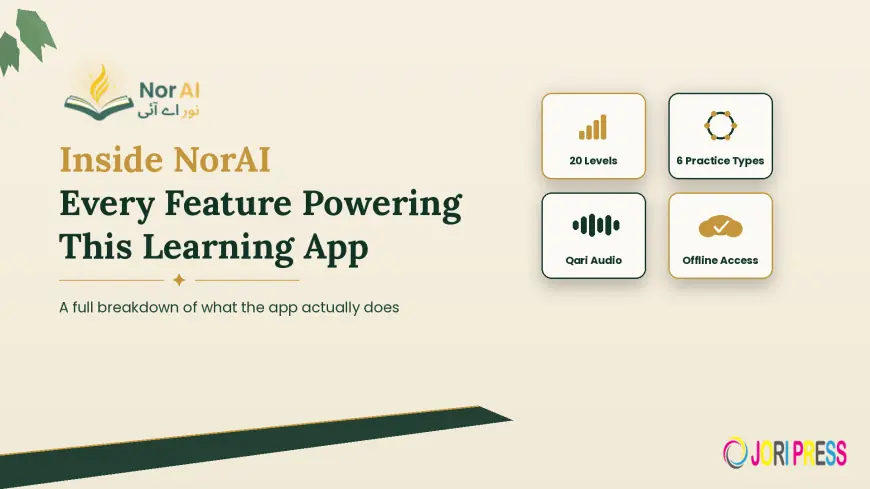
Most language learning apps borrow the same basic playbook. Bite sized lessons, repetition, and progress tracking. What's interesting about NorAI is watching that playbook applied specifically to Quranic Arabic, a classical language with no casual conversational use, learned by people ranging from five year olds to grandparents revisiting prayers they memorised decades ago.
Here's a full breakdown of what the app actually does, based on its published feature set.
A 20 Level Structured Curriculum
The core of NorAI is a curriculum spread across 20 levels, moving from Arabic letter recognition through to word patterns and connected phrases. Each level is designed to build on the one before it. Letters come first, then individual words, then relationships between words, so learners aren't asked to recognise sentence structure before they can recognise the letters inside it.
One Lesson, Six Practice Types
Rather than teaching a word once and moving on, each lesson cycles a word through six different practice formats.
Visual Learning pairs words with clear images that reinforce meaning. Articulation Practice shows visual guidance for how each Arabic letter's sound is physically formed. Audio Practice lets learners hear a word recited and repeat it, training listening and pronunciation together. Writing Practice offers step by step guided tracing for handwriting retention. Match Quiz asks learners to pick the correct image for a given word, testing recall under light quiz pressure. Word Joining is introduced at Level 16, where learners combine letters and word parts into complete Quranic words.
The logic here mirrors general language app design. The same word, approached from six different angles, is more likely to stick than the same word repeated six times in one format.
Four Stages Every Word Moves Through
Zooming out from individual practice types, every word a learner encounters moves through four broader stages. Learn the Word covers visuals plus audio. Connect the Meaning links the word to its definition. Practise Recognition has learners matching, listening, and working with it actively. Review What You Learned resurfaces older words over time so they don't fade.
Recitation From a Qualified Qari
Every word in the app includes audio recitation from a qualified Qari rather than synthetic text to speech. This detail matters given how central correct pronunciation is to how the Quran is engaged with in the first place.
Noor, a Progress Indicator That Skips the Gamification
Instead of streaks, leaderboards, or point systems common in language apps, NorAI uses something it calls Noor. It's an animated light that brightens with consistent practice and dims quietly during breaks. There are no penalties for missing a day and no competitive comparison between users. The company describes it as reflecting engagement rather than performance, a deliberate departure from the streak anxiety mechanics common in mainstream learning apps.
Tracking Completion and Mastery as Two Separate Things
One of the more technically interesting design choices is tracking two distinct things separately. Lesson completion means a learner finished the activity and answered correctly. Word mastery means the learner still remembers that word later, unprompted. The app treats these as genuinely different signals rather than collapsing them into a single progress bar. Completion shows movement while mastery shows retention.
A Family Dashboard With Room for Four Profiles
For households with more than one learner, NorAI supports up to four child profiles under a single account, each tracked separately. Parents get a weekly summary of what was learned, a completion versus mastery breakdown per child, and a PIN gated settings area so billing and account controls stay out of reach of younger learners during a session.
Built to Work Offline First
Once a level is downloaded, lessons, audio, and practice activities function without an internet connection, with progress syncing automatically once connectivity returns. This is a practical design choice for a global user base where reliable data access can't always be assumed.
Scholar Review Built Into the Structure
Every word and lesson goes through review by qualified Islamic scholars before release, and the app explicitly states it does not provide tafseer, fatwa, or AI generated religious interpretation. Vocabulary and recognition are the scope, while deeper interpretation is left to qualified scholarship elsewhere. According to the company, once content is approved it isn't silently edited. Any correction requires a new review cycle.
Available in Ten Interface Languages
The app interface itself is available in ten languages, including Arabic, English, Urdu, Hindi, Persian, Dari, Pashto, French, Spanish, and Chinese. The Quranic Arabic learning content is currently offered in English, Urdu, Pashto, and Dari.
Where NorAI Positions Itself in the Market
NorAI's own positioning is direct about what it isn't. It doesn't teach Tajweed, the technique of correct recitation, which the company says still requires a qualified teacher. The stated differentiator is narrower and more specific. It's about helping learners know what they're already reciting, rather than teaching them to recite it, or interpreting it for them.
For a product operating in a sensitive, faith based space, that kind of explicit scope limiting, repeated consistently across its features page, FAQ, and safety documentation, is arguably as notable as any individual feature on the list.
Questions People Often Ask About NorAI
Does NorAI teach Tajweed or recitation?
No. NorAI focuses on Quranic Arabic vocabulary and understanding. It helps learners know what they are reciting rather than how to recite it, and Tajweed is left to qualified teachers.
Can NorAI be used without an internet connection?
Yes. Once a level is downloaded, all lessons and practice can be completed offline, and progress syncs automatically once the device reconnects.
How is NorAI different from other Quran learning apps?
It focuses on understanding rather than memorisation alone, teaching Quranic Arabic step by step so learners can connect meaning with what they already recite.
How much daily time does NorAI recommend?
Short, consistent sessions work best, with the company suggesting even ten to fifteen minutes a day supports long term retention.
Is NorAI available in languages other than English?
Yes. The interface supports ten languages including Arabic, Urdu, Hindi, Persian, Dari, Pashto, French, Spanish, and Chinese, while learning content itself is currently offered in English, Urdu, Pashto, and Dari.
A Feature Set Built Around a Narrow, Clearly Stated Goal
What stands out across all of this is how consistently NorAI repeats its own limits. It teaches words, not rulings. It builds recognition, not recitation technique. In a space where it would be easy for an app to quietly expand its scope, NorAI's features, FAQ, and safety pages all point back to the same narrow claim, helping people understand the words of the Quran they already recite every day.
Source : norai.app
What's Your Reaction?
 Like
0
Like
0
 Dislike
0
Dislike
0
 Love
0
Love
0
 Funny
0
Funny
0
 Angry
0
Angry
0
 Sad
0
Sad
0
 Wow
0
Wow
0