





































How to Know if Your Yoga Posture Is Actually Correct When Practicing from Home
Not sure your yoga poses are right? Learn why mirrors and videos fall short, simple self-checks to try at home, and how live online feedback helps.
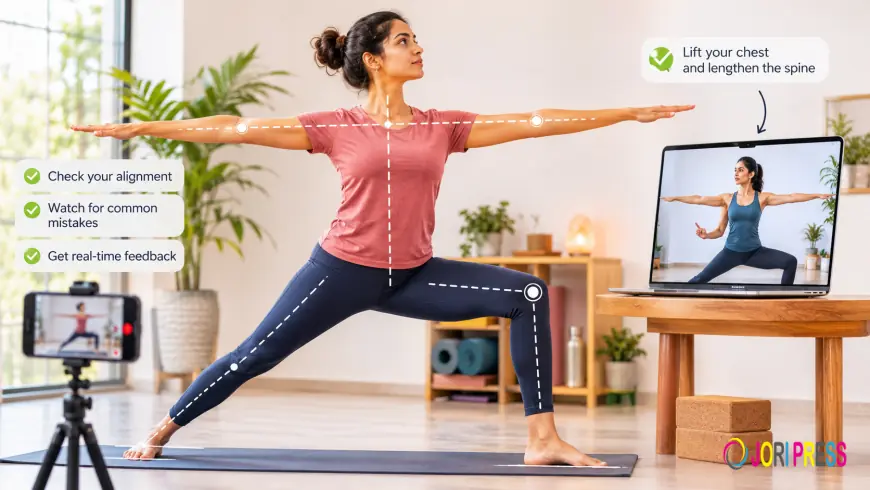
You roll out the mat, follow a video, and hold the pose for the full count. Then a quiet question shows up: is this actually right? Nobody is watching. Nothing hurts, but nothing feels clearly "correct" either. If that doubt sounds familiar, you are not being overly critical. Most people who practice alone run into it sooner or later.
Why You Can't Trust the Feeling from the Inside
The trouble starts with how posture is sensed. Your body reports effort and stretch, but it is a poor judge of position. A shoulder can feel level while it hikes toward your ear. A knee can feel "fine" while it caves slightly inward. Habits you have carried for years feel like neutral ground, so a misaligned pose often feels perfectly normal to you.
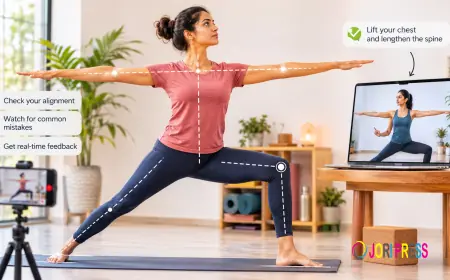
That is why self-assessment tends to fail even for committed students. You are comparing a pose you cannot see against a picture in your head that may itself be incomplete. This is where online yoga classes with live feedback change the equation: a trained teacher watches you in real time, spots what you cannot feel, and tells you what to adjust while you are still in the posture, not days later.
Before you decide whether you need that kind of support, it helps to understand what the usual home-practice shortcuts can and cannot tell you.
The Mirror Trap and the Pre-Recorded Video Problem
A mirror seems like the obvious answer, and it does help with some things. But the moment you turn your head to look at yourself, you change the pose. In a twist, a side bend, or a forward fold, the neck and spine you are trying to assess are the very parts that move when you check. A mirror also shows you only one angle.
A pre-recorded video has the opposite weakness. It shows you a flawless demonstration, but it cannot see you. It will not notice that your back heel is lifting in a standing pose, or that your lower back is collapsing in a forward fold. It keeps playing whether you are aligned or not. Watching a demonstration and receiving a correction are two different things.
Quick Checks You Can Run Yourself
Self-checks will not replace a teacher, but they can catch the obvious errors. Try these:
- Film one pose from the side. Prop your phone at hip height and record a single posture for thirty seconds. Compare it with a reference photo from a reliable teacher. Side views reveal spinal curves that mirrors hide.
- Check the foundation first. In any standing pose, look at your feet before anything else. Weight spread evenly, toes and heels grounded, knees pointing the same way as the toes. Faults higher up often start here.
- Notice where the effort sits. If a pose is meant to stretch the hamstrings and you feel it mainly in the lower back or behind the knee joint, something is off.
- Treat sharp or joint-centered pain as a stop sign. A muscular stretch is one thing. Sharp pain, pinching, or discomfort concentrated in a joint means you should come out of the pose gently. If it recurs, consider speaking to a qualified health professional.
- Check your breath. If you cannot breathe smoothly, you are probably forcing the shape rather than building it.
What a Teacher Sees That a Camera Angle Never Will
An experienced teacher reads a body the way a mechanic listens to an engine. They notice uneven weight, a locked joint, a shoulder that is compensating for tight hips. More importantly, they know what to say next. A good correction is rarely "do it more." It is usually a small change: shift this, soften that, bring the floor closer with a block.
Alignment-focused teaching, such as the Iyengar-inspired approach Ganga Yogshala describes for its classes, leans on exactly this kind of precision. It also treats props as tools rather than crutches. Blocks, belts, bolsters, and chairs let you reach correct alignment now instead of forcing a shape your body is not ready for. If you do not own props, household items can often stand in: a sturdy chair, thick books for blocks, a belt or strap, firm pillows in place of bolsters.
What Real-Time Screen Correction Looks Like in Practice
Live online teaching only works when the teacher can actually see you. If you are considering a class, a few details are worth checking:
- Is it truly live? Real-time interaction is the whole point. A class you simply press play on cannot correct you.
- Can the teacher see your full body? Camera placement matters. Set your device far enough back that your whole posture is in frame, and keep your camera on so corrections are possible.
- Does the teacher give individual cues? Look for classes where instructors observe each participant and adjust instructions to your flexibility, strength, and experience, rather than teaching one generic version to everyone.
- Can you try before committing? A free trial session lets you judge how closely you are actually watched.
Ganga Yogshala, for instance, teaches live on Zoom and offers a free trial class, which makes it easy to test whether this style of feedback suits you.
Turning Doubt into Steady Practice
Doubt about your posture is not a sign you are doing yoga badly. It is a sign you care about doing it well. The goal is not to hunt for perfection in every pose, but to build a practice you can trust: one where your effort lands in the right places and your joints are respected.
Start with a few honest self-checks, film yourself from the side, and watch for pain signals. Then, if you want certainty rather than guesswork, put a teacher's eyes on your practice. Even a single session of live correction can change how a familiar pose feels, and it tends to show you how much you had been missing.
What's Your Reaction?
 Like
0
 Dislike
0
 Love
0
 Funny
0
 Angry
0
 Sad
0
 Wow
0