










































How to Evacuate an AC or Refrigeration System: Vacuum Pump Setup, Micron Readings and Common Mistakes
Learn how to choose a vacuum pump for AC systems, read micron levels, and run a standing vacuum test so the circuit is dry and leak-free before charging.

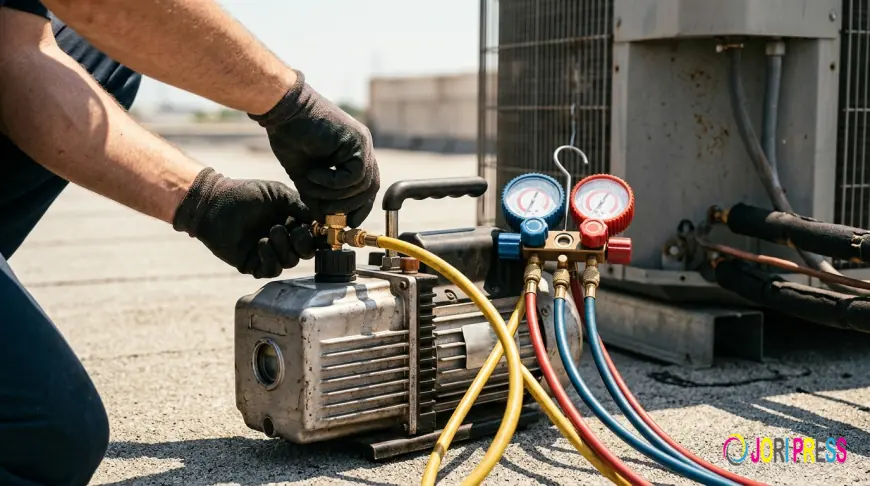
A vacuum pump clears air, moisture and other non-condensable gases out of a refrigerant circuit before charging. It is also one of the easiest steps to rush, because a poor evacuation rarely causes trouble on day one. The damage shows up months later as weak cooling, high head pressure or a failed compressor. This guide, from the technical team at Haste Trading, explains what a vacuum does inside the system, how to choose and set up a pump, and how to confirm the circuit is dry and tight before refrigerant goes in.
What evacuation actually does
Moisture left in a system mixes with refrigerant oil and forms acids that slowly attack compressor windings. Trapped air does a different kind of harm. It raises head pressure, which cuts capacity and makes the compressor work hotter than it should.
Neither problem can be seen from outside, so evacuation is judged by measurement, not by how long the pump ran. In hot and humid regions the stakes are higher, because open pipework picks up more moisture during installation and high temperatures speed up acid formation.
Reading microns correctly
A micron is a very small unit of pressure. Atmospheric pressure is roughly 760,000 microns, so the lower the reading, the less air and moisture remain inside. A common target in HVAC/R work is 500 microns or lower, and some sensitive systems call for 250. Where the equipment manufacturer states a figure, that figure takes priority.
The reading alone is not proof of a sound system. The real test is the standing vacuum test: close the valve to the pump and watch the gauge.
-
A fast, continuous rise usually points to a leak.
-
A slower rise that levels off often means leftover moisture or out-gassing.
Either way, find the cause before charging.
Choosing a pump: CFM and stages
CFM describes how quickly a pump moves volume, not how deep a vacuum it can reach. An undersized pump can still get there, but it may take hours on a large circuit. These starting points are a guide, not a rule:
|
System |
Typical size |
Starting CFM |
|
Residential split or window unit |
1-3 tons |
3-4 |
|
Ducted split or small commercial |
3-8 tons |
4-6 |
|
VRF branch systems |
8-20 tons |
6-8 |
|
Large rooftop units |
20-50 tons |
8-10 |
|
Cold storage and industrial refrigeration |
Varies by pipe volume |
10-12+ |
Pipe length, pipe diameter, hose size and moisture load all matter as much as tonnage. If the line set is longer than usual for its class, move up one bracket.
Single-stage pumps suit occasional light residential work. Two-stage pumps pull deeper, work faster and cope better with moisture, which is especially important on systems that use POE oil because it absorbs water readily. Always check each pump's own rated ultimate vacuum instead of relying on general figures. If you are comparing options, the vacuum pumps range is a good place to check CFM ratings side by side.
Setting up the hoses and gauge
-
Pull the Schrader valve cores with a core removal tool. Left in place, they restrict flow and can make the system look evacuated before it is.
-
Use the largest hoses your fittings accept and keep them short. A 1/4" hose chokes flow on bigger systems, so 3/8" is worth switching to on commercial jobs. Make sure your charging hoses are in good condition and the right size for the job.
-
Fit a dedicated micron gauge, not a compound gauge. A compound gauge cannot tell 1,000 microns from 10,000.
-
Place the micron gauge as far from the pump as possible, ideally at the far end of the system, so it reads the system and not the pump.
Running the evacuation and the standing test
Run the pump until the gauge reaches 500 microns or the manufacturer's target. Aim for roughly 200-300 microns while the pump is still running, since the reading creeps up slightly once the system is isolated.
Then valve off the pump and hold. On residential systems, 10-15 minutes is a common minimum, and larger commercial circuits are held longer, so follow the manufacturer's hold time and allowable rise. Charge only once the reading holds.
There is no fixed pump run time. It may take 20 minutes on a small split or several hours on a large cold room, and the reading is the benchmark.
Looking after the pump
Contaminated oil is one of the most common reasons a pump cannot reach its rated vacuum. In hot, dusty conditions, check the oil often and change it as soon as it looks cloudy or dirty, following the pump maker's instructions. Keep intake filters clean too, since sand and dust clog them quickly. If you work with A2L refrigerants such as R32 or R454B, confirm the pump is approved for them and use the oil the manufacturer specifies. Fresh refrigeration oil on the shelf makes it far easier to change oil on schedule.
Why evacuations fail
-
Schrader cores left in during pumping
-
A compound gauge used in place of a micron gauge
-
No standing vacuum test, so slow leaks go unnoticed
-
Undersized hoses on a large system
-
Degraded pump oil that cannot reach rated vacuum
-
Charging as soon as the target is touched, without a hold
Each one is simple to avoid on site and costly to fix once the system is running. The most reliable habit is to follow the same sequence on every job.
Frequently asked questions
What micron level is acceptable for an AC system?
500 microns or lower is commonly used, confirmed with a standing vacuum test. Hold time and acceptable rise vary by manufacturer, and some sensitive systems call for 250 microns or lower.
What size vacuum pump suits a 3-ton split?
A 3-4 CFM two-stage pump is a typical starting point. Adjust for line length and hose diameter.
Can a single-stage pump be used on commercial refrigeration?
It is generally not recommended. Two-stage pumps evacuate faster and handle moisture better, which matters on larger circuits.
How long should the pump run before charging?
There is no set time. Run it until the system reaches and holds the target micron level during the standing test.
Is triple evacuation always necessary?
No. A single evacuation that reaches and holds the target is often enough. Some manufacturers specify triple evacuation, and it may help when heavy moisture is suspected, so check their guidance.
Final thoughts
A dry, tight system comes from the right pump, proper hoses, a true micron gauge and a standing test you actually wait for. Take those extra minutes before charging and the system will perform well long after the job is closed.
Need help choosing a pump or hoses for your next job? Contact the Haste Trading team in Dubai, Sharjah or Abu Dhabi.
What's Your Reaction?
 Like
0
Like
0
 Dislike
0
Dislike
0
 Love
0
Love
0
 Funny
0
Funny
0
 Angry
0
Angry
0
 Sad
0
Sad
0
 Wow
0
Wow
0