








































How Syncing Breath with Movement Restores an Overstimulated Nervous System
By mid-afternoon, plenty of us are running on a strange kind of fuel: a tight jaw, shallow chest breathing, a phone buzzing against the desk, and a mind that keeps refreshing tabs it already closed. Nothing is technically wrong. And yet the body behaves as if something is.
That mismatch is the signature of an overstimulated nervous system. The sympathetic branch, the part that readies you to act, keeps getting nudged by notifications, deadlines and noise, while the parasympathetic branch that lets you settle never gets a clear turn. Breathing sits right at the hinge between the two, which is why it is one of the few levers you can pull on purpose.
This is also why traditions built around breath have lasted so long. Teachers trained in the lineage of authentic Rishikesh yoga online have long treated breath and movement as a single practice instead of two separate ones. Modern physiology, it turns out, offers a fairly tidy explanation for why that pairing works.
The Alarm That Never Gets Switched Off
Under stress, breathing tends to climb upward into the chest and speed up. The upper ribs and neck muscles do work the diaphragm should be doing, and the body reads that rapid, high pattern as a cue that it is under threat. It is a loop: stress shortens the breath, and a shortened breath tells the brain that stress is still here.
Chronic overstimulation rarely feels dramatic. It feels like being tired and wired at once, startling easily, struggling to fall asleep, or reaching for caffeine to push through a fog that more caffeine makes worse.
Why the Exhale Gets the Last Word
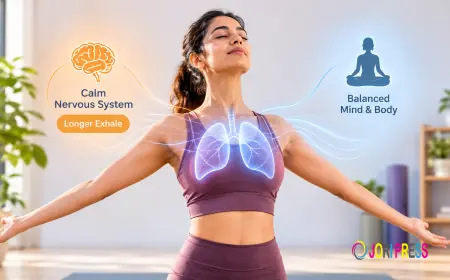
Every inhale slightly speeds the heart, and every exhale slightly slows it. This natural rhythm is called respiratory sinus arrhythmia, and it is mediated largely by the vagus nerve, the long communication line between the brainstem and organs including the heart and lungs.
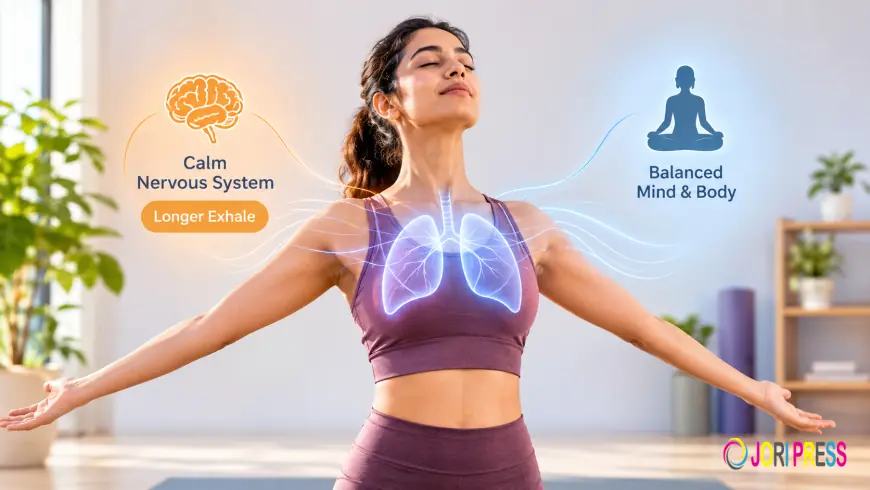
Because the slowing happens on the exhale, lengthening the out-breath gives the calming side of that rhythm more room. You do not need an elaborate technique for this. Breathing in through the nose for a count of four and letting the exhale run to six is enough to start shifting the balance for many people. Slow breathing at roughly five to six breaths per minute has also been studied for its effect on heart rate variability, a marker often used to gauge how flexibly the nervous system can respond to demands.
The diaphragm matters here too. When it descends fully on the inhale, the belly expands softly and the lower lungs fill. That deeper pattern is associated with the slower, steadier breathing the body uses when it feels safe.
A Movement That Waits for Your Lungs
Breathing exercises done while sitting still work for some people and fall flat for others. A restless mind often has no patience for counting. This is where pairing breath with movement earns its place.
When an arm rises on the inhale and lowers on the exhale, the movement gives attention a physical task. You are no longer trying to quiet your thoughts by force; the thoughts simply have something steadier to follow. The movement also sets the tempo. If you move faster than your breath can comfortably support, you notice immediately, and the correction is to slow down.
That feedback is the quiet genius of the approach. Instead of the breath serving the pose, the pose serves the breath. A forward fold becomes a long exhale. A gentle backbend opens the front of the ribcage and invites a fuller inhale. Cat-cow, one of the simplest sequences there is, is essentially a breathing lesson disguised as spinal movement.
Reading Your Own Signals
Syncing breath and movement also trains interoception, the ability to sense what is happening inside the body. People living in a constant state of overstimulation often lose this skill. They notice tension only when it becomes pain, and exhaustion only when they collapse.
Practiced regularly, the breath becomes a kind of dashboard. You begin to catch the held breath before an email reply, the clenched stomach during a difficult conversation, the shoulders creeping toward the ears. Noticing is the first half of regulating, and it happens earlier than any crisis.
Five Minutes That Do Real Work
You do not need a full class to start. Try this once or twice a day:
- Stand or sit tall. Let your hands rest on your lower ribs so you can feel them widen.
- Inhale through the nose for four counts while slowly raising both arms out to the sides and overhead.
- Exhale for six counts as the arms float down, letting the shoulders drop away from the ears.
- Repeat for ten rounds. If the counts feel strained, shorten both and keep the exhale longer than the inhale.
- Finish with a pause. Stand still for three natural breaths and notice what has changed, even slightly.
If you feel lightheaded at any point, return to normal breathing. Gentle is the goal; forcing the breath defeats the purpose.
What Changes Over Weeks, Not Minutes
A single session can leave you calmer, but the larger shift comes from repetition. The nervous system learns by pattern. Each time you pair a slow exhale with an unhurried movement, you rehearse the transition from alert to settled, and that transition gets easier to access when real stress arrives.
Many people report sleeping more deeply, reacting less sharply, and recovering faster after tense moments. None of this requires flexibility, experience or special equipment. It asks for a little attention, a steady rhythm, and the willingness to let the exhale run a bit longer than feels natural at first.
This article is for general wellness information and is not a substitute for medical advice. If you experience persistent anxiety, panic or breathing difficulties, consult a qualified healthcare professional.
gangayogshala.com
What's Your Reaction?
 Like
0
 Dislike
0
 Love
0
 Funny
0
 Angry
0
 Sad
0
 Wow
0