
































How Prediction Market Sharps Turned Geopolitics and Pop Culture Into a Million-Dollar Edge
Learn how prediction market sharps use data, research, and disciplined strategy to profit from geopolitical events and cultural moments on platforms like Polymarket and Kalshi.
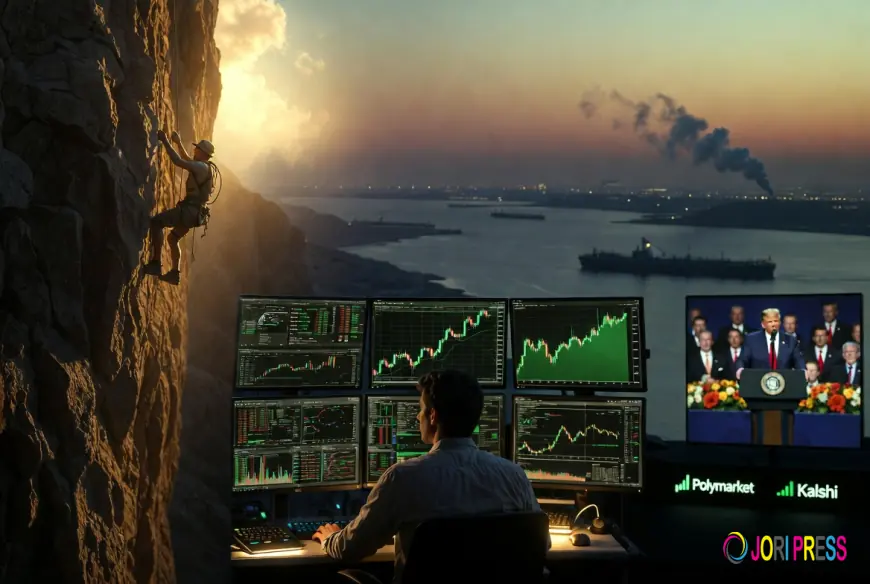
There's a man who quit his corporate accounting job to bet on which words the President would say at a turkey pardon ceremony. He reviewed transcripts, studied speech patterns, avoided obvious traps like "stuffing" and "cheaper," and walked away with hundreds of dollars in a single afternoon. He now makes thousands every week doing the same kind of work across dozens of markets.
He isn't gambling. He's operating a system.
This is the world of prediction market sharps — a small, disciplined class of traders who have quietly turned one of finance's newest arenas into a reliable income machine. While casual bettors chase headlines and gut feelings, sharps are running algorithms, reading satellite imagery, and building portfolio strategies that consistently outperform the crowd. The result? A tiny fraction of accounts capture the vast majority of profits on platforms like Polymarket and Kalshi.
The Geopolitical Edge
For most people, geopolitical instability is background noise. For sharps, it's a trading opportunity with a time stamp.
The strategy is simple in theory: find contracts where the crowd has mispriced the probability, move early, exit before the market corrects. A trader who read diplomatic signals correctly could buy a ceasefire extension contract at 30 cents when the true probability was closer to 60. Once the announcement dropped, it was resolved at a dollar. That's research converted into a position.
The edge occasionally bleeds into murkier territory though. Suspiciously timed trades on Polymarket conflict contracts have raised insider trading red flags. For the legitimate sharp, that's an occupational hazard — you can build the best model in the room and still lose to someone who had a phone call you didn't.
The Cultural Angle
If geopolitical markets reward intelligence analysts, cultural markets reward obsessives — and obsessives with spreadsheets tend to win.
Crowd sentiment is a lagging indicator. A studio drops a trailer, buzz spikes, odds shift. A sharp who's tracked critic previews and festival reception buys the contrarian position and waits. The same logic applies to speech mention contracts — Joel Holsinger built a system around studying presidential transcripts to predict exact word usage, and scaled it to thousands weekly.
If you follow this space closely — outlets like PolyPunter have been covering it for months — the pattern is clear. Cultural markets look frivolous from the outside. That's precisely why the mispricings are frequent and the returns consistent for those willing to do the work.
The Infrastructure Behind Every Trade
What separates a sharp from a lucky bettor isn't one great call. It's the system running underneath every trade.
The most disciplined traders operate with a few consistent principles:
-
Limit orders over market orders — providing liquidity instead of consuming it, a small structural edge that compounds across hundreds of trades.
-
Rigorous record-keeping — not just wins and losses, but why each trade was made and where the model was wrong.
-
Conservative position sizing — never overexposing the bankroll on a single contract, no matter how high the conviction.
-
Diversified portfolios — broad exposure across geopolitics, sports, entertainment, and weather so no single result can devastate the book.
One pseudonymous trader known as Domer has publicly documented generating over $2.6 million in profits since early 2022, through a combination of market-making and deep research. His edge isn't insider access. It's doing more work than the people on the other side of his trades.
The Risks Nobody Mentions
Impressive numbers attract attention. The risks get buried.
Prediction market trading is volatile in ways traditional investing isn't. Sudden news breaks can reverse a well-reasoned position in minutes. Platform fees erode margins on smaller bets. And the window between spotting a mispricing and having it corrected by other sharps is often very short.
The One Risk No Model Can Solve
The deeper problem is insider trading. Sharps build edges by being better at analyzing publicly available information. But when participants trade on non-public information, even a perfect model can't account for it. The legitimate sharp loses not because their analysis was wrong — but because someone else was cheating. It's a structural issue the platforms are still actively working through.
What This Means for Everyone Else
The concentration of profits among a small number of disciplined traders isn't a bug in prediction markets — it's a feature. Sharps improve overall accuracy by incorporating specialized knowledge into prices, making the whole system more useful as a forecasting tool.
But for anyone considering entering these markets, the honest message is this: the person on the other side of your trade may have been doing this full time for three years. They have models you don't have, data you haven't found, and a track record of being right in ways you can't fully evaluate.
That's not a reason to stay out. It's a reason to understand, before you put money in, whether you're the sharp or the liquidity.
What's Your Reaction?
 Like
0
Like
0
 Dislike
0
Dislike
0
 Love
0
Love
0
 Funny
0
Funny
0
 Angry
0
Angry
0
 Sad
0
Sad
0
 Wow
0
Wow
0