








































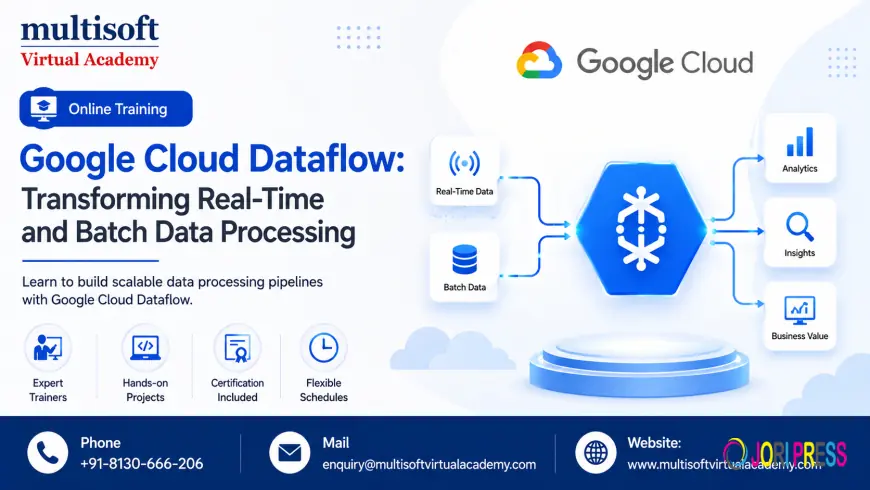
Google Cloud Dataflow: Transforming Real-Time and Batch Data Processing
Learn Google Cloud Dataflow for scalable data processing, real-time analytics, batch workloads, and efficient cloud data pipeline development.

Data has become one of the most valuable assets for modern organizations. From customer transactions and application logs to IoT devices and business operations, companies continuously generate enormous amounts of information. However, collecting data is only the first step. Businesses need reliable technologies that can process, transform and deliver this information quickly enough to support better decisions.
This is where Google Cloud Dataflow plays an important role.
Google Cloud Dataflow is a managed service for executing data processing pipelines. It supports both batch and streaming workloads and works closely with the Apache Beam programming model. Instead of requiring teams to maintain complex processing infrastructure manually, Dataflow provides a managed environment where organizations can develop scalable data pipelines for analytics, integration, machine learning and other workloads.
As cloud adoption, real-time analytics and artificial intelligence continue to expand, understanding how Dataflow fits into a modern cloud architecture has become increasingly valuable for data engineers, cloud professionals and organizations modernizing their data platforms.
What Is Google Cloud Dataflow?
Google Cloud Dataflow is a fully managed service designed to process large volumes of data through distributed pipelines.
A pipeline generally performs three fundamental activities:
Input → Processing → Output
Data can arrive from systems such as files, databases, messaging platforms or applications. Dataflow then performs operations such as filtering, grouping, aggregation, transformation or enrichment before delivering the results to a destination.
The destination may include an analytical warehouse, storage platform, database or another application.
One of the major advantages of Dataflow is its ability to handle both bounded and unbounded data. Bounded data represents a fixed dataset, such as a collection of files. Unbounded data continuously arrives over time, such as events generated by applications or IoT devices.
This makes Dataflow suitable for both traditional batch processing and modern real-time streaming architectures.
How Does Google Cloud Dataflow Work?
Dataflow is based on the Apache Beam programming model.
Apache Beam allows developers to describe how data should move through a processing pipeline. The pipeline can contain multiple stages where information is read, transformed, combined, filtered or written to another system.
A simplified workflow can look like this:
Data Source → Apache Beam Pipeline → Dataflow → Transformation → Data Destination
For example, a company may receive customer events through Google Cloud Pub/Sub. A Dataflow pipeline can consume those events, validate the information, enrich records with additional attributes and send the processed data to BigQuery.
This architecture allows businesses to turn raw event data into information that can be used for dashboards, reporting and analytical applications.
Apache Beam and Dataflow: What Is the Difference?
A common question among beginners is whether Apache Beam and Google Cloud Dataflow are the same technology.
They are not.
Apache Beam is an open-source programming model used to define data processing pipelines.
Google Cloud Dataflow is a managed execution service that can run Apache Beam pipelines.
This distinction is important because developers can focus on writing pipeline logic using Beam while Google Cloud handles much of the underlying infrastructure required to execute that pipeline.
Apache Beam supports SDKs such as Java, Python and Go, making the ecosystem accessible to professionals with different programming backgrounds.
Batch Data Processing With Dataflow
Batch processing remains an important requirement for many organizations.
A business may need to process:
- Daily sales information
- Historical customer records
- Financial transactions
- Application logs
- CSV and JSON files
- Archived operational data
- Machine learning datasets
Instead of processing these datasets manually, organizations can create automated pipelines.
For example:
Cloud Storage → Dataflow → Data Transformation → BigQuery
A Dataflow pipeline can read raw files, remove invalid records, standardize fields, perform calculations and load the resulting dataset into BigQuery.
This type of architecture can simplify large-scale ETL data processing while making workflows more repeatable.
Real-Time Streaming With Google Cloud Dataflow
Real-time processing is one of the most important reasons organizations consider Dataflow.
Traditional batch systems wait for data to accumulate before processing it. Streaming systems process events as they arrive.
Application → Pub/Sub → Dataflow → BigQuery → Analytics
Dataflow processes the incoming events while applying the required business logic before sending the information to downstream systems.
This approach can support real-time analytics, fraud detection, operational monitoring, recommendation systems and customer behavior analysis.
Dataflow and Google Cloud Pub/Sub
Google Cloud Pub/Sub is commonly used as an event ingestion service in streaming architectures.
Pub/Sub receives messages generated by applications, devices and other systems. Dataflow can then consume these messages and perform transformations before delivering the processed information to another platform.
This combination is useful when organizations need to separate event ingestion from data processing.
For example:
IoT Devices → Pub/Sub → Dataflow → BigQuery
IoT devices continuously generate sensor information. Pub/Sub receives those events while Dataflow processes them at scale.
The resulting information can then be analyzed to identify trends, anomalies or operational problems.
Dataflow and BigQuery Integration
BigQuery is Google's cloud data warehouse and is frequently used with Dataflow.
The two services perform different but complementary functions.
Dataflow focuses on data processing and transformation.
BigQuery focuses on large-scale analytical querying and data warehousing.
A modern architecture may therefore look like:
Operational Systems → Dataflow → BigQuery → BI Dashboard
Dataflow prepares the information while BigQuery makes it available for analytical queries.
This combination can help organizations build centralized data platforms without maintaining traditional on-premises data processing clusters.
What Is Dataflow ETL?
ETL stands for Extract, Transform and Load.
Dataflow can be used to implement sophisticated ETL pipelines where information is collected from different sources, processed according to business requirements and delivered to a target system.
A typical ETL pipeline may include:
Extract
Information is collected from databases, files, APIs, applications or messaging services.
Transform
The pipeline cleans and modifies the information. This can include changing data types, removing duplicates, filtering records and applying calculations.
Enrich
Additional information can be added to make the dataset more useful for analytics.
Load
The processed information is written to a data warehouse, database or storage platform.
This automated approach can reduce repetitive manual processing and improve consistency across data workflows.
Dataflow for Real-Time Analytics
Organizations increasingly want analytics that reflect what is happening now rather than what happened yesterday.
Real-time analytics can help businesses monitor events as they occur.
For example, a financial organization may analyze transaction activity continuously. A logistics company may process vehicle location information in near real time. An online retailer may monitor customer activity while a campaign is running.
Dataflow can act as the processing layer between incoming events and analytical systems.
This makes Google Cloud Dataflow for real-time analytics an important consideration when designing cloud-native data architectures.
Dataflow Autoscaling and Performance
Data processing workloads can change significantly throughout the day.
A fixed infrastructure model may provide too much capacity during periods of low activity and insufficient capacity during peak workloads.
Dataflow provides autoscaling capabilities that can adjust processing resources according to workload requirements.
Horizontal autoscaling can increase or decrease the number of workers used for processing. Dataflow Prime also introduces additional capabilities for resource optimization, including vertical autoscaling.
These features can reduce the need for constant manual infrastructure adjustments.
However, autoscaling does not eliminate the need for good pipeline design. Poorly designed transformations, inefficient data distribution and inappropriate resource configuration can still affect performance.
What Is Dataflow Prime?
Dataflow Prime extends the managed processing capabilities available for Apache Beam pipelines.
It is designed to improve resource utilization and pipeline performance through features such as compute and state separation and vertical autoscaling.
Vertical autoscaling can adjust worker memory based on workload requirements.
This can be particularly useful for complex pipelines where memory requirements vary during processing.
For data engineering teams, these capabilities can simplify resource management while helping them focus more on pipeline behavior and business requirements.
Google Cloud Dataflow for Machine Learning
Machine learning depends heavily on high-quality data.
Before a model can produce reliable predictions, information usually needs to be collected, cleaned, transformed and prepared.
Dataflow can support these data preparation stages.
Potential applications include:
- Training dataset preparation
- Feature transformation
- Streaming data preparation
- Batch inference pipelines
- Real-time inference workflows
- Data enrichment
- ML data processing
The growing integration between data engineering and AI makes scalable processing platforms increasingly important.
Recent Dataflow developments have also expanded infrastructure capabilities for machine learning workloads, including GPU-related support. This reflects Google's broader effort to make cloud data processing suitable for increasingly demanding AI and analytics applications.
Google Cloud Dataflow Use Cases
The technology can be applied across many industries and business scenarios.
1. Financial Data Processing
Banks and financial organizations can process transaction information, customer activity and financial events through automated pipelines.
2. Fraud Detection
Streaming data pipelines can help organizations analyze transactions and identify suspicious patterns quickly.
3. IoT Data Processing
IoT systems produce continuous streams of information. Dataflow can transform and route sensor data for further analysis.
4. Application Monitoring
Application logs and operational events can be processed to support monitoring and troubleshooting.
5. Customer Analytics
Businesses can combine information from different customer touchpoints to understand behavior and improve personalization.
6. Data Warehouse Integration
Dataflow can transform information before it is loaded into analytical platforms such as BigQuery.
7. Machine Learning
Dataflow can prepare large datasets and support data processing stages in machine learning workflows.
8. Cloud Migration
Organizations moving legacy data processing systems to the cloud can use managed processing services as part of their modernization strategy.
Key Benefits of Google Cloud Dataflow
Several characteristics make Dataflow attractive for modern data engineering.
Managed Infrastructure
Organizations do not need to manually manage traditional processing clusters for every workload.
Scalability
Processing resources can adapt to changing workloads.
Batch and Streaming Support
Teams can use a unified approach for both historical and continuously arriving datasets.
Apache Beam Integration
Developers can use the Apache Beam programming model to build pipelines.
Cloud Ecosystem Integration
Dataflow can work with various Google Cloud services and external systems.
Support for Modern Analytics
It can serve as a processing layer for data warehouses, dashboards and machine learning applications.
Reduced Operational Complexity
Managed infrastructure allows data teams to spend more time on data quality and business logic rather than infrastructure administration.
Google Cloud Dataflow vs Traditional ETL Tools
Traditional ETL environments often depend on fixed infrastructure, scheduled processing and manually managed systems.
Cloud-native data processing changes this approach.
With Dataflow, organizations can create pipelines that respond to changing workloads and process both batch and streaming information.
However, choosing a data processing platform should always depend on the specific use case.
A simple data movement requirement may not need a sophisticated Dataflow pipeline. More complex workloads involving transformation, enrichment, streaming and distributed processing can benefit considerably from its capabilities.
The best architecture is therefore the one that matches technical requirements, performance expectations, operational needs and cost considerations.
Best Practices for Building Dataflow Pipelines
A technically correct pipeline is not necessarily a production-ready pipeline.
Organizations should consider several practices when designing Dataflow workloads.
Build for Scale
Pipeline logic should be designed with distributed execution in mind.
Manage Data Quality
Invalid, missing or unexpected records should be handled systematically.
Monitor Performance
Teams should monitor processing time, throughput, errors and resource utilization.
Optimize Costs
Resource consumption should be reviewed regularly to avoid unnecessary processing expenses.
Design for Reliability
Production pipelines should include appropriate error handling and recovery strategies.
Secure the Environment
Access controls, identities, permissions and encryption should be incorporated into the architecture.
Test Before Production
Pipeline transformations should be validated against realistic datasets before deployment.
Why Google Cloud Dataflow Skills Are Becoming Valuable
The growth of cloud analytics, real-time applications and artificial intelligence is creating a greater need for professionals who understand data processing at scale.
Data engineers are increasingly expected to work across multiple layers of the modern data stack.
This includes collecting information, transforming it, managing data quality, supporting analytics and preparing data for AI systems.
Learning Dataflow can therefore complement broader knowledge of Google Cloud data engineering, BigQuery, Apache Beam, Pub/Sub, cloud ETL and real-time analytics.
Rather than viewing Dataflow as just another cloud service, professionals can understand it as part of a larger architecture for moving raw information toward useful business intelligence.
Future of Cloud Data Processing
The future of data processing is moving toward greater automation, real-time decision-making and closer integration with artificial intelligence.
Organizations want data platforms that can handle increasing volumes without creating equally increasing operational complexity.
At the same time, AI applications require increasingly sophisticated data pipelines.
This creates demand for technologies capable of processing information efficiently while supporting different workload patterns.
Google Cloud Dataflow is positioned within this broader evolution by supporting batch processing, streaming, Apache Beam pipelines, autoscaling and increasingly AI-oriented workloads.
Frequently Asked Questions About Google Cloud Dataflow
Is Google Cloud Dataflow a database?
No. Dataflow is a managed data processing service. It processes and transforms information rather than functioning as a traditional database.
Is Dataflow used for ETL?
Yes. Dataflow can be used to build ETL pipelines that extract, transform and load information between different systems.
Can Dataflow process real-time data?
Yes. Dataflow supports streaming pipelines designed to process continuously arriving data.
What is Apache Beam used for?
Apache Beam provides a programming model for defining data processing pipelines that can operate on batch and streaming data.
Is Dataflow useful for data engineers?
Yes. Dataflow is particularly relevant to professionals working with cloud data pipelines, distributed processing, streaming analytics and data integration.
Can Dataflow work with BigQuery?
Yes. Dataflow and BigQuery can be integrated to create data processing and analytical architectures.
Final Thought
Google Cloud Dataflow represents an important part of the modern cloud data ecosystem, bringing together scalable processing, batch and streaming capabilities, Apache Beam, automated resource management and integration with analytics and AI workflows. As organizations continue moving toward real-time analytics and cloud-native data platforms, professionals who understand how to design, deploy and optimize reliable data pipelines can gain valuable technical capabilities. For organizations and learners looking to develop practical expertise in cloud data engineering and related technologies, Multisoft Virtual Academy provides professional learning and service-oriented guidance designed to support modern technology requirements.
What's Your Reaction?
 Like
0
Like
0
 Dislike
0
Dislike
0
 Love
0
Love
0
 Funny
0
Funny
0
 Angry
0
Angry
0
 Sad
0
Sad
0
 Wow
0
Wow
0