






































How Much Car Can You Actually Afford? (It's Probably Less Than the Bank Approved You For)
Getting approved for a car loan feels like a green light. If the bank says you qualify for a certain amount, it's easy to assume that number is what you can comfortably afford. It isn't — and that gap is exactly why so many people end up "car poor," technically owning a nice vehicle while feeling squeezed every single month.

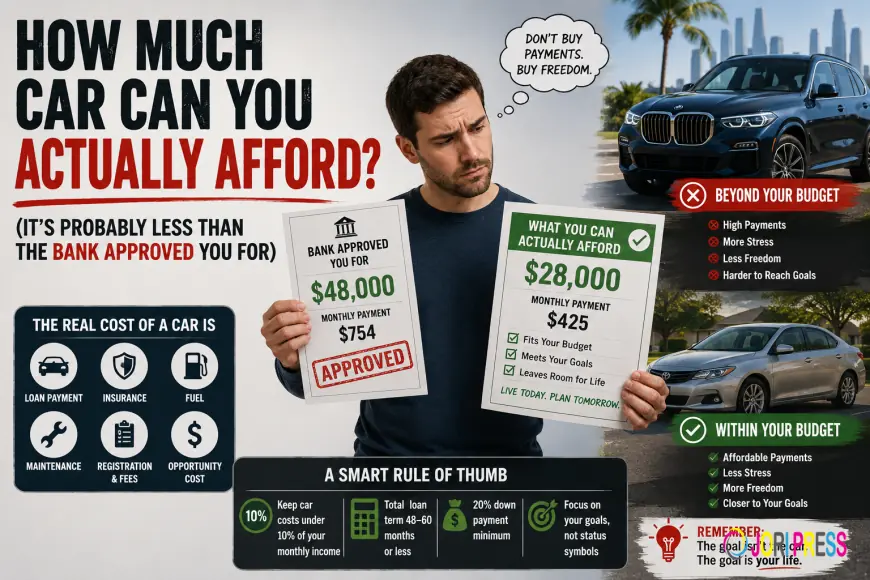
Getting approved for a car loan feels like a green light. If the bank says you qualify for a certain amount, it's easy to assume that number is what you can comfortably afford. It isn't — and that gap is exactly why so many people end up "car poor," technically owning a nice vehicle while feeling squeezed every single month.
The Bank's Number and Your Number Are Different Questions
Lenders approve you based on your income, credit history, and existing debt relative to their risk tolerance — not based on your actual monthly budget, your savings goals, or the fact that you'd like to eat out occasionally. A loan approval tells you the maximum the bank is willing to risk on you. It says nothing about what leaves you with a comfortable, sustainable budget. Treating an approval amount as a target is one of the most common ways people overcommit.
The 20/4/10 Rule Is a Reasonable Starting Point
A commonly cited guideline suggests putting down at least 20%, financing for no more than 4 years, and keeping total transportation costs under 10% of your gross income. It's not a law, but it's a useful sanity check — if your planned purchase blows past all three, it's worth pausing before signing anything.
Total Cost of Ownership Is Bigger Than the Sticker Price
The monthly loan payment is only one piece of what a car actually costs. Insurance, fuel, maintenance, and depreciation all add up, and they vary significantly between vehicle types — a larger SUV and a compact sedan with the same loan payment can have very different total monthly costs once insurance and fuel are factored in. Before comparing two cars by payment alone, it's worth estimating the fuller monthly cost of each.
Run the Real Numbers Before You Walk Into a Dealership
Dealerships are skilled at presenting numbers in a way that feels manageable — "it's only $80 more a month" sounds small until you multiply it across a 5-6 year loan term. Rather than reacting to a monthly figure in the moment, it helps to calculate your actual affordable range beforehand, based on your income and existing expenses, so you have a firm number to compare against instead of negotiating from a place of uncertainty. A calculator like zencalculators.com can show you exactly how loan term, interest rate, and down payment interact, so you walk in already knowing your ceiling.
A Longer Loan Term Isn't Free Money
Stretching a loan from 4 years to 6 or 7 years lowers the monthly payment, which is exactly why dealers often push it — but it also means paying significantly more in total interest, and it increases the odds you'll owe more than the car is worth for a large chunk of the loan. A lower monthly number isn't automatically the better deal once you look at the full cost over the life of the loan.
Compare Financing Options Before You're at the Table
Dealership financing isn't always your cheapest option, even when it's presented as the convenient default. Credit unions and banks frequently offer better rates, and having a pre-approved offer in hand also gives you real leverage to negotiate — or walk away — if the dealership's terms aren't competitive.
Recalculate Before You Sign Anything Final
Whatever number you settle on going in, it's worth re-running the math one more time with the actual final terms — interest rate, term length, and any add-ons — before signing, since dealership negotiations often shift these details from your original plan. Comparing the final offer against your original budget at zencalculators.com takes a few minutes and can catch a term that quietly crept past what you'd planned to spend.
The Bottom Line
A loan approval is a ceiling set by a bank's risk model, not a recommendation for what you should spend. Work out your own affordable range before you shop, look at total cost of ownership rather than payment alone, and double-check the final terms before signing — the goal is a car you can afford comfortably, not just one you were approved for.
What's Your Reaction?
 Like
0
Like
0
 Dislike
0
Dislike
0
 Love
0
Love
0
 Funny
0
Funny
0
 Angry
0
Angry
0
 Sad
0
Sad
0
 Wow
0
Wow
0