




































How Industry Projects Are Changing the Way BCA Students Learn
Discover how live industry projects are reshaping the BCA Course experience. Compare BCA course fees, curriculum & outcomes at Moople Institute, Kolkata.
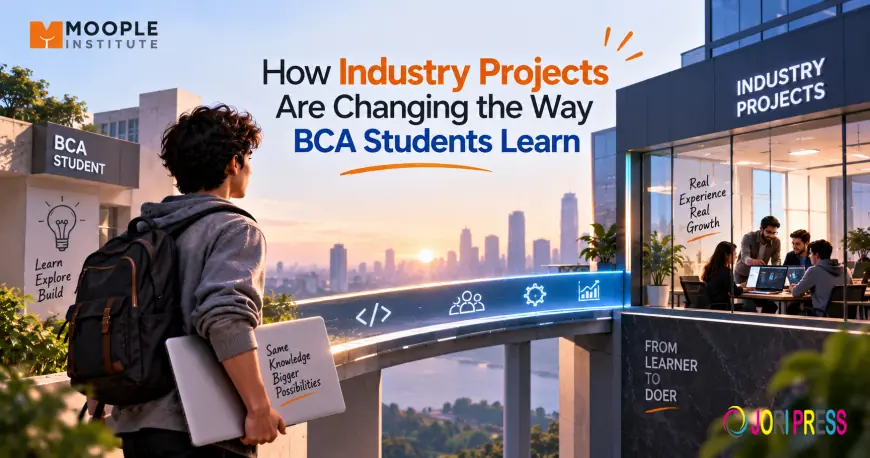
A BCA Course used to mean three years of textbooks, exams, and theory that rarely touched a real computer screen outside the lab hour. That is changing fast. Colleges and institutes across India, including here in Kolkata, are rebuilding their BCA degree programs around live industry projects instead of only classroom lectures.
For an 18 to 25 year old student trying to build a career in software, design, or animation, this shift matters a lot. Employers today rarely ask "what did you score in your exams?" They ask "what have you built?" Industry projects give students a real answer to that question, and that is exactly why this model is spreading so quickly across Bachelor of computer applications colleges nationwide.
In this article, we will break down what project-based learning actually looks like inside a bachelor of computer application course, why it beats the old lecture-only model, and what to check before you enrol.
What Makes a BCA Course Different Today
A BCA Course (Bachelor of Computer Applications) is a three-year undergraduate degree that trains students in programming, databases, networking, and software development. That definition has not changed. What has changed is how the degree is taught.
Ten years ago, a typical semester revolved around theory papers with a small lab component tacked on at the end. Today, a well-designed bachelor of computer application course treats every semester as a chance to apply concepts to a real brief, whether that is a website for a local business, a small mobile app, or a data-driven dashboard.
Why Industry Projects Matter More Than Theory Alone
Industry projects close the gap between what a syllabus covers and what a hiring manager expects. Here is what changes when project work becomes central to a BCA degree:
Real-World Problem Solving
Textbook problems have one correct answer. Client and industry briefs rarely do. A student asked to build a booking system for a real gym or salon has to deal with messy requirements, changing deadlines, and unclear instructions, exactly what happens on the job. This kind of exposure teaches judgment, not just syntax.
Building a Portfolio Employers Actually Notice
A resume with grades tells an employer very little. A portfolio with two or three completed projects, even small ones, tells them a candidate can plan, build, and ship something. Recruiters in animation, web design, and software firms consistently rank a working portfolio above academic scores during shortlisting.
Expert tip: If your current course does not assign at least one substantial project per year, start one on your own. Even a personal website or a small automation script, documented well, adds real weight to your portfolio.
How Institutes Are Integrating Industry Projects into BCA Learning
Institutes that take this seriously usually follow a pattern that looks something like this:
-
Semester-end capstone projects that mirror actual client briefs
-
Mentorship from working professionals rather than only full-time lecturers
-
Cross-disciplinary collaboration, for example a BCA student pairing with a graphic design or animation student on one project
-
Presentation and review sessions that mimic client feedback rounds
At Moople Institute, this approach shapes the entire BCA Course structure. Students work alongside faculty who have hands-on industry backgrounds in design, animation, and software development, which means the feedback students receive reflects what a studio or company would actually expect, not just what fits an exam pattern.
BCA Course Fees and What You Are Really Paying For
One of the most common questions students and parents ask is about BCA course fees. Fees vary widely across institutes, and the number alone does not tell you much. What matters is what is included in that fee.
A concise way to think about it: BCA course fees should be evaluated against the practical exposure, project mentoring, software access, and placement support bundled into the program, not against the tuition number in isolation.
|
Factor |
Traditional Theory-Heavy BCA |
Project-Based BCA Course |
|
Learning Style |
Lecture-heavy, exam-focused |
Applied, project and mentor-driven |
|
Portfolio by Graduation |
Usually none or minimal |
2 to 4 real projects on average |
|
Industry Readiness |
Requires extra upskilling post-degree |
Job-ready workflow experience built in |
|
Typical Fee Range* |
Lower, but limited support included |
Moderate, with mentoring and tools included |
*Fee ranges vary by institute and city; always request a detailed fee breakup before enrolling.
Choosing the Right BCA Course in Kolkata
If you are comparing options for a BCA Course in Kolkata, do not stop at the brochure. A few questions will tell you more than any marketing page:
1. How many live or industry-linked projects does each semester include?
2. Who teaches the practical modules, full-time academic staff or working industry mentors?
3. What software, labs, and tools will you actually get hands-on access to?
4. Does the institute help with internships or placement, and can they show past outcomes?
Common mistake: Many students pick a college purely on fee comparison or proximity to home. A slightly higher-fee program with strong project exposure and mentorship almost always pays off faster once you start job hunting.
Common Mistakes Students Make While Choosing a BCA Degree
-
Ignoring the practical-to-theory ratio in the syllabus
-
Not asking to see sample student projects from previous batches
-
Assuming all bachelor of computer application course programs are identical because the degree name is the same
-
Choosing based on fees alone without checking placement or mentorship support
FAQs
1. Is a BCA Course still relevant with so many coding bootcamps available now?
Yes. A BCA Course gives you a recognised undergraduate degree along with foundational computer science knowledge, something most short bootcamps do not offer. Combined with project-based learning, it covers both credibility and hands-on skill.
2. What is the average duration of a BCA degree?
A BCA degree is typically a three-year, six-semester undergraduate program, though some institutes now offer specialised tracks that extend slightly to include deeper project or internship phases.
3. Do BCA course fees usually include software and lab access?
It depends on the institute. Always confirm whether BCA course fees cover licensed software, lab hours, and project materials, or whether these are charged separately, before you compare two programs on price alone.
4. Can a BCA graduate move into animation, VFX, or design fields later?
Yes, this is increasingly common. The programming and problem-solving foundation from a BCA course pairs well with additional training in animation, VFX, or design software, which is why some institutes offer cross-disciplinary project work between these tracks.
5. How do I evaluate a BCA Course in Kolkata before applying?
Visit the campus if possible, ask to speak with current students, review sample projects from past batches, and confirm mentor qualifications. A genuine BCA Course in Kolkata with strong industry ties will usually be transparent about all of this upfront.
Conclusion
The shift toward industry projects is not a trend, it is a correction. A BCA Course that pairs core computer science learning with real, mentored project work prepares students far better for the job market than theory alone ever could. If you are researching a BCA Course in Kolkata, look closely at project exposure, mentor quality, and placement support, not just the fee sheet. You can review the full program structure and past student work on the Moople Institute website, explore insdustry insights from UGC guidelines on undergraduate curricula, or check current tech hiring trends on NASSCOM's industry reports to see why applied learning is becoming the standard.
Ready to Build a Career, Not Just a Degree?
If you want a BCA Course built around real projects, mentorship from industry professionals, and a portfolio you can actually show employers, Moople Institute in Kolkata is a strong place to start. Reach out today to talk to a counsellor, compare BCA course fees, and see sample student projects before you decide.
What's Your Reaction?
 Like
0
Like
0
 Dislike
0
Dislike
0
 Love
0
Love
0
 Funny
0
Funny
0
 Angry
0
Angry
0
 Sad
0
Sad
0
 Wow
0
Wow
0