






































How European Banks Are Using AI for Risk Management and Customer Service
The Europe AI in Banking Market is projected to reach USD 133.1 billion by 2035 as banks invest in fraud detection, risk analytics, and automated customer support.
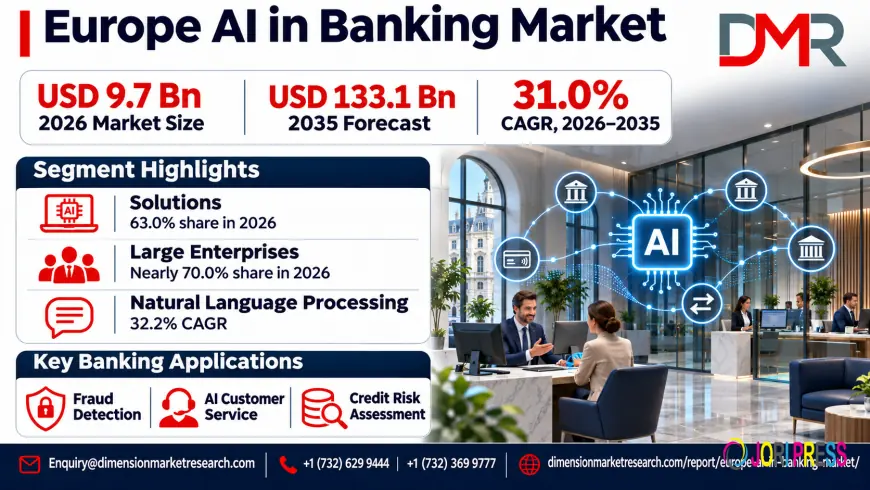
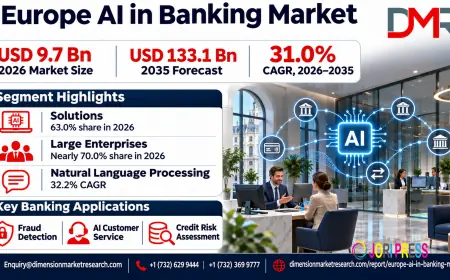
According to Dimension Market Research, the Europe AI in Banking Market Size is estimated at USD 9.7 billion in 2026 and is projected to reach USD 133.1 billion by 2035, growing at a compound annual growth rate (CAGR) of 31.0%. Banks are investing in fraud detection, predictive analytics, and automation as more transactions and customer interactions move to digital channels.
The same banking app can show how these investments serve different teams. A virtual assistant can answer a customer’s account question, while a transaction monitoring system can flag unusual payment activity for the fraud team to review. Behind those customer interactions, lenders can use predictive tools to assess credit risk and operations teams can automate parts of document processing.
What Is the Europe AI in Banking Market?
The market covers AI software and services used across retail, corporate, and investment banking in Europe. Software includes tools for transaction monitoring, credit assessment, customer support, and financial advisory. Services include consulting, implementation, integration, and ongoing support. This distinction matters because a bank buying a fraud detection platform may also need help connecting it to existing payment systems and monitoring how it performs after deployment.
Why Does Risk Management Lead AI Adoption in European Banking?
Risk management is projected to be the largest application, accounting for about 44.0% of market revenue in 2026. Banks use AI to review transaction patterns, assess credit exposure, and identify activity that may warrant investigation. The growth of digital payments and cross-border transactions increases the volume of activity that risk and compliance teams need to review.
For a fraud team, the practical question is whether a tool helps analysts prioritize alerts. For a lending team, the question is how well the model fits the existing credit review process. These differences matter for suppliers because a platform that supports several banking functions may still need a distinct deployment and review process for each one.
Which Segments Are Shaping Demand?
AI solutions are expected to account for about 63.0% of the market in 2026. The category includes fraud detection platforms, predictive analytics tools, and software that automates routine banking processes. Large enterprises are projected to account for around 70.0% of market revenue that year. Their transaction volumes and established IT infrastructure support deployments across multiple functions, while smaller institutions can use cloud-based tools to adopt AI for specific tasks such as onboarding or payment analytics.
Natural language processing (NLP) is projected to be the fastest-growing technology category, with a CAGR of 32.2% over the forecast period. Customer-facing uses include chatbots and voice assistants that interpret questions in everyday language. In back-office operations, NLP can extract relevant information from contracts and regulatory documents, giving staff a starting point for review.
Where Are the Opportunities for Banks and Technology Providers?
The report highlights fintech ecosystems in the United Kingdom, Germany, France, and the Netherlands. Open banking gives banks and fintechs ways to share data through secure interfaces and collaborate on payments, credit assessment, and digital lending. In November 2025, BKN301 acquired Planky to strengthen its AI capabilities for open banking and expand its digital banking offering across Europe and the broader EMEA region.
Legacy infrastructure and customer data protection can slow adoption. An AI platform may need to work with older systems and fit the bank’s existing controls for handling financial data. That makes integration support a commercial opportunity in its own right. A supplier that can show how its product fits an existing workflow gives buyers a clearer basis for estimating the effort required to move from a pilot to wider use.
Frequently Asked Questions
How large is the Europe AI in Banking Market?
The market is estimated at USD 9.7 billion in 2026 and is projected to reach USD 133.1 billion by 2035.
What is the projected CAGR of the Europe AI in Banking Market?
The market is projected to grow at a CAGR of 31.0% from 2026 to 2035.
Which application leads the Europe AI in Banking Market?
Risk management is projected to lead with about 44.0% of market revenue in 2026.
Which AI technology is expected to grow fastest?
Natural language processing is projected to grow fastest, at a CAGR of 32.2%, supported by demand for conversational banking and automated customer support.
What are the main barriers to AI adoption in European banking?
Integrating AI with older banking systems and managing sensitive customer data are two major barriers identified in the report.
Conclusion
Risk management gives European banks an immediate reason to invest in AI, while conversational banking and open banking partnerships create opportunities to improve customer services. Through 2035, suppliers can address both needs by building tools that fit existing banking systems and giving customers the implementation support to put them into everyday use.
What's Your Reaction?
 Like
0
 Dislike
0
 Love
0
 Funny
0
 Angry
0
 Sad
0
 Wow
0