






































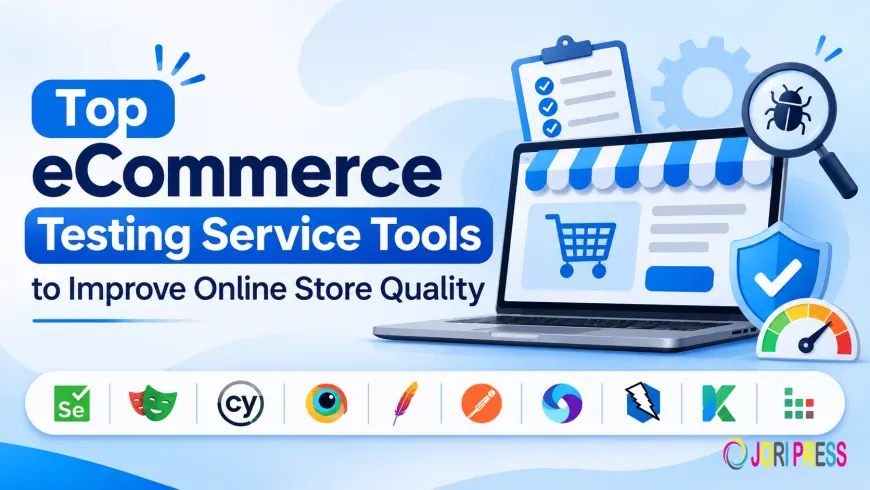
Top eCommerce Testing Service Tools to Improve Online Store Quality
Discover the top 10 eCommerce testing service tools in 2026 to automate testing, improve website performance, validate security, and enhance user experience.
Online shopping has become an essential part of everyday life. Customers expect eCommerce websites and applications to provide fast performance, secure payments, accurate product information, and a smooth checkout experience. Even a minor technical issue can interrupt a purchase and affect customer trust.
For businesses operating online stores, maintaining application quality is therefore a continuous responsibility. This is where software testing tools play an important role. They help QA teams identify defects, automate repetitive test cases, evaluate website performance, and validate different shopping workflows.
Choosing the right eCommerce testing service tools can make the testing process more efficient and help businesses deliver reliable digital shopping experiences.
However, not every testing tool performs the same function. Some are designed for browser automation, while others focus on API validation, performance testing, mobile compatibility, or security.
In this article, we will explore the top 10 eCommerce testing tools in 2026, their key features, and how businesses can use them to improve online store quality.
Why Are eCommerce Testing Tools Important?
An eCommerce application includes several interconnected features, such as product searches, customer accounts, shopping carts, payment gateways, order tracking, and inventory management.
Testing each functionality manually can become time-consuming, particularly when an online store frequently introduces new features or updates.
Here are some reasons why businesses use specialized eCommerce testing tools.
1. Automate Repetitive Testing Activities
Automation tools help QA teams execute repetitive test scenarios, including login, product selection, cart updates, and checkout validation. This reduces manual effort and supports faster regression testing.
2. Improve Website Performance
Performance testing tools help evaluate how an online store behaves under different traffic conditions. They can identify slow response times, server bottlenecks, and scalability issues.
3. Validate Payment and API Integrations
eCommerce platforms depend on payment gateways, shipping services, inventory systems, and third-party APIs. API testing tools help verify communication between these connected services.
4. Ensure Cross-Browser Compatibility
Customers access online stores using different browsers, devices, and operating systems. Compatibility testing tools help identify rendering issues and inconsistent application behavior.
5. Strengthen Application Security
Security testing tools help identify common vulnerabilities that may expose customer information, payment details, and business data.
Top 10 eCommerce Testing Service Tools in 2026
Here are ten useful testing tools that QA professionals and eCommerce development teams can consider for different testing requirements.
1. Selenium
Selenium is an open-source browser automation framework widely used for testing web applications. It allows QA engineers to automate browser interactions and validate application behavior across supported browsers.
For eCommerce websites, Selenium can automate important customer journeys, such as account registration, product searches, adding products to a cart, and completing checkout workflows.
Key Features:
-
Supports multiple programming languages.
-
Automates browser-based interactions.
-
Supports major web browsers.
-
Integrates with CI/CD pipelines.
-
Supports scalable execution through Selenium Grid.
Best For: Teams looking for flexible browser automation and regression testing.
2. Playwright
Playwright is a modern end-to-end testing framework that helps developers and QA engineers automate web application testing.
It supports Chromium, Firefox, and WebKit, making it useful for validating eCommerce websites across different browser engines.
QA teams can use Playwright to test product filtering, customer login, checkout workflows, and other important shopping activities.
Key Features:
-
Supports cross-browser testing.
-
Provides automatic waiting mechanisms.
-
Supports parallel test execution.
-
Offers screenshots, video, and trace-based debugging.
-
Supports JavaScript, TypeScript, Python, Java, and .NET.
Best For: Modern eCommerce applications requiring reliable end-to-end automation.
3. Cypress
Cypress is a JavaScript-based testing framework designed for modern web applications. It provides an interactive testing environment that helps developers identify issues during application development.
For online stores, Cypress can validate frontend functionality, navigation, product selection, and shopping cart operations.
Key Features:
-
Supports end-to-end testing.
-
Provides interactive debugging.
-
Supports JavaScript and TypeScript.
-
Offers screenshots and test recordings.
-
Integrates with development workflows.
Best For: Frontend development teams testing JavaScript-based eCommerce applications.
4. BrowserStack
BrowserStack is a cloud-based testing platform that allows QA teams to test websites and applications across different browsers, operating systems, and real devices.
It is particularly useful for eCommerce businesses that want to ensure customers receive a consistent experience regardless of the device they use.
Key Features:
-
Real-device testing.
-
Cross-browser compatibility testing.
-
Automated browser testing.
-
Supports multiple operating systems.
-
Integration with automation frameworks.
Best For: Businesses requiring extensive browser and device coverage without maintaining their own device lab.
5. Apache JMeter
Apache JMeter is an open-source performance testing tool used to evaluate application behavior under different workloads.
An eCommerce website may experience sudden traffic increases during holiday sales, promotional campaigns, and product launches. JMeter helps QA teams simulate user requests and evaluate how the application performs under load.
Key Features:
-
Load and performance testing.
-
Supports multiple protocols.
-
Simulates concurrent user activity.
-
Generates performance reports.
-
Supports distributed testing.
Best For: Evaluating the performance and scalability of eCommerce platforms.
6. Postman
Postman is an API development and testing platform that helps QA engineers validate communication between different application components.
eCommerce systems frequently integrate with payment gateways, shipping providers, customer management platforms, and inventory services. Postman helps test these API connections.
Key Features:
-
API request and response validation.
-
Automated API test scripts.
-
Environment and variable management.
-
Collection-based testing.
-
API documentation and collaboration.
Best For: Testing REST APIs and third-party integrations used by eCommerce platforms.
7. Appium
Appium is an open-source automation framework for testing mobile applications. It supports native, hybrid, and mobile web applications across Android and iOS.
For businesses operating mobile shopping applications, Appium helps automate customer interactions and verify important application functionalities.
Key Features:
-
Android and iOS automation.
-
Supports native and hybrid applications.
-
Multiple programming language options.
-
Cross-platform automation.
-
Integration with CI/CD workflows.
Best For: Businesses testing mobile eCommerce applications across different devices.
8. OWASP ZAP
OWASP ZAP, also known as Zed Attack Proxy, is an open-source web application security testing tool.
Since eCommerce platforms handle customer accounts, personal information, and payment-related workflows, security testing is an important part of quality assurance.
OWASP ZAP helps security professionals identify potential web application vulnerabilities.
Key Features:
-
Automated vulnerability scanning.
-
Passive and active security scanning.
-
Intercepting proxy functionality.
-
API security testing support.
-
Extensible through add-ons.
Best For: Identifying common web application security vulnerabilities.
9. Katalon
Katalon is a software testing platform that provides automation capabilities for web, mobile, desktop, and API applications.
It offers testing features that can help QA teams manage automated test scenarios across different application environments.
For eCommerce businesses, Katalon can support regression testing, browser automation, and API validation.
Key Features:
-
Web application automation.
-
Mobile application testing.
-
API testing.
-
Low-code and scripting capabilities.
-
Test execution and reporting.
Best For: Teams looking for a unified testing platform across multiple application types.
10. TestRail
TestRail is a test management platform designed to help QA teams organize, track, and manage their software testing activities.
Unlike browser automation frameworks, TestRail focuses on test case management and reporting. It helps teams maintain visibility into testing progress and results.
For large eCommerce projects, it can support organized test coverage across product catalogs, payment processes, customer accounts, and order management.
Key Features:
-
Test case management.
-
Test execution tracking.
-
Test planning and organization.
-
Reporting and dashboards.
-
Integration with development tools.
Best For: QA teams managing large test suites and multiple testing cycles.
How to Choose the Right eCommerce Testing Tools?
Selecting the right tools depends on your application architecture, testing requirements, available resources, and business objectives.
Consider these factors before making a decision.
1. Identify Your Testing Requirements
Determine whether your project requires functional testing, browser automation, API testing, security validation, or performance testing.
2. Check Technology Compatibility
Choose tools that work with your existing programming languages, application frameworks, browsers, and development environments.
3. Evaluate Automation Capabilities
Look for automation features that can simplify repetitive workflows and support regression testing.
4. Consider Scalability
Your testing requirements may increase as your online store grows. Select tools that can support larger test suites and higher testing workloads.
5. Review Reporting and Integration Features
Testing tools should provide useful reports and integrate with your development and CI/CD processes.
Can One Testing Tool Handle All eCommerce Testing Requirements?
No. A single testing tool generally cannot cover every aspect of eCommerce quality assurance.
For example, Playwright and Selenium are useful for browser automation, Postman focuses on API validation, JMeter evaluates performance, and OWASP ZAP helps identify security vulnerabilities.
Businesses should combine suitable tools based on their application requirements.
A well-planned testing strategy may include:
-
Functional and regression testing.
-
Browser and device compatibility testing.
-
API and integration testing.
-
Performance and load testing.
-
Security testing.
-
Mobile application testing.
Combining these approaches helps QA teams evaluate different parts of an eCommerce application more effectively.
How TabdeltaQA Helps Businesses Improve eCommerce Application Quality
Selecting the right tools is only one part of an effective quality assurance strategy. Businesses also need experienced QA professionals who understand application workflows and know how to identify critical defects.
TabdeltaQA is a software testing and quality assurance company offering testing solutions for businesses that want to improve application reliability and functionality.
Its eCommerce QA testing services focus on validating important online shopping activities, including product browsing, shopping cart operations, checkout workflows, payment integrations, and application behavior.
By combining appropriate manual and automation testing approaches, businesses can identify potential issues and improve their online store experience.
TabdeltaQA Testing Services Include:
-
eCommerce QA Testing
-
Manual Testing
-
Automation Testing
-
Functional Testing
-
Performance Testing
-
API Testing
-
Security Testing
-
Compatibility Testing
Final Thoughts
Choosing the right eCommerce testing service tools is important for maintaining a reliable online shopping platform. From browser automation and API validation to performance and security testing, each tool supports a different part of the quality assurance process.
Selenium, Playwright, Cypress, BrowserStack, JMeter, Postman, and other tools can help QA teams identify defects and validate important application workflows.
However, tools alone cannot guarantee software quality. An effective testing strategy also requires proper test planning, experienced QA professionals, and continuous validation throughout the development lifecycle.
With the right combination of testing tools and professional QA services, businesses can improve application stability, reduce technical issues, and deliver better shopping experiences.
Frequently Asked Questions (FAQs)
1. What are eCommerce testing service tools?
eCommerce testing service tools are software applications and frameworks used to validate online shopping websites and mobile applications. They help test functionality, performance, security, APIs, browser compatibility, and customer workflows.
2. Which are the best tools for eCommerce testing in 2026?
Some commonly used tools include Selenium, Playwright, Cypress, BrowserStack, Apache JMeter, Postman, Appium, OWASP ZAP, Katalon, and TestRail. The best choice depends on the specific testing requirement.
3. Which tools are used for eCommerce automation testing?
Selenium, Playwright, Cypress, and Katalon are commonly used for automating eCommerce website testing. They can help validate login, product searches, shopping cart functionality, and checkout processes.
4. Which tools are best for eCommerce performance testing?
Apache JMeter and Grafana k6 are useful options for evaluating website performance, simulating user traffic, and identifying application bottlenecks.
5. Why is API testing important for eCommerce applications?
API testing helps verify communication between an eCommerce application and external services such as payment gateways, shipping providers, and inventory management systems.
6. Can eCommerce testing tools reduce manual testing efforts?
Yes. Automation tools can execute repetitive test scenarios and regression tests, reducing manual effort. However, exploratory, usability, and certain other testing activities still benefit from manual testing.
7. Why should businesses hire an eCommerce QA testing company?
An experienced eCommerce QA testing company can provide testing expertise, structured test coverage, defect reporting, and appropriate testing strategies to help businesses improve application quality and reliability.
8. Does TabdeltaQA provide eCommerce QA testing services?
Yes. TabdeltaQA offers eCommerce QA testing services to help businesses validate online shopping functionality, identify defects, and improve application reliability and user experience.
What's Your Reaction?
 Like
0
 Dislike
0
 Love
0
 Funny
0
 Angry
0
 Sad
0
 Wow
0