











































How Big Should My Marketing Budget Be?
There's no single correct percentage for a marketing budget — it depends on your stage, CAC target, and revenue. Here's a practical framework for marketing budget planning, from early-stage startups to growing businesses.
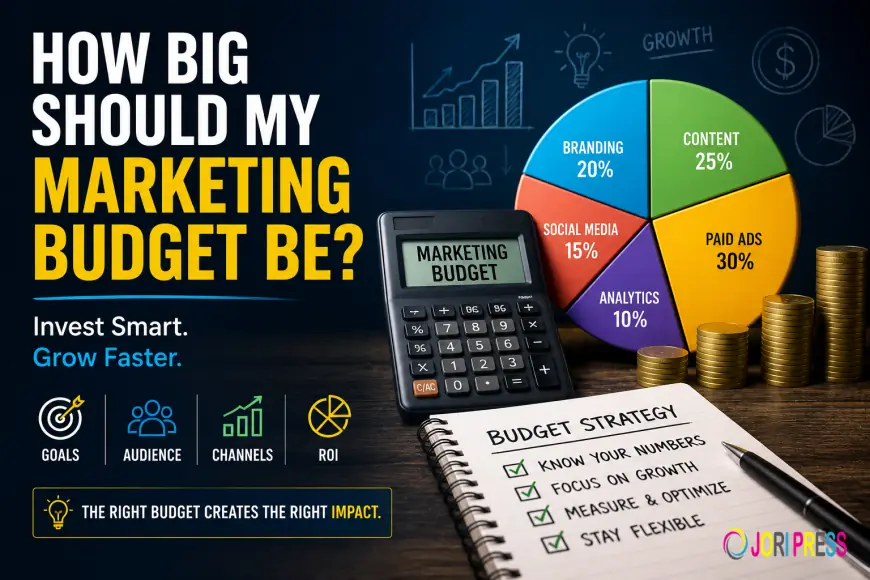
This is one of the most common questions I get from founders, and the honest answer is: it depends less on a magic percentage and more on what stage your business is in and what you're trying to achieve. But since "it depends" isn't useful advice on its own, let me break down how I actually think about marketing budget planning.
The Rule of Thumb (And Why It's Just a Starting Point)
A commonly cited benchmark is that businesses spend somewhere between 5–10% of annual revenue on marketing if they're established and looking to maintain market share, and up to 15–20% if they're in growth mode and trying to gain market share fast. These numbers are a reasonable starting point for a marketing budget plan, but they shouldn't be treated as gospel.
Why? Because annual business revenue alone doesn't tell you much about your actual customer acquisition costs, your sales cycle length, or how competitive your specific market is. A SaaS company with a 12-month sales cycle needs a very different marketing budget structure than a D2C brand selling a $20 product with impulse-buy behavior.
Marketing Costs for Startups Look Different
If you're a startup without meaningful annual revenue yet, percentage-of-revenue models don't really apply — you're essentially investing to create revenue, not protecting existing revenue. In this stage, I usually tell founders to think in terms of:
1. What's your target customer acquisition cost (CAC)? Work backwards from what you can afford to pay to acquire a customer, based on their lifetime value, and build your budget around hitting that CAC target — not around an arbitrary percentage.
2. How much runway can you dedicate to testing? Early-stage marketing costs for startups should include a testing budget — enough to try 2–3 channels properly before doubling down on the one that's working, rather than betting everything on one channel from day one.
3. What's the cost of NOT spending enough? Underspending on marketing at an early stage can be just as damaging as overspending. If your budget is too thin to reach statistical significance in your tests, you'll never actually learn which channel works.
What Growing Companies Get Right
Companies that scale well tend to treat their marketing budget as a living plan, not a fixed number set once a year. They review performance monthly, shift budget away from underperforming channels quickly, and aren't afraid to increase spend when a channel is clearly working — even mid-quarter.
It's worth noting that even large, well-known companies structure their spending this way. Companies like Toast, as their annual revenue has scaled, have continued to treat marketing as a flexible, performance-driven investment rather than a static line item — reallocating spend toward what's proven to convert rather than locking in a fixed plan for the year.
A Simple Framework I Use
When founders ask me to help build a marketing budget plan, I usually walk through this:
- Define the goal — awareness, leads, or direct sales? Each requires different channel mixes and different budget levels.
- Estimate CAC target based on your margins and customer lifetime value.
- Allocate a testing budget (10-20% of total) for new channels you haven't validated yet.
- Set a review cadence — monthly at minimum — to reallocate based on actual results, not gut feeling.
- Revisit the percentage-of-revenue benchmark only as a sanity check, not as your primary planning tool.
The Honest Bottom Line
There's no universal correct number for how big your marketing budget should be. What matters more is whether you have a clear framework for deciding where that budget goes, and the discipline to move it toward what's actually working instead of what you originally planned. A smaller budget spent with discipline usually outperforms a larger budget spent without one.
If you're working through your own marketing budget planning and want a second set of eyes on where to allocate spend, you can find more of my work and reach out through ashishsinghsomvanshi.com.
What's Your Reaction?
 Like
0
Like
0
 Dislike
0
Dislike
0
 Love
0
Love
0
 Funny
0
Funny
0
 Angry
0
Angry
0
 Sad
0
Sad
0
 Wow
0
Wow
0