







































Heat Recovery Wheel in HVAC: How It Works, Benefits and Applications

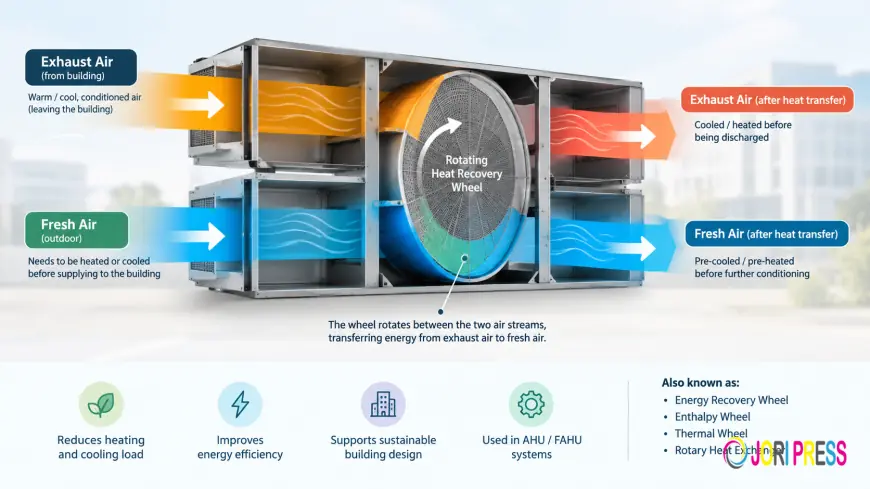
For people who are not mechanical engineers, understanding how a heat recovery wheel in HVAC works can initially seem complicated. However, the basic concept becomes much easier when we look at what happens to fresh air and exhaust air inside a building.
A heat recovery wheel is an energy recovery heat exchanger that works between two streams of air. It is also known as an Energy Recovery Wheel, Enthalpy Wheel, Thermal Wheel, or Rotary Heat Exchanger.
But how does it actually work? Why is it used in buildings? And how does it help reduce the energy required for heating or cooling fresh air?
This article explains the concept in simple terms and focuses on the working principle and applications of a heat recovery wheel in HVAC systems.
What Is a Heat Recovery Wheel?
A Heat Recovery Wheel is a type of energy recovery heat exchanger that operates between two air streams.
Buildings use mechanical ventilation to bring fresh air into the building while extracting contaminated air. The incoming fresh air cannot simply be supplied to the building without conditioning. Depending on the required indoor conditions, the fresh air needs to be heated or cooled to reach an acceptable temperature and relative humidity.
At the same time, conditioned air from the building is being exhausted.
This creates an opportunity to recover energy from the exhaust air rather than allowing the conditioned air to leave the building without transferring its energy.
A heat recovery wheel rotates between the fresh-air and exhaust-air streams and transfers energy between them. In this way, the incoming fresh air can be pre-cooled or pre-heated before it undergoes further conditioning.
How Does a Heat Recovery Wheel Work?
The working principle can be understood through the movement of two air streams.
First, a building requires mechanical ventilation to supply fresh air and remove contaminated air. The fresh outdoor air enters the ventilation system, while air from inside the building is extracted.
The fresh air needs to be brought to an acceptable temperature and relative humidity. Heating or cooling this fresh air requires energy.
Meanwhile, the exhaust air leaving the building has already been conditioned.
The heat recovery wheel rotates between these two air streams. As it rotates, it transfers energy between the fresh air and exhaust air.
This energy transfer allows the incoming fresh air to be pre-cooled or pre-heated before it reaches the next stage of conditioning.
As a result, the amount of heating or cooling energy required for the fresh air can be reduced.
This is the key principle behind a heat recovery wheel: recover energy from the exhaust air and transfer it to the incoming fresh air stream.
Why Is Heat Recovery Important in HVAC?
Fresh-air conditioning can consume significant energy because outdoor air needs to be conditioned before it can be supplied to the building.
The situation becomes particularly important when a building uses mechanical ventilation continuously. Fresh air is supplied while contaminated air is extracted, meaning conditioned air is continuously leaving the building.
A heat recovery wheel provides a way to transfer energy between these two air streams.
Instead of treating the incoming fresh air completely independently from the exhaust air, the heat recovery wheel allows energy to be transferred between them.
The incoming air can therefore be pre-cooled or pre-heated, reducing the heating or cooling energy required afterward.
This makes heat recovery an important concept when considering energy use associated with mechanical ventilation.
Heat Recovery Wheel in AHU and FAHU
The Conserve Solutions article illustrates the details of heat recovery wheels for both AHU and FAHU applications through cross-sectional views.
The same basic principle applies: the wheel operates between the air streams and transfers energy between fresh air and exhaust air.
For engineers and professionals working with HVAC systems, understanding this interaction is important when considering how fresh-air conditioning and exhaust-air streams are handled within a ventilation system.
Heat Recovery Wheel: Other Names
One reason people may find information about this technology under different search terms is that a heat recovery wheel has several commonly used names.
It may also be referred to as:
-
Energy Recovery Wheel
-
Enthalpy Wheel
-
Thermal Wheel
-
Rotary Heat Exchanger
Therefore, someone searching for an energy recovery wheel, enthalpy wheel, or rotary heat exchanger may be looking at the same fundamental heat recovery concept.
Understanding these related terms can also make it easier to find technical information about the technology.
How Is Heat Recovery Wheel Effectiveness Evaluated?
Understanding how a heat recovery wheel works is only one part of the process. Engineers may also need to understand its effectiveness.
Conserve Solutions refers to the calculation of heat recovery wheel effectiveness based on ASHRAE 84 and provides an interactive tool where users can enter real-time values to understand the calculation.
This provides a practical way to move beyond simply understanding the concept and examine heat recovery wheel effectiveness using relevant project values.
For professionals working with HVAC systems, such calculation-based evaluation can provide additional insight into the performance of the heat recovery wheel.
Who Can Benefit From Understanding Heat Recovery Wheels?
The topic is particularly relevant to people involved in mechanical and building systems who need to understand how ventilation air is conditioned.
This includes professionals working with:
-
HVAC systems
-
Air Handling Units (AHU)
-
Fresh Air Handling Units (FAHU)
-
Mechanical ventilation
-
MEP systems
-
Building sustainability
-
Energy efficiency
It is also useful for professionals and students who need a straightforward explanation of the heat recovery wheel concept for technical learning or green-building-related preparation.
A Simple Way to Remember the Concept
The entire working principle can be simplified into four steps:
Fresh air enters → Exhaust air leaves → The wheel transfers energy between the two air streams → Fresh air is pre-cooled or pre-heated.
The purpose is not to eliminate the need for heating or cooling. Instead, the heat recovery wheel transfers energy between the two air streams so that the incoming fresh air can be conditioned more efficiently.
This simple principle explains why the technology is relevant to mechanical ventilation and HVAC applications.
Conclusion
A Heat Recovery Wheel provides a practical way to transfer energy between fresh-air and exhaust-air streams in mechanically ventilated buildings. By rotating between the two air streams, it can pre-cool or pre-heat incoming fresh air and thereby reduce the heating or cooling energy required for conditioning that air.
It is also important to remember the different terms used for the technology, including Energy Recovery Wheel, Enthalpy Wheel, Thermal Wheel, and Rotary Heat Exchanger.
For professionals who want to understand the concept in greater detail, including heat recovery wheel effectiveness based on ASHRAE 84, Conserve Solutions provides technical information and an interactive effectiveness calculation resource to support further understanding.
Understanding the basic operation of heat recovery wheels can help HVAC and building professionals better understand the relationship between mechanical ventilation, fresh-air conditioning, exhaust air, and energy recovery.
What's Your Reaction?
 Like
0
Like
0
 Dislike
0
Dislike
0
 Love
0
Love
0
 Funny
0
Funny
0
 Angry
0
Angry
0
 Sad
0
Sad
0
 Wow
0
Wow
0