









































Global Aircraft Tires Market: Growth Drivers and Future Outlook
Discover the global aircraft tires market outlook, growth drivers, demand trends, regional opportunities, segments and potential through 2032.

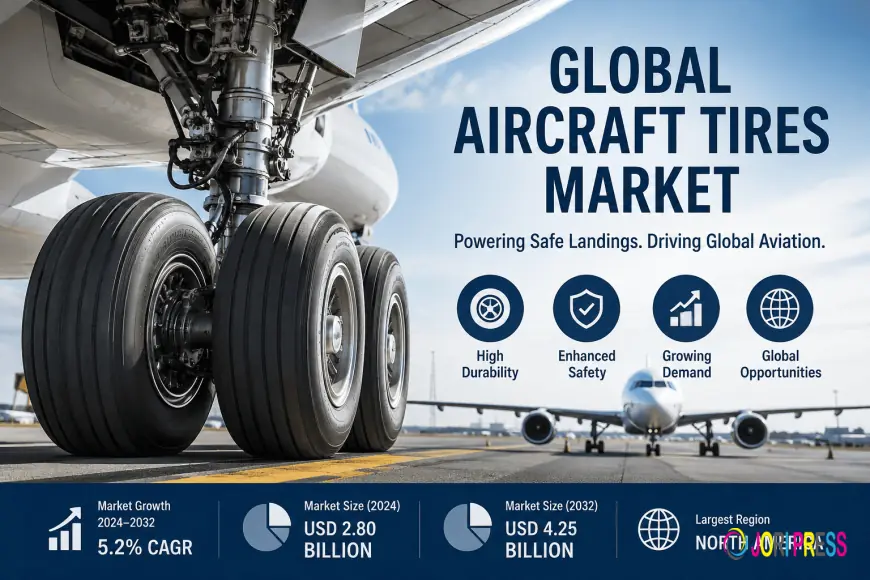
The aviation industry is entering a period of sustained expansion as passenger traffic rises, airline fleets modernize, and aircraft manufacturers increase production. At the center of this transformation is the need for reliable, high-performance components that can support aircraft safety and operational efficiency. The Global aircraft tires market is therefore gaining strategic importance, with 6Wresearch estimating the market at USD 1.6 billion in 2025 and projecting it to reach USD 2.3 billion by 2032, representing a CAGR of 5.10% during 2026–2032.
Global Aircraft Tires Market Growth Is Taking Off With Aviation Demand
The expansion of global aviation remains one of the strongest forces supporting the Global aircraft tires market. As airlines add aircraft and increase flight frequencies, tires experience more takeoffs, landings, braking cycles, and operational stress. This creates recurring replacement requirements while simultaneously increasing demand from original equipment manufacturers and maintenance, repair, and overhaul providers.
The market is also benefiting from the growth of low-cost carriers and rising air travel among middle-class populations in developing economies. Fleet modernization is encouraging operators to prioritize tires that can deliver durability, safety, lower maintenance requirements, and efficient performance. These factors create a broad demand base across commercial, regional, business, helicopter, and military aviation.
Advantages of Investing in Aircraft Tire Innovation
Investment opportunities are increasingly connected to technological innovation. Aircraft tires must withstand substantial loads, high speeds, temperature variations, runway friction, and repeated landing impacts. Manufacturers that develop products offering improved durability, reduced weight, better heat resistance, and longer service intervals can strengthen their competitive position.
The Global aircraft tires market is also moving toward smarter tire-management solutions. Sensor-enabled technologies can support real-time monitoring of pressure, wear, and operating conditions, helping airlines make maintenance decisions more efficiently. Such innovations can reduce unexpected maintenance events and support better asset utilization, creating opportunities for manufacturers and technology providers alike.
Why Airlines Prefer Aircraft Tires for Future Growth
For airlines and aircraft operators, tire performance directly affects operational reliability. A high-quality aircraft tire can contribute to safer landings, efficient braking, improved maintenance planning, and reduced replacement frequency. As fleets become larger and aircraft utilization increases, operators have stronger incentives to select tire solutions that balance performance with lifecycle economics.
The aftermarket is particularly important because aging aircraft fleets require replacement tires and associated services. According to 6Wresearch, the aftermarket segment is projected to grow at a 6.5% CAGR from 2026 to 2032, supported by increasing fleet age and replacement requirements. This creates a recurring revenue opportunity beyond initial aircraft deliveries.
Search Visibility Through Strong Aircraft Tire Market Insights
For businesses operating within the aerospace supply chain, understanding market trends can improve strategic positioning. Manufacturers, distributors, MRO providers, investors, and technology companies can use market intelligence to identify high-growth applications, evaluate regional opportunities, and understand competitive movements.
The Global aircraft tires market spans multiple dimensions, including construction, product type, aircraft category, platform, end-user, and tire position. This segmentation enables companies to identify specific opportunities rather than approaching the aviation tire industry as a single market. The 6Wresearch study covers radial and bias constructions, tube and tubeless products, commercial and military aircraft, fixed- and rotary-wing platforms, OEM and aftermarket channels, and main and nose/tail positions.
Demand and Benefits Are Strengthening Across Key Segments
Commercial aircraft currently represent the largest aircraft category, while fixed-wing aircraft account for the largest platform share. Radial tires also hold a leading position, while tubeless tires represent a substantial portion of the market because of their safety and weight-related advantages.
At the same time, faster-growing niches are creating new opportunities. Military aircraft tires are benefiting from increased defense aviation requirements, while rotary-wing applications are supported by demand for military helicopters and commercial operations. The aftermarket is another important growth avenue as operators seek replacement solutions for expanding and aging fleets.
Enhance User Experience With Safer and More Reliable Tire Technology
Although aircraft tires are not directly associated with passenger-facing technology, their performance contributes significantly to the overall travel experience. Reliable tires support controlled landings, effective braking, smooth ground operations, and aircraft availability. Better tire durability can also help reduce maintenance-related disruptions that affect airline schedules.
Technological advancements are expected to enhance this role further. Smart monitoring systems and improved materials can provide operators with better visibility into tire condition, allowing maintenance teams to identify potential issues earlier. Sustainability is also becoming more relevant as manufacturers explore environmentally responsible materials and improved lifecycle management.
Lifestyle Benefits From Expanding Air Connectivity
Growing air travel is changing how people work, study, conduct business, and travel internationally. More frequent flights and expanding airline networks depend on reliable aircraft operations, and tires are a fundamental part of that ecosystem.
Asia is particularly significant in this context. 6Wresearch identifies Asia as the fastest-growing regional market, with an estimated CAGR of 7.0% between 2026 and 2032. Increasing air travel in countries such as China and India, combined with aviation infrastructure investment, is creating a strong foundation for future aircraft tire demand.
Infrastructure Development Is Creating New Market Opportunities
Aviation infrastructure development is another important factor shaping market expansion. New airports, terminal upgrades, expanded runways, aircraft maintenance facilities, and growing MRO networks can support higher aircraft utilization and consequently increase tire requirements.
North America remains the largest regional market, supported by its established aviation infrastructure, while Asia offers strong expansion potential. This regional contrast provides opportunities for companies with different strategies: established markets can support replacement and premium products, while high-growth markets can generate demand through new aircraft deliveries, infrastructure expansion, and fleet modernization.
Technology, Sustainability, and Smart Maintenance Will Define the Future
The next phase of the Global aircraft tires market is likely to be shaped by a combination of material innovation, digitalization, sustainability, and lifecycle optimization. Manufacturers are increasingly exploring advanced materials and smart technologies that can improve tire performance while helping operators manage maintenance more efficiently.
Sustainability is also becoming a stronger strategic consideration. Eco-friendly materials, improved recyclability, reduced waste, and longer product life can help manufacturers respond to changing environmental expectations. At the same time, regulatory requirements continue to emphasize safety and performance, encouraging ongoing investment in research and development.
Wrapping Up
The Global aircraft tires market is moving beyond conventional replacement demand toward a broader growth story built around fleet expansion, air traffic growth, MRO activity, technological advancement, sustainability, and aviation infrastructure development. With the market projected to rise from USD 1.6 billion in 2025 to USD 2.3 billion by 2032, the sector presents meaningful opportunities for manufacturers, suppliers, investors, and aviation service providers.
For businesses evaluating the sector, acting early can provide an advantage as aircraft fleets expand and operators increasingly demand durable, efficient, and technologically advanced tire solutions. Investing now in market intelligence, product innovation, regional expansion, and strategic partnerships can help companies position themselves for the next stage of aviation growth.
Frequently Asked Questions
1. What is driving the Global aircraft tires market?
The Global aircraft tires market is primarily driven by rising air traffic, fleet expansion, aircraft modernization, and increasing replacement requirements. Growing MRO activity and demand for durable, high-performance tires are also supporting market development across commercial, military, regional, business, and helicopter aviation.
2. How large is the Global aircraft tires market?
According to 6Wresearch, the Global aircraft tires market was valued at approximately USD 1.6 billion in 2025. It is projected to reach around USD 2.3 billion by 2032, expanding at a CAGR of 5.10% between 2026 and 2032.
3. Which region is expected to grow fastest in aircraft tires?
Asia is expected to be the fastest-growing region in the Global aircraft tires market. Increasing air travel, expanding airline fleets, and investment in aviation infrastructure across countries such as China and India are expected to support regional growth through 2032.
4. Why are tubeless tires important in the aircraft tire market?
Tubeless tires are gaining importance because they can offer weight, safety, and operational advantages. In the Global aircraft tires market, tubeless products accounted for an estimated 70% share in 2025, reflecting strong adoption among aviation operators and manufacturers.
5. What is the role of the aftermarket in aircraft tires?
The aftermarket provides recurring demand because aircraft tires must be replaced throughout an aircraft's operating life. The Global aircraft tires market is expected to see strong aftermarket growth as commercial fleets age and airlines require dependable replacement products and maintenance services.
6. Which aircraft segment dominates the market?
Commercial aircraft currently represent the largest aircraft segment in the Global aircraft tires market. Their large fleet base, high flight frequency, and recurring tire replacement requirements create substantial demand, while military aircraft are expected to record comparatively strong growth during the forecast period.
7. How is technology changing aircraft tires?
Technology is improving aircraft tires through advanced materials, digital manufacturing, and smart monitoring systems. These developments can support better pressure and wear monitoring, maintenance planning, durability, and operational efficiency, making technology an increasingly important competitive factor in the aircraft tire market.
8. What opportunities exist for investors in aircraft tires?
Investment opportunities exist across tire manufacturing, smart tire technologies, sustainable materials, aftermarket services, and regional expansion. The Global aircraft tires market also offers potential in military aviation, electric aircraft, and emerging urban air mobility applications as these segments develop.
9. Why is sustainability becoming important for aircraft tires?
Sustainability is becoming increasingly relevant because aviation companies are seeking ways to reduce environmental impact and improve resource efficiency. In the Global aircraft tires market, manufacturers are exploring sustainable materials, improved recyclability, longer product lifecycles, and technologies designed to reduce tire waste.
10. What is the future outlook for the Global aircraft tires market?
The future outlook remains positive, supported by rising air travel, fleet modernization, MRO expansion, infrastructure investment, and technological innovation. The Global aircraft tires market is expected to continue expanding through 2032 as operators prioritize safety, durability, efficiency, and increasingly sustainable tire solutions.
What's Your Reaction?
 Like
0
Like
0
 Dislike
0
Dislike
0
 Love
0
Love
0
 Funny
0
Funny
0
 Angry
0
Angry
0
 Sad
0
Sad
0
 Wow
0
Wow
0