










































FSMA 204 Compliance: A Complete Guide to Food Supply Chain Traceability
Learn how FSMA 204 compliance works, what Critical Tracking Events and Key Data Elements mean, and how digital food traceability can support faster recalls and better supply chain visibility.

Introduction
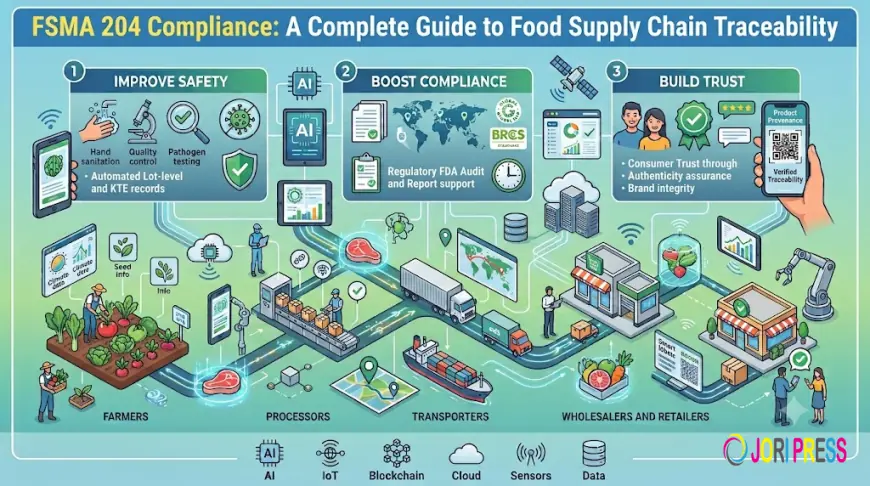
Food supply chains have become increasingly complex. A single food product can move through farms, processors, manufacturers, distributors, warehouses, retailers, and other supply chain partners before reaching consumers. When information about these movements is fragmented, identifying affected products during a food safety incident can become difficult and time-consuming.
This is where FSMA 204 compliance and modern food traceability practices become important.
The U.S. Food and Drug Administration's Food Safety Modernization Act (FSMA) Section 204 focuses on improving traceability for certain foods on the Food Traceability List. The rule establishes additional recordkeeping requirements around specific supply chain events and data elements so that affected foods can be traced more efficiently.
For businesses operating in or supplying the U.S. food market, understanding these requirements is an important part of building a modern food safety and traceability strategy.
Digital traceability technology can help organizations capture, organize, connect, and retrieve supply chain information. However, technology should be viewed as an enabler of compliance processes rather than a substitute for regulatory assessment, documented procedures, or legal advice.
What Is FSMA 204?
FSMA 204 is a section of the Food Safety Modernization Act that addresses additional traceability recordkeeping requirements for certain foods.
The FDA's Food Traceability Rule establishes a standardized approach for documenting important events in the supply chain. Rather than relying only on traditional records, the framework emphasizes information that can help organizations trace food products through specific points in their journey.
The objective is straightforward:
Make it easier and faster to identify where food came from and where it went.
Better traceability can support:
- Faster identification of affected products
- More targeted recalls
- Improved food safety investigations
- Better supply chain visibility
- More consistent recordkeeping
- Faster access to relevant product information
- Improved collaboration between supply chain partners
For businesses, FSMA 204 compliance therefore involves more than simply storing documents. Organizations need processes that enable relevant traceability information to be captured, maintained, and retrieved effectively.
Why Is FSMA 204 Compliance Important?
Food safety incidents can affect multiple organizations simultaneously.
A contaminated ingredient may have passed through several facilities before becoming part of a finished product. Without reliable traceability records, determining the scope of the issue may require manually reviewing invoices, spreadsheets, emails, paper records, warehouse systems, and supplier documents.
This can slow down investigations and increase the difficulty of managing recalls.
A well-designed food traceability system can help create a connected view of product movements.
1. Faster Product Identification
Traceability data can help organizations determine which products, lots, or batches may be associated with a particular event.
2. More Targeted Recalls
Instead of treating an entire product category as potentially affected, organizations may be able to identify specific lots or supply chain segments involved in an incident.
3. Better Supply Chain Visibility
Digital records can provide greater visibility into product movement across suppliers, processors, distributors, and other participants.
4. Improved Record Retrieval
During an investigation or audit, teams need to retrieve relevant information quickly. Centralized digital records can make this process more efficient.
5. Stronger Supply Chain Collaboration
Food traceability often depends on information coming from multiple organizations. Standardized data and connected systems can make information exchange easier.
Understanding Critical Tracking Events
One of the important concepts associated with the FSMA Food Traceability Rule is the Critical Tracking Event (CTE).
A Critical Tracking Event is a specific event in the supply chain where relevant traceability information needs to be recorded.
Examples of supply chain activities can include:
- Growing
- Receiving
- Transforming
- Creating
- Shipping
The exact requirements depend on the applicable product and supply chain activity.
The purpose is to establish traceability records around important points where food changes ownership, location, or form.
For example, consider a packaged food product.
The traceability journey could involve:
Farm → Processor → Manufacturer → Distributor → Retailer → Consumer
Each relevant stage can contribute information that helps establish the product's history.
This creates a connected chain of records instead of isolated documents.
What Are Key Data Elements?
Another major concept is the Key Data Element (KDE).
KDEs are specific pieces of information associated with relevant Critical Tracking Events.
Depending on the event, information can include details such as:
- Product identification
- Lot information
- Quantity
- Location
- Date
- Business identification
- Receiving information
- Shipping information
- Transformation information
- Other applicable traceability information
The exact data requirements vary depending on the event and product.
This is why organizations should not assume that a generic inventory system automatically provides everything required for their particular traceability process.
A traceability platform should instead be configured around the organization's actual products, supply chain activities, partners, and applicable regulatory requirements.
FSMA 204 and the Food Traceability List
The Food Traceability Rule applies to foods included on the FDA's Food Traceability List (FTL), subject to the rule's scope and applicable exemptions.
Examples of food categories associated with the list include certain:
- Cheeses
- Shell eggs
- Nut butters
- Cucumbers
- Herbs
- Leafy greens
- Melons
- Peppers
- Tomatoes
- Tropical tree fruits
- Fresh-cut fruits and vegetables
- Ready-to-eat deli salads
- Certain seafood products
The applicability of the rule can depend on the specific product and supply chain activity.
Therefore, food businesses should review the current FDA requirements and determine whether their products and operations fall within the applicable scope.
How Digital Food Traceability Supports FSMA 204 Processes
Manual recordkeeping can become difficult when organizations manage large numbers of suppliers, products, lots, locations, and transactions.
A digital food traceability platform can provide a centralized environment for managing traceability information.
A typical workflow can look like this:
Step 1: Product Identification
The business establishes consistent product, lot, batch, or other identification methods.
Step 2: Supplier Data Collection
Relevant information is collected from suppliers and upstream partners.
Step 3: Event Capture
Important supply chain events are recorded as products move through the organization.
Step 4: Transformation Tracking
When ingredients or raw materials are transformed into another product, the relationship between inputs and outputs can be recorded.
Step 5: Distribution Tracking
Shipping and receiving activities can connect products to downstream locations.
Step 6: Centralized Data Storage
Relevant traceability information is maintained in a searchable digital environment.
Step 7: Rapid Traceback
If a food safety issue occurs, teams can use connected records to investigate product movement and identify potentially affected products.
Batch and Lot Traceability
Lot traceability is one of the most important capabilities in food supply chain management.
A lot or batch identifier provides a way to connect a product to relevant supply chain information.
For example:
Supplier → Ingredient Lot → Production Batch → Finished Product → Distribution Location
If an ingredient is associated with a food safety problem, the business can use traceability relationships to investigate which production batches used that ingredient.
This can help reduce the amount of manual investigation required during a recall.
Digital systems can also help businesses maintain relationships between:
- Raw materials
- Ingredients
- Production batches
- Finished products
- Warehouses
- Shipments
- Customers
- Distribution locations
This creates a more complete traceability chain.
Food Recall Management and FSMA 204
One of the strongest business benefits of improved traceability is better recall management.
A recall requires fast action.
Organizations may need to answer questions such as:
- Which product is affected?
- Which lot is involved?
- Which supplier provided the ingredient?
- Which production batches used that ingredient?
- Where were the affected products shipped?
- Which customers received them?
- How much inventory remains?
- Which facilities handled the product?
Without connected data, answering these questions can take significant time.
With digital traceability, organizations can use product and lot relationships to investigate these questions more efficiently.
Example
Imagine a food manufacturer discovers that a specific ingredient lot may be contaminated.
A digital traceability system could help the organization identify:
Ingredient Lot → Production Batches → Finished Product Lots → Shipments → Distribution Locations
This enables the company to investigate the potentially affected product scope more efficiently.
The goal is not simply to make recalls faster. It is also to make them more targeted and data-driven.
Technology Used for Modern Food Traceability
Businesses can use several technologies to support digital traceability.
QR Codes
QR codes can provide a cost-effective way to identify products, lots, cases, or other traceability units.
They can connect physical products with digital records.
RFID
RFID technology can automate identification and tracking in environments where products move through warehouses, production facilities, or distribution centers.
Barcode Technology
Barcodes remain widely used for product and logistics identification.
They can be integrated with digital traceability platforms to connect physical inventory with digital records.
IoT Sensors
IoT devices can capture information such as:
- Temperature
- Humidity
- Location
- Environmental conditions
This can be particularly useful for temperature-sensitive food products.
Cloud Platforms
Cloud-based traceability platforms can allow authorized users and supply chain partners to access relevant information across multiple locations.
APIs and System Integrations
Traceability systems can integrate with:
- ERP platforms
- Warehouse management systems
- Inventory software
- Manufacturing systems
- Supplier platforms
- Logistics systems
Integration reduces the need to manually transfer information between systems.
How FSMA 204 Can Influence Supply Chain Data Management
FSMA 204 encourages businesses to think more systematically about traceability information.
Instead of treating traceability as a collection of separate documents, organizations can build a connected data model.
For example:
Product
↓
Lot
↓
Critical Tracking Event
↓
Location
↓
Supplier or Customer
↓
Shipment
This relationship-based approach can make product investigations more efficient.
It also creates opportunities for organizations to use traceability information beyond regulatory recordkeeping.
The same data can support:
- Inventory management
- Supplier performance analysis
- Recall preparedness
- Quality management
- Demand planning
- Operational analytics
- Product transparency
Benefits of Implementing a Digital Food Traceability System
A modern food traceability solution can provide several operational benefits.
1. Better Product Visibility
Organizations can gain a clearer understanding of where products are located throughout the supply chain.
2. Faster Investigations
Connected records can reduce the amount of time teams spend searching across disconnected systems.
3. Improved Recall Readiness
Businesses can establish processes for quickly identifying potentially affected products.
4. Reduced Manual Work
Digital workflows can reduce dependency on spreadsheets and paper-based processes.
5. Better Supplier Visibility
Businesses can connect supplier information with ingredients, lots, batches, and production records.
6. Improved Data Accuracy
Standardized digital processes can reduce data-entry inconsistencies.
7. Better Customer Transparency
Depending on the business model, traceability information can support consumer-facing transparency initiatives.
8. Stronger Business Resilience
Organizations with better supply chain visibility may be better positioned to identify disruptions and respond to operational risks.
Common Challenges With FSMA 204 Implementation
Implementing a traceability strategy can present challenges.
Fragmented Data
Many organizations have information spread across multiple systems.
Supplier Data Gaps
Traceability depends on information from upstream and downstream partners. Missing data can weaken the overall chain.
Inconsistent Identification
Different organizations may use different product, lot, or location identifiers.
Legacy Systems
Older software may not easily support modern traceability workflows.
Manual Processes
Spreadsheets and paper records can make large-scale traceability difficult to maintain.
Employee Training
Employees need to understand how and when traceability information should be captured.
Integration Complexity
Connecting ERP, warehouse, manufacturing, logistics, and traceability platforms may require careful planning.
Best Practices for FSMA 204 Readiness
Businesses can take a structured approach to improving traceability.
1. Map Your Supply Chain
Document how products move from suppliers to customers.
2. Identify Relevant Products
Determine which products may fall within the applicable regulatory scope.
3. Map Critical Tracking Events
Identify where relevant events occur in your operations.
4. Define Required Data
Establish which data elements need to be captured at each stage.
5. Standardize Identification
Create consistent approaches for products, lots, batches, locations, and trading partners.
6. Reduce Manual Data Entry
Where practical, use barcode, QR, RFID, API, and system integrations to automate data capture.
7. Test Traceback Workflows
Do not wait for an actual recall to discover that information is difficult to retrieve.
Conduct traceability exercises to identify gaps.
8. Establish Data Ownership
Clearly define who is responsible for creating, validating, updating, and maintaining traceability records.
9. Secure Traceability Data
Use appropriate access controls, authentication, backups, and security measures.
10. Review Requirements Regularly
Regulatory requirements can change. Businesses should monitor applicable regulatory guidance and work with qualified compliance professionals when necessary.
Choosing Food Traceability Software
When evaluating food traceability software, businesses should look beyond basic inventory tracking.
Important capabilities may include:
- Lot and batch tracking
- Supplier management
- Product genealogy
- Traceability event management
- Receiving and shipping records
- Recall management
- QR and barcode support
- RFID integration
- IoT integration
- Document management
- Audit trails
- Reporting
- Searchable records
- API integrations
- Role-based access
- Cloud deployment
- Data export capabilities
The best solution depends on the organization's products, operational processes, supply chain complexity, and regulatory obligations.
The Role of Automation in Food Traceability
Automation can significantly improve the efficiency of traceability operations.
For example, a business can automate data collection when products are:
Received → Stored → Processed → Packed → Shipped
Instead of employees repeatedly entering the same information manually, integrated systems can capture relevant events automatically.
Automation can also trigger alerts when:
- Required information is missing
- A product reaches a defined condition
- A supplier record is incomplete
- A temperature threshold is exceeded
- A recall investigation begins
- A traceability relationship cannot be established
This allows teams to focus on exceptions rather than manually checking every transaction.
AI and the Future of Food Traceability
Artificial intelligence can add another layer of intelligence to digital traceability systems.
AI can analyze large volumes of supply chain data to identify unusual patterns.
Potential applications include:
- Supplier risk analysis
- Anomaly detection
- Predictive quality monitoring
- Recall impact analysis
- Demand forecasting
- Risk scoring
- Automated data validation
- Supply chain disruption prediction
For example, an AI-powered system could analyze historical supplier, product, shipment, and quality data to identify unusual patterns that deserve investigation.
However, AI depends heavily on the quality and completeness of the underlying data.
A business should therefore establish strong foundational traceability before expecting AI to deliver reliable results.
Preparing for a More Connected Food Supply Chain
Food traceability is moving toward greater digital connectivity.
Future systems are likely to combine:
Traceability + IoT + AI + Cloud + Digital Identity + Automated Workflows
This could create supply chains where product information is available closer to real time.
For businesses, the long-term objective should not simply be regulatory recordkeeping.
The larger opportunity is to build a supply chain where reliable data supports:
- Safety
- Transparency
- Efficiency
- Quality
- Sustainability
- Risk management
- Customer trust
How TransGenie Can Support Digital Food Traceability
Businesses looking to modernize their food traceability processes can use digital platforms to connect product, supplier, batch, lot, and supply chain information.
TransGenie focuses on digital traceability capabilities that can help businesses improve visibility across complex supply chains.
A traceability platform can help organizations establish connected product records, manage supply chain information, support lot and batch tracking, and create a foundation for faster product investigations.
The exact implementation should be designed around each organization's products, processes, trading partners, and applicable regulatory requirements.
For businesses preparing for more connected food supply chains, implementing a scalable digital traceability foundation can be an important step toward improving operational visibility and recall readiness.
Conclusion
FSMA 204 compliance has made food traceability an increasingly important consideration for organizations operating within affected food supply chains.
The core objective is better access to information about where food comes from, how it moves through the supply chain, and where it goes.
Businesses can strengthen their traceability programs by:
- Mapping their supply chains
- Understanding applicable regulatory requirements
- Identifying relevant tracking events
- Capturing required data
- Standardizing product and lot identification
- Connecting suppliers and downstream partners
- Automating data collection
- Testing recall and traceback processes
- Using digital traceability platforms
Technology alone does not guarantee regulatory compliance. But the right technology can provide the infrastructure businesses need to manage traceability information more efficiently.
As food supply chains become more complex, digital traceability will increasingly become a strategic capability—not simply a compliance exercise.
Frequently Asked Questions
What is FSMA 204 compliance?
FSMA 204 compliance refers to meeting the applicable additional traceability recordkeeping requirements established under Section 204 of the Food Safety Modernization Act for foods and activities within the rule's scope.
What is the purpose of FSMA 204?
The rule is designed to improve the traceability of certain foods by establishing additional recordkeeping requirements around specified supply chain events and data elements.
What are Critical Tracking Events?
Critical Tracking Events are defined supply chain events around which relevant traceability information must be recorded under the applicable requirements.
What are Key Data Elements?
Key Data Elements are specific pieces of information associated with applicable Critical Tracking Events. The required information depends on the event and product.
Does FSMA 204 apply to every food product?
No. The Food Traceability Rule has a defined scope and applies to foods included on the applicable Food Traceability List, subject to exemptions and other requirements.
Can software guarantee FSMA 204 compliance?
No. Software can support traceability and recordkeeping processes, but compliance depends on the organization's products, operations, procedures, data, and applicable regulatory requirements.
How can food traceability software help with recalls?
Digital traceability software can connect products, lots, batches, suppliers, shipments, and locations, helping teams investigate potentially affected products more efficiently.
What's Your Reaction?
 Like
0
Like
0
 Dislike
0
Dislike
0
 Love
0
Love
0
 Funny
0
Funny
0
 Angry
0
Angry
0
 Sad
0
Sad
0
 Wow
0
Wow
0