





































Finance PSST Ramathan Ggoobi, MOH PS Atwine Commit to Support Dei Biopharma

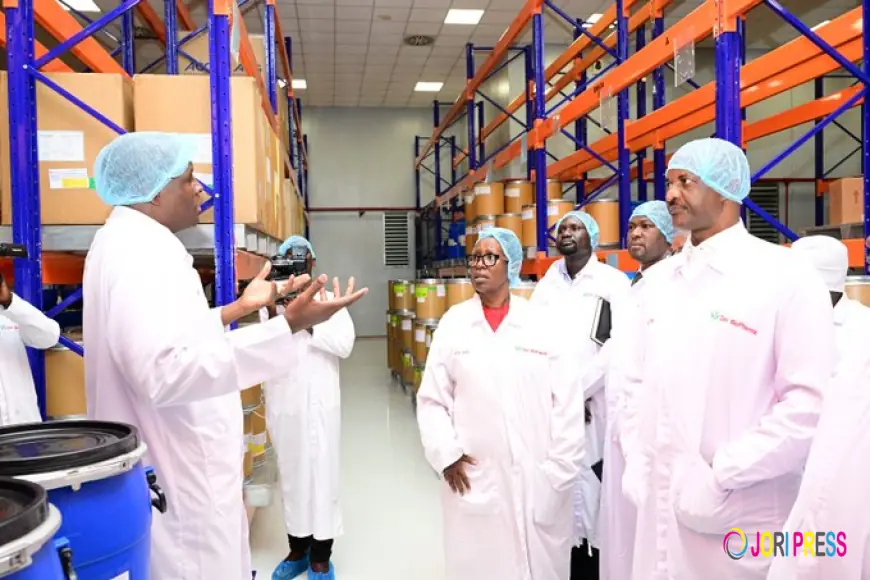
The Permanent Secretary snd Secretary to tbe Treasury Mr. Ramathan Ggoobi together the Permanent Secretary to the Ministry of Health Ministry Dr. Diana Atwine have backed the Dei Biopharma drug manufacturing plant in Matugga, Wakiso District, as a potential engine of economic growth and a key solution to Uganda’s growing medicine import bill, which has for years consumed the country’s foreign exchange reserves.
While touring the plant in Monday, fkanked by officials from National Medical Stores (NMS) to assess the progress and potential of the pharmaceutical investment, they said that the government has invested more than Shs700 billion (about $190 million) in the facility, with additional funding allocated under the Science and Technology budget in the new financial year.
Dr. Ggoobi described the plant as one of the largest pharmaceutical manufacturing facilities he has visited, saying the government’s inspection was aimed at assessing the scale of the investment and ensuring value for money.
“People ask if Dr. Matthias Magoola is serious, if he can actually produce the medicine and medical supplies he talks about,” Dr. Ggoobi said, referring to the company’s founder. “So far, it is always a good surprise when you come here. We are on the right track as far as emerging sectors in our economy, especially manufacturing and the knowledge economy, are concerned.”
He said Uganda spends billions of shillings annually importing medicines that could potentially be produced locally, adding that Dei Biopharma’s expansion could significantly reduce the country’s dependence on imported pharmaceutical products.
The facility currently produces about nine generic medicines, including paracetamol and capsules used in cancer treatment, and plans to expand into insulin, vaccines and cardiovascular medicines.
Dr. Ggoobi said that if the project achieves its targets, it could replace nearly half of Uganda’s medicine imports, retain foreign exchange within the economy and create thousands of jobs.
He, however, stressed that government support for the project comes with accountability measures.
“The Auditor General audits the project regularly because the government holds a stake in it as a co-investor,” Dr. Ggoobi said, adding that a newly appointed panel of about six bankers and scientists approved by President Yoweri Museveni will review future funding requests before additional resources are released.
He also highlighted the government’s fiscal discipline, noting that the financial year ended on June 30 with all submitted invoices paid and a remaining balance.
“We cannot develop Uganda by simply growing more potatoes and maize,” Dr. Ggoobi said. “We need emerging sectors of the economy that offer a high return on investment. Science, technology and innovation is an accelerator industry, and this campus is by far the leader in taking Uganda to another level.
Meanwhile, Dr. Atwine pledged that the Ministry of Health would support local pharmaceutical manufacturers through government procurement under the Buy Uganda, Build Uganda (BUBU) policy.
She said the ministry would purchase medicines produced by Dei Biopharma alongside other local manufacturers, providing the company with a reliable domestic market as it expands operations.
Dr. Atwine said the long-term goal is for Dei Biopharma products to receive prequalification from the World Health Organization and other international regulators, allowing Uganda to access wider African and global markets.
She noted that the facility still requires additional investments in human resources, product approvals, domestic production of active pharmaceutical ingredients (APIs), research and development.
“Dei Biopharma needs to be given the opportunity to grow,” Dr. Atwine said. “It must be supported to ensure it achieves its goals.”
Dr. Matthias Magoola said the company has filed more than 100 patent applications with the United States Patent and Trademark Office covering treatments for cancer, HIV, malaria, tuberculosis, sickle cell disease, diabetes and Alzheimer’s disease.
The company has also submitted patents for a cancer immunotherapy treatment and a foot-and-mouth disease vaccine for livestock, while pursuing plans to manufacture cheaper generic versions of patented medicines.
The National Drug Authority has already licensed the company to manufacture several biological medicines, including filgrastim, erythropoietin and trastuzumab.
However, Dr. Magoola said the plant’s full production capacity remains limited by inadequate electricity supply.
He said the facility currently operates only three or four of its eight completed production blocks because it lacks sufficient power, adding that full operations will require up to 80 megawatts of electricity.
The plant also consumes up to two million litres of water daily and is not yet connected to the National Water and Sewerage Corporation network.
“We are requesting that the government provide us with stable and sufficient power to run this facility,” Dr. Magoola said, adding that extending the national water grid to the facility is also critical.
What's Your Reaction?
 Like
0
Like
0
 Dislike
0
Dislike
0
 Love
0
Love
0
 Funny
0
Funny
0
 Angry
0
Angry
0
 Sad
0
Sad
0
 Wow
0
Wow
0