






































The Right Way to Run Facebook Ads as a Marriage Counselor
A practical breakdown of how marriage counselors can run Facebook ads correctly, covering compliance, realistic budgets, and why most campaigns fail on the landing page, not the ad.
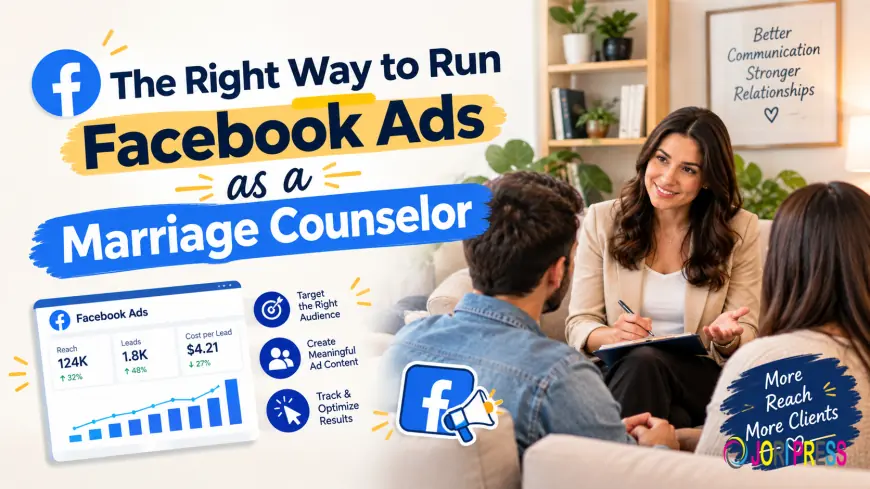
Ask ten marriage counselors about Facebook ads and you'll likely get five different opinions, ranging from "it filled my calendar" to "I lost hundreds of dollars and got nothing." Both can be true at the same time, because the outcome usually depends less on the platform itself and more on a handful of decisions most people never get right on the first attempt.
This piece walks through what actually separates a Facebook ad campaign that works for a marriage counseling practice from one that quietly burns through a budget without producing a single booked session.
Facebook is not a search engine, and treating it like one is the first mistake
Someone typing a marriage counselor into Google has already made a decision, they're actively looking and ready to act on what they find. Facebook works nothing like that. People scrolling their feed aren't thinking about counseling at all in that moment, which means an ad has to do more work than simply showing up, it has to interrupt a scroll and plant something worth remembering later.
This changes what a good campaign is even trying to accomplish. Rather than expecting immediate bookings the way a Google search campaign might deliver, Facebook tends to work better as a way to stay visible to people who've already shown some interest, whether that's visiting your website once or engaging with a previous post. For counselors weighing both channels, google ads for therapists covers how the search side of this works, which tends to complement rather than replace what Facebook does.
The targeting mistake almost everyone makes early on
New advertisers often try to target people directly interested in marriage counseling or relationship struggles, assuming that option exists somewhere in Meta's targeting menu. It doesn't, and hasn't for years. Meta removed the ability to target based on health related interests, including anything tied to mental health or relationship difficulties, which rules out the most obvious targeting approach entirely.
What tends to work instead is targeting life stages that often precede someone seeking counseling on their own, newly engaged couples, recently married couples, and people navigating major relationship transitions within a realistic service area. Since Meta's delivery system is largely automated at this point, understanding how meta ads for marriage counselors should actually be structured makes a real difference in whether that automation works for you or just burns through budget while it learns.
The part almost no guide actually explains
Here's where most advice about Facebook ads for any therapy adjacent field falls short, and it's arguably the most important part. Meta's tracking pixel, the tool that measures whether someone booked an appointment after clicking an ad, was never designed with healthcare privacy rules in mind. Meta doesn't sign the legal agreement required to handle protected health information safely, which means a careless setup can send patient related data to Meta's servers without anyone realizing it happened.
This isn't a small technicality. If a booking confirmation page reveals through its URL or title that someone scheduled couples counseling, and the pixel fires there, that data heading to Meta can constitute a real compliance violation, regardless of good intentions. Several healthcare providers have already faced serious legal consequences over nearly identical setups. The fix isn't avoiding tracking altogether, it's being deliberate about what the pixel can see, keeping it off any page that reveals specific health information and firing conversion events only on generic confirmation pages.
What it actually costs to test properly
Most Facebook ad cost figures online are averaged across every industry, which makes them mostly useless for a specific field like counseling. For services adjacent to healthcare, cost per click tends to run somewhat above the general average, and cost per lead typically falls somewhere between the high teens and high twenties in dollars, though location and local competition shift that meaningfully.
A fair test generally starts around ten to twenty dollars a day, run for at least two to four weeks. Below that daily spend, Meta's system rarely has enough data to optimize delivery properly, which means a short, underfunded test usually just produces noise rather than a real answer about whether the approach works.
Messaging that builds trust instead of urgency
Couples weighing whether to try counseling are often already hesitant, which makes fear based or urgency driven messaging risky rather than effective. Ads that frame counseling as a crisis response tend to push people away. What tends to work better is language that treats counseling as something proactive, a step healthy relationships take too, rather than a last resort.
Video also consistently outperforms static images in this space, largely because trust builds faster when someone can actually see and hear the person they might eventually sit across from. A short, unpolished video explaining your approach often beats a heavily designed graphic with a headline and button.
If clicks aren't turning into bookings, look here first
When a campaign generates clicks but few actual bookings, the instinct is to blame the ad itself. More often, the real issue sits on the landing page. A page that's unclear about next steps, asks for too much upfront, or loads too slowly will undercut even a well built campaign. Comparing click through rate against actual booking rate separately usually reveals which side of the equation is actually broken, the ad or the page it leads to. For a deeper look at how targeting systems evolved into the automated versions running today, how AI is used in PPC breaks down the mechanics behind both Meta and Google's current approach.
Running Facebook ads well as a marriage counselor isn't about finding a secret targeting trick or a clever piece of ad copy. It comes down to realistic expectations, compliance handled correctly from the start, and a campaign built around how people actually behave on the platform rather than copied from advice meant for a completely different kind of business. For a broader breakdown of the full setup process, this facebook ads for marriage counselors guide covers the fundamentals from the ground up.
What's Your Reaction?
 Like
0
Like
0
 Dislike
0
Dislike
0
 Love
0
Love
0
 Funny
0
Funny
0
 Angry
0
Angry
0
 Sad
0
Sad
0
 Wow
0
Wow
0