

































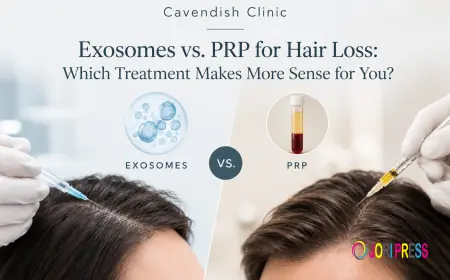






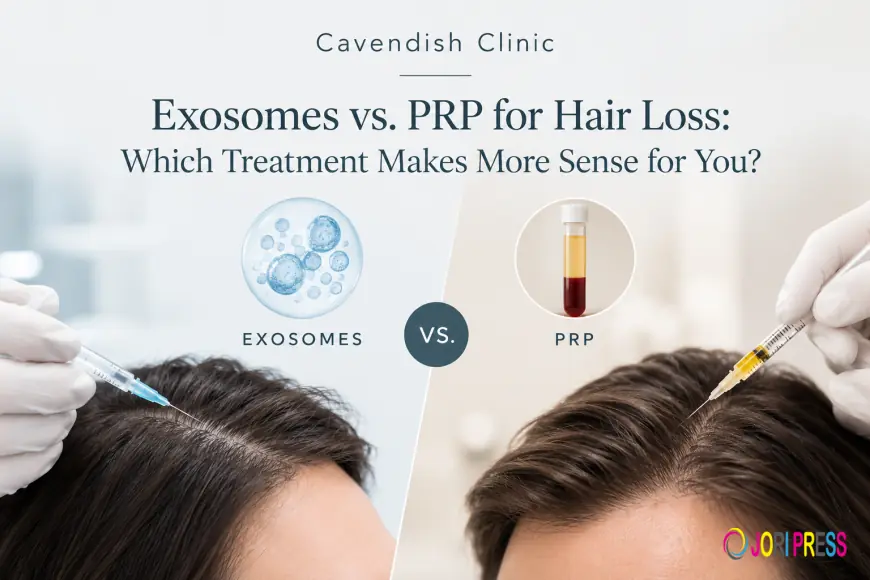
Exosomes vs. PRP for Hair Loss: Which Treatment Makes More Sense for You?
If you have started researching treatments for thinning hair, two names probably keep coming up: PRP and exosomes. Both are nonsurgical, both are performed in clinic, and both aim to wake up tired hair follicles rather than simply cover up the problem.
So which one should you choose? The honest answer is that it depends on your hair loss, your comfort with needles and blood draws, your budget and the results you are hoping for. In this guide, we compare exosomes and PRP side by side, explain how each one works, and help you work out which option makes more sense for you.
What Is PRP Hair Treatment?
PRP stands for platelet rich plasma. It has been used in sports medicine, dentistry and wound care for decades, and in hair restoration for well over ten years.
The process starts with a small blood sample, much like a routine blood test. The blood is placed in a centrifuge, which spins it at high speed to separate the platelets from the red blood cells. The resulting golden plasma, rich in platelets, is then injected into areas of the scalp where hair is thinning.
Platelets contain growth factors that support tissue repair. When delivered to the scalp, these growth factors are thought to improve blood supply to the follicles, extend the growing phase of the hair cycle and encourage thicker hair. Because PRP comes from your own body, the risk of an allergic reaction is very low.
The main limitation is that results depend partly on the quality of your own blood. Age, health, hydration and even the day of treatment can affect how concentrated and active your platelets are.
What Is Exosome Hair Therapy?
Exosomes are microscopic particles that cells release to send messages to one another. Each one carries a cargo of proteins, growth factors, lipids and genetic signals such as microRNA. When these messengers reach other cells, they can encourage repair, reduce inflammation and stimulate renewal.
In hair treatment, a purified exosome solution, usually derived from stem cells grown in a laboratory, is delivered into the scalp through fine microinjections or microneedling. The aim is to send regenerative instructions directly to weakened follicles and to the dermal papilla cells that control hair growth.
A treatment such as Exosome Hair Rejuvenation needs no blood draw, and because the solution is prepared to a set standard, each session delivers a consistent formula. Exosomes are a newer option than PRP, which makes them exciting but also means the research is still developing.
Exosomes vs. PRP at a Glance
|
Factor |
PRP |
Exosomes |
|---|---|---|
|
Source |
Your own blood |
Purified exosomes from laboratory grown stem cells |
|
Blood draw needed |
Yes |
No |
|
Consistency |
Varies with your health and blood quality |
Standardised formula each session |
|
Typical course |
3 to 4 sessions, about a month apart |
1 to 3 sessions, a few weeks apart |
|
Session time |
60 to 90 minutes including preparation |
45 to 60 minutes |
|
Downtime |
Minimal, mild tenderness |
Minimal, mild redness |
|
Research history |
Over a decade of studies |
Newer, early but encouraging evidence |
|
Typical cost |
Usually lower per session |
Usually higher per session |
The Key Differences Explained
Comfort and convenience
PRP requires a blood draw before every session, followed by processing time while the sample is spun. For people who feel anxious around needles or faint easily at the sight of blood, this can be a real barrier. Exosome treatment skips that step entirely, which makes appointments shorter and often more relaxed.
Consistency of results
With PRP, the treatment is only as strong as your platelets on the day. Someone who is older, unwell or taking certain medicines may have a less potent sample. Exosome solutions are prepared to a defined concentration, so every patient receives a similar dose of signalling molecules regardless of their own blood quality.
Strength of the signal
PRP mainly delivers growth factors. Exosomes carry growth factors too, along with microRNA and other messengers that may influence cell behaviour more broadly. Many practitioners believe this richer cargo gives exosomes a stronger regenerative effect, although head to head studies are still limited.
Evidence and track record
This is where PRP has the edge. It has been studied for longer, and a number of clinical trials support its use for pattern hair loss. Exosome research is younger. Early results are promising, but larger long term trials are needed, and exosome products are not currently licensed as medicines for hair loss in the UK. Choosing a reputable clinic with properly sourced products is essential.
Safety
Both treatments are generally well tolerated. Side effects for either tend to be mild and temporary: redness, tenderness, slight swelling or small bruises at treatment points.
Which Treatment Makes More Sense for You?
PRP may suit you if you prefer a treatment with a longer research history, you are comfortable with blood draws, you are in generally good health, and you want a more budget friendly option.
Exosomes may suit you if you dislike needles for blood tests, you want shorter appointments and fewer sessions, your own platelet quality may be lower because of age or health, or PRP has not given you the results you hoped for.
Neither may be right if you are pregnant or breastfeeding, have an active scalp infection, are having cancer treatment, or have areas that have been completely bald for years. If your shedding is sudden or patchy, see your GP first to rule out thyroid problems, low iron or other medical causes.
Do not forget the scalp itself
Whichever regenerative treatment you choose, follicles respond best in a clean, healthy scalp. HydraFacial Keravive Hair and Scalp cleanses, exfoliates and nourishes the scalp, clearing away buildup that can hold follicles back. For a more targeted boost, LaseMD Keralase for Hair uses a gentle laser to open microscopic channels before applying a growth factor solution, improving absorption. Both can be built into a plan alongside exosomes or PRP.
Frequently Asked Questions
Are exosomes more effective than PRP for hair loss?
Exosomes may deliver a broader range of regenerative signals, and some patients see stronger results. However, direct comparison studies are still limited, so neither can be called better for everyone.
Can I combine exosomes and PRP?
Yes, some clinics combine them in a single plan, either in the same session or in alternating appointments. Your practitioner can advise whether this suits your hair loss.
How long do results take with each treatment?
For both, reduced shedding often appears within six to eight weeks, with thicker hair becoming visible over three to six months.
Which treatment is less painful?
The scalp treatment itself feels similar for both, and numbing cream is usually used. Exosomes avoid the blood draw, so many people find the overall experience more comfortable.
Do I need maintenance sessions?
Usually, yes. Neither treatment stops genetic or age related hair loss for good, so occasional top up sessions help maintain your results.
Is either treatment suitable for women?
Both are suitable for women with thinning hair, including female pattern hair loss, as long as they are not pregnant or breastfeeding.
The Bottom Line
PRP and exosomes share the same goal: helping weakened follicles grow stronger, thicker hair without surgery. PRP offers a longer track record and a lower cost per session. Exosomes offer treatment with no blood draw, consistent formulation and potentially a richer regenerative signal, backed by newer but growing evidence.
The right choice comes down to your hair loss pattern, health, comfort and goals. At Cavendish Clinic, our practitioners assess your scalp, explain realistic outcomes and recommend a plan that fits you. Book a consultation to discover which treatment makes the most sense for your hair.
What's Your Reaction?
 Like
0
 Dislike
0
 Love
0
 Funny
0
 Angry
0
 Sad
0
 Wow
0