







































Europe in Summer vs Winter: Which Season Fits Your Travel Style?
Trying to decide between visiting Europe in summer vs winter? Discover the best time to visit Europe based on weather, crowds, festivals, and travel experiences.
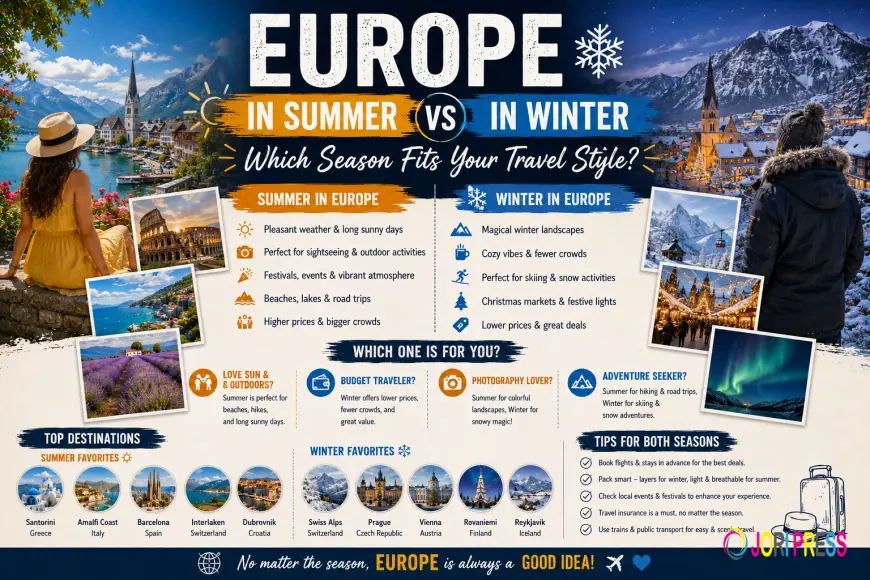
Planning a European trip usually starts with one big question. Is it better to plan a trip to Europe in summer vs winter? Ask ten travellers and you'll get ten different answers, and they're all probably right.
Europe doesn't just change between seasons — it becomes a different destination. The crowds shift, the daylight changes, the food changes, and the version of yourself you get to be as a traveller changes too. That's not something you can shortcut with a weather chart.
Summer in europe is loud in the best way. Barcelona's beaches are packed by mid-morning, and Nice's promenades stay buzzing well past midnight. Winter is something else entirely. Walk through Vienna or Prague in December and you'll find streets strung with lights, market stalls selling mulled wine, and a quietness that somehow still feels full of life. The smell of roasted chestnuts alone is enough to justify the trip.
So which version of Europe do you actually want? That's the real question.
Europe in Summer: Sun, Festivals, and Endless Energy
Almost perfect weather—clear skies and warm, sunlit days
The summer season in Europe runs June through August. Most of the continent sits comfortably between 20°C and 30°C, though southern countries like Spain, Italy, and Greece push hotter through July and August. Some days in Seville or Athens, you're looking at 38°C or above — and that's before the humidity hits.
Long daylight hours change how a trip feels day to day. A WanderOn Summer Europe Tour suits travellers who enjoy wandering without a tight agenda — popping into a café, doubling back to a street that caught your eye, staying out later because the sun simply won't go down. Museums and major attractions often extend their hours too, which helps spread the crowds a bit.
Peak Season for Culture and Events
You don't have to search hard for things to do in summer. Cities like Barcelona, Paris, and Berlin practically hand you a schedule. Open-air concerts appear on random squares, street performers set up outside major landmarks, and large festivals like Tomorrowland in Belgium or the Edinburgh Festival Fringe in Scotland draw visitors from everywhere.
Food markets are a highlight too, particularly in Florence and Lyon, where seasonal produce and regional cooking take center stage. Beach life becomes its own whole chapter — spots like Navagio Beach and La Concha Beach offer the kind of clear water and dramatic scenery that actually lives up to the photos. And if nightlife is part of the plan, Ibiza and Mykonos don't disappoint. Clubs and beach bars build slowly through the evening and run until sunrise.
Whether you're a foodie, a beach lover, or a party animal, summer season in Europe doesn't require much planning. The energy finds you.
The Challenges of Summer Travel
Summer has a flip side, though, and it's worth being honest about. Cities like Paris, Rome, and Barcelona get genuinely crowded. By midday, the queues at major sites can eat up an hour of your day easily. Locals in tourist-heavy areas are used to it, but after day three it starts to grind.
Costs climb too. Flights and accommodation during peak months are noticeably more expensive, and last-minute bookings are a gamble. If summer is the plan, locking in travel and stays early makes a real difference.
Europe in Winter: Snowy Magic and Cosy Escapes
The magic of a winter wonderland and Christmas markets
Something happens to European cities in winter that photos never quite capture. When you explore during the winter season in Europe, the tourist layer peels back. Lights go up, market stalls appear in historic squares, and places that felt touristy in summer suddenly feel like they belong to the people who actually live there.
From December to February, northern and central cities like Vienna, Prague, Munich, and Oslo sit between -5°C and 5°C. Further south, Rome and Barcelona stay milder, usually between 5°C and 12°C — cold enough for a coat but perfectly walkable.
Prague feels noticeably calmer in winter. Charles Bridge, which can feel like a crowded corridor in summer, is quiet enough to actually stop and look at the statues. Vienna's streets around St. Stephen's Cathedral glow with decorations. Salzburg, with snow on the rooftops and the Alps sitting behind it all, looks like somewhere a film crew would invent if it didn't already exist.
December is also when Europe's Christmas markets hit their stride. The Rathausplatz market in Vienna, the Old Town Square market in Prague, and the Christmas markets of Strasbourg are among the most visited — handcrafted gifts, seasonal decorations, mulled wine, roasted chestnuts, and hours you didn't plan to spend there.
Winter Sports and Northern Lights
Planning to visit Europe in winter makes a lot of sense if you're after something more active. The Alps across Switzerland, Austria, and France offer skiing and snowboarding that draws serious enthusiasts every year. Further north, Norway, Finland, and Iceland give you a shot at the Northern Lights — the Aurora Borealis — and no amount of travel writing does it justice. You really do just have to see it.
The Challenges of Winter Travel
Winter travel does come with trade-offs, and some of them are easy to underestimate. Temperatures in places like Prague or Budapest hit differently when you're outside all day, and cities like Stockholm get dark by mid-afternoon, which cuts your sightseeing window short. Seasonal destinations take the biggest hit — the Amalfi Coast and islands like Santorini go quiet in the off-season, with many hotels and restaurants simply shut until spring.
Europe in Summer vs Winter: How to Choose the Right Season for Your Trip
Choose Summer If:
In the battle between Europe in summer vs winter, summer works well if you want long days, open-air energy, and events built around being outside. Festivals like La Tomatina or Oktoberfest draw massive, enthusiastic crowds and are the kind of thing you tell people about for years after. Coastal spots, outdoor dining, rooftop bars, beach clubs — summer in Europe is built around all of it.
Choose Winter If:
Europe in winter season is an appealing time if you prefer quieter surroundings and a slower pace. Cities like Prague feel noticeably less crowded, and travel deals across places like Austria are often easier to come by during this period. The seasonal atmosphere is its own reward — the Vienna Christmas Market, snow-covered Lapland, the French Alps in full winter form. It's a different kind of trip, but a memorable one.
Consider the Shoulder Seasons for the Best Balance
Not sold on either? Spring and autumn sit in a comfortable middle ground and are widely considered the best time to visit Europe by travellers who've done it more than once. April to May and September to October bring mild weather and smaller crowds at places like the Colosseum and the Louvre Museum — you actually get to look at things instead of the back of someone's head.
Costs tend to be more manageable too. Flights and hotels in cities like Amsterdam and Barcelona often come in lower during shoulder months, which gives you more flexibility when planning.
Final Thoughts
Europe in summer vs winter doesn't have one right answer. It has two very different ones, and the better choice depends entirely on what you're after.
If sunny days, coastlines, and a festival atmosphere sound right, summer delivers. Think afternoons on the beaches of the Amalfi Coast, outdoor cafés in Paris, or island hopping in the Greek Islands.
If festive streets, snow, and a slower pace appeal to you more, winter has its pull. Christmas markets in Vienna, skiing in the Swiss Alps, quiet mornings on snow-covered streets in Prague — it's a different Europe, but no less worth the trip. Whether you're enjoying chilled beer in sunny cafes or strolling through a Christmas winter market, each season offers its own unique charm.
What's Your Reaction?
 Like
0
Like
0
 Dislike
0
Dislike
0
 Love
0
Love
0
 Funny
0
Funny
0
 Angry
0
Angry
0
 Sad
0
Sad
0
 Wow
0
Wow
0