








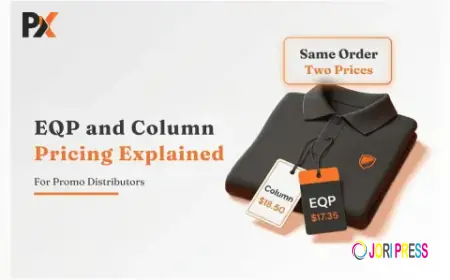
































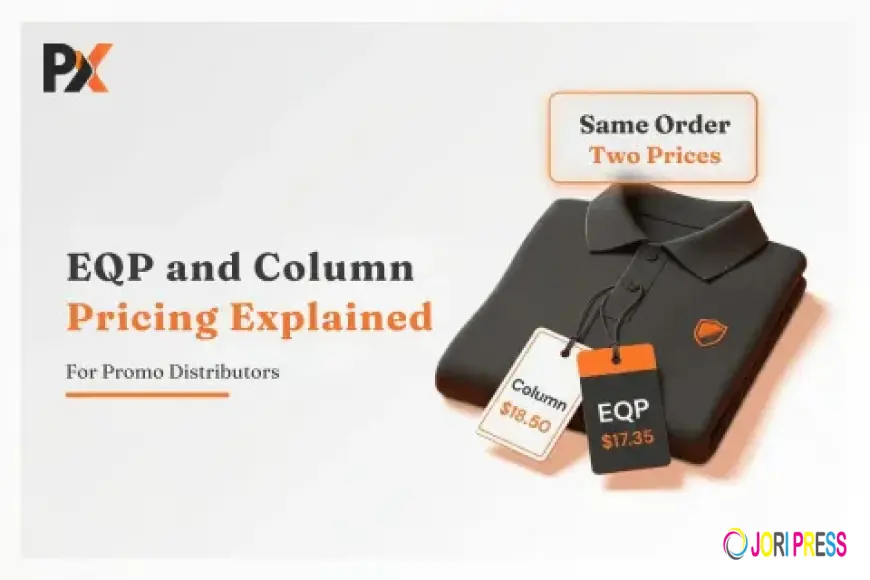
EQP and Column Pricing Explained for Promo Distributors

Pricing is one of the most important parts of running a promotional products distribution business. When working with multiple suppliers, distributors need to understand how each vendor calculates product costs, especially when customers order quantities that do not match standard pricing brackets.
Two common pricing methods used by promotional product suppliers are Column Pricing and EQP (Exact Quantity Pricing). Although both methods help determine product prices based on order quantities, they work differently.
Confusing these pricing models can result in inaccurate quotations, unexpected supplier invoices, and reduced profit margins.
Imagine a distributor quoting a customer for 140 embroidered polos. The distributor calculates the price using a standard quantity bracket, but the supplier uses Exact Quantity Pricing. Even though the calculations may appear reasonable, the final quoted amount can differ from what the supplier actually charges.
Understanding these two pricing methods is essential for promotional product distributors who work with multiple suppliers and manage large order volumes.
Let's explore how column pricing and EQP work, their differences, common pricing mistakes, and how estimating software can simplify the entire process.
What Is Column Pricing in the Promotional Products Industry?
Column pricing is a traditional pricing method used by promotional product suppliers. In this model, suppliers publish a pricing grid containing predefined quantity brackets and corresponding per-unit prices.
For example, a supplier might provide pricing for the following quantities:
-
24 pieces
-
48 pieces
-
96 pieces
-
144 pieces
-
288 pieces
-
500 pieces
Each quantity has a fixed price per unit. When a distributor receives an order, they identify the quantity bracket that applies and use the corresponding price.
The important thing to understand is that column pricing only works with the predefined quantity levels.
For example, if a customer orders 96 products, the distributor uses the 96-piece pricing column. However, if the customer orders 95 pieces, the order falls into the 48-piece pricing bracket because it does not reach the next available quantity level.
This can create a noticeable difference in pricing.
Why Does Column Pricing Affect Orders Between Quantity Brackets?

Column pricing rewards customers who reach the next quantity threshold but can be less favorable for orders that fall just below it.
Consider a customer ordering 143 embroidered products. The supplier's pricing grid offers a 96-piece bracket and a 144-piece bracket.
Since the order contains only 143 pieces, it qualifies for the 96-piece price.
Even though the customer is just one piece short of the next bracket, they cannot receive the lower 144-piece rate under this pricing structure.
This is how traditional column pricing works. The supplier uses fixed quantity levels rather than calculating a separate price for every possible order quantity.
What Is EQP (Exact Quantity Pricing)?
EQP stands for Exact Quantity Pricing. Unlike column pricing, this model calculates the price according to the exact number of products ordered.
Instead of placing every order into a predefined quantity bracket, the supplier's pricing system determines the cost for the specific quantity requested by the customer.
For example, if a customer orders 143 embroidered polos, the supplier calculates the price specifically for 143 units rather than assigning the order to the 96-piece or 144-piece bracket.
How Does EQP Calculate Product Prices?
EQP pricing can use a pricing curve that considers how production costs change as order quantities increase.
For example, certain production expenses, such as setup costs, can be distributed across a larger number of products as the order quantity increases.
As the quantity grows, the effective per-unit cost can decrease.
The pricing system uses this calculation to determine the appropriate price for the exact quantity ordered.
There is an important distinction here: EQP does not automatically give customers the next quantity bracket's discounted rate.
Instead, it calculates a price that reflects the actual production economics of the requested quantity.
For example, the price for 143 pieces should generally fall between the prices associated with the 96-piece and 144-piece levels under the corresponding column pricing structure.
This makes EQP useful for distributors who regularly receive orders with quantities that do not match standard pricing brackets.
Column Pricing vs. EQP: A Practical Pricing Example
Understanding the difference between these two methods becomes easier when we compare an actual order.
Consider a supplier offering embroidered polo shirts under both pricing models. A promotional product distributor receives an order for 140 pieces.
Let's see how the quotation changes depending on the pricing structure.
Example 1: Column Pricing
Suppose the supplier offers the following pricing:
|
Quantity Bracket |
Price Per Unit |
|
100–149 pieces |
$18.50 |
|
150–249 pieces |
$16.75 |
Since the customer orders 140 pieces, the order falls into the 100–149 quantity bracket.
Calculation:
140 × $18.50 = $2,590.00
The total quotation is $2,590.00.
Even though the order is only 10 pieces short of the next pricing bracket, the customer receives no additional quantity-based discount.
Example 2: EQP Pricing
Now consider the same order under Exact Quantity Pricing.
The supplier's pricing engine calculates the cost specifically for 140 pieces.
The effective per-unit price is $17.35.
Calculation:
140 × $17.35 = $2,429.00
The total quotation becomes $2,429.00.
Unlike column pricing, this amount is calculated for the exact order quantity and does not need to match any price listed in a predefined quantity grid.
Understanding the Difference
|
Pricing Details |
Column Pricing |
EQP Pricing |
|
Order Quantity |
140 |
140 |
|
Price Per Unit |
$18.50 |
$17.35 |
|
Total Order Value |
$2,590.00 |
$2,429.00 |
|
Pricing Method |
Fixed quantity bracket |
Exact quantity calculation |
The difference between the two quotations is $161.
Neither pricing method is incorrect. They simply calculate product costs differently.
The problem occurs when a distributor assumes that a supplier uses column pricing when the supplier actually uses EQP, or vice versa.
This is why understanding the pricing structure behind every supplier quotation is important.
Why Do Promotional Product Distributors Confuse These Pricing Models?
One of the biggest challenges is that supplier price sheets do not always clearly identify which pricing model they use.
A traditional pricing grid with predefined quantity levels usually indicates column pricing.
On the other hand, a pricing interface that accepts a specific quantity and returns a calculated price may indicate EQP.
However, distributors should not rely entirely on the appearance of the pricing sheet.
Understanding the Role of PromoStandards
PromoStandards is an important data-exchange standard used by promotional product suppliers to share product, inventory, and pricing information.
Its Pricing and Configuration service supports quantity-based pricing information.
However, the standard does not force every supplier to use the same pricing model.
One supplier may provide fixed quantity brackets, while another may calculate prices using EQP.
Both pricing structures can be transmitted through the same general service.
This means distributors need to understand the actual pricing information provided by each supplier rather than assuming that every supplier feed works identically.
The Problem With Outdated Supplier Price Sheets
Another common issue is relying on old supplier pricing information.
Imagine a distributor downloads a price sheet six months ago and continues using it for customer quotations.
During that period, the supplier may have changed its pricing structure from column pricing to EQP.
If the distributor continues calculating prices using the outdated information, the final quotation may no longer match the supplier's current pricing.
This can create unexpected costs and affect customer relationships.
Keeping supplier pricing information updated is essential for maintaining accurate quotations.
Common Pricing Mistakes Promotional Product Distributors Should Avoid
Even experienced distributors can make pricing mistakes when working with multiple suppliers.
Here are some common problems worth avoiding.
1. Using Outdated Supplier Price Sheets
A downloaded price grid may no longer reflect the supplier's current pricing structure. Always use updated supplier feeds whenever possible.
2. Applying Quantity-Bracket Rules to EQP Orders
Increasing a customer's requested quantity to the nearest pricing bracket may make sense under column pricing.
However, doing this under EQP can result in quoting more products than the customer actually requested.
3. Assuming Every Supplier Uses the Same Pricing Model
A distributor may work with SanMar, S&S Activewear, and smaller regional suppliers within the same quotation.
One supplier might use column pricing while another uses EQP.
Applying one pricing calculation to every supplier can result in inaccurate quotations.
4. Ignoring Differences in Supplier Data Feeds
A CPQ or quoting tool that processes every supplier's pricing information in the same way may calculate incorrect prices if it does not recognize the underlying pricing structure.
5. Forgetting Decoration and Setup Charges
Column pricing and EQP generally describe the pricing of the blank product itself.
Additional charges, including setup fees, embroidery digitizing costs, and per-location decoration charges, need to be calculated separately.
A quotation can still be incorrect even when the product pricing model is handled correctly.
Why Accurate Pricing Matters When Profit Margins Are Already Tight
Pricing accuracy becomes even more important when promotional product distributors operate with limited profit margins.
According to the PPAI industry figures cited in the original article, the promotional products industry exceeded $27 billion in sales, but only 53% of distributors expected to turn a profit in 2026.
This highlights an important challenge: increasing revenue does not necessarily mean businesses are generating higher profits.
Consider a distributor processing an order for 500 promotional products.
If the quotation is incorrect by just $1 or $2 per unit, the total difference can become substantial.
A small pricing mistake can reduce the expected profit from an order or even turn a profitable job into a loss.
When distributors process hundreds of quotations throughout the year, these small errors can accumulate.
Getting column pricing and EQP calculations right is therefore not just a technical requirement. It is an important part of protecting business margins.
How Promotional Products Software Handles Column Pricing and EQP Automatically

Manually checking every supplier's pricing structure becomes increasingly difficult as distributors expand their supplier networks.
A business working with only two or three suppliers may be able to manage pricing through spreadsheets. However, this approach becomes less practical when dealing with multiple catalogs, different pricing models, and frequent supplier updates.
This is where promotional products software and print estimating software can help.
A suitable estimating system should be able to:
-
Retrieve supplier pricing information through PromoStandards feeds.
-
Identify whether a supplier uses column pricing or EQP.
-
Apply the appropriate calculation based on the supplier's pricing structure.
-
Include decoration charges and setup fees separately.
-
Generate accurate customer quotations.
-
Keep product and supplier information updated.
How PrintXpand's Print Estimating Tool Helps
PrintXpand's Print Estimating Tool helps promotional product distributors automate supplier-specific pricing calculations.
It processes the actual pricing structure provided by each supplier, whether it is column-based or EQP-based.
For column pricing, the system applies the correct quantity bracket.
For EQP pricing, it calculates the price based on the exact quantity requested.
This eliminates the need for employees to manually determine which pricing method a supplier uses before preparing every quotation.
Connecting Multiple Supplier Catalogs Through PrintXpand Connect
PrintXpand Connect provides access to more than 500 supplier catalogs through a single integration.
It connects with suppliers such as:
-
SanMar
-
S&S Activewear
-
MidOcean
-
PF Concept
It also supports PromoStandards-compliant suppliers.
Through PrintXpand Connect, distributors can retrieve supplier product information, pricing, and inventory data.
This helps ensure that quotations are based on current supplier information rather than outdated spreadsheets saved on individual employees' computers.
Keeping Decoration and Setup Charges Separate
Another useful capability is the ability to configure decoration charges and setup fees as separate pricing components.
For example, an embroidered polo quotation may include:
-
Blank product cost.
-
Embroidery setup fee.
-
Digitizing cost.
-
Additional decoration location charges.
-
Final selling margin.
Keeping these elements separate makes it easier to understand how the final quotation is calculated.
It also helps distributors avoid hiding additional expenses inside a single combined product price.
By combining supplier integrations with automated estimating, PrintXpand helps businesses create more consistent quotations while reducing manual pricing work.
Frequently Asked Questions About EQP and Column Pricing
1. What Is the Main Difference Between Column Pricing and EQP Pricing?
Column pricing uses predefined quantity brackets to determine the per-unit price. EQP, or Exact Quantity Pricing, calculates the price according to the exact quantity ordered.
For example, an order of 143 pieces may receive the 96-piece bracket price under column pricing, while EQP calculates a separate price specifically for 143 pieces.
2. Why Can a 143-Piece Order Cost More Under Column Pricing?
Under column pricing, an order of 143 pieces may fall into the 96-piece pricing bracket if the next available bracket starts at 144 pieces.
This means the customer receives the same per-unit price as someone ordering 96 or 100 pieces, even though they are very close to the next quantity level.
3. How Does PromoStandards Handle EQP and Column Pricing?
PromoStandards' Pricing and Configuration service carries quantity-based pricing information for both models.
It does not require every supplier to follow the same pricing structure. Instead, it transmits the pricing information provided by the individual supplier.
Distributors must understand the actual data to apply the correct calculation.
4. How Does Estimating Software Manage Different Supplier Pricing Models?
Estimating software can retrieve each supplier's pricing information through its PromoStandards feed and apply the appropriate calculation.
It handles fixed quantity brackets for column pricing and exact quantity calculations for EQP, helping distributors avoid manual pricing mistakes.
Conclusion
Column pricing and EQP are two different approaches to calculating product prices in the promotional products industry.
Column pricing relies on fixed quantity brackets, while Exact Quantity Pricing calculates costs according to the precise quantity ordered.
Neither method is inherently better for every supplier or order. The important thing is understanding which pricing model applies before preparing a customer quotation.
For distributors working with multiple suppliers, managing these differences manually can become time-consuming and increase the risk of inaccurate pricing.
PrintXpand's Print Estimating Tool helps automate these calculations by applying supplier-specific pricing rules.
Combined with PrintXpand Connect, distributors can access supplier catalogs, pricing, and inventory information through a unified system.
Instead of guessing which pricing model applies to each supplier, businesses can generate quotations based on the actual pricing structure provided by their vendors.
Stop guessing which pricing model you're quoting. Book a Personalised Demo and explore how PrintXpand can help automate your promotional product estimating and quoting process.
Original Article :- Click Here
What's Your Reaction?
 Like
0
 Dislike
0
 Love
0
 Funny
0
 Angry
0
 Sad
0
 Wow
0