









































Ecommerce Software for Every Business Model: What Actually Changes Under the Hood
This article breaks down why no single ecommerce software fits every business, mapping the actual technical differences between B2C, B2B, marketplace, subscription, and D2C models — from checkout logic and pricing structures to backend architecture. It covers the shift toward headless/composable commerce, the role of PIM systems and ERP integration in keeping multi-channel data consistent, and backs each point with current market data (2026 global ecommerce size, B2B ecommerce volume, marketplace purchase behavior, and personalization-driven revenue lift). The piece closes on the core idea: choosing the right software starts with understanding the business model it needs to serve, not the feature list of a platform.
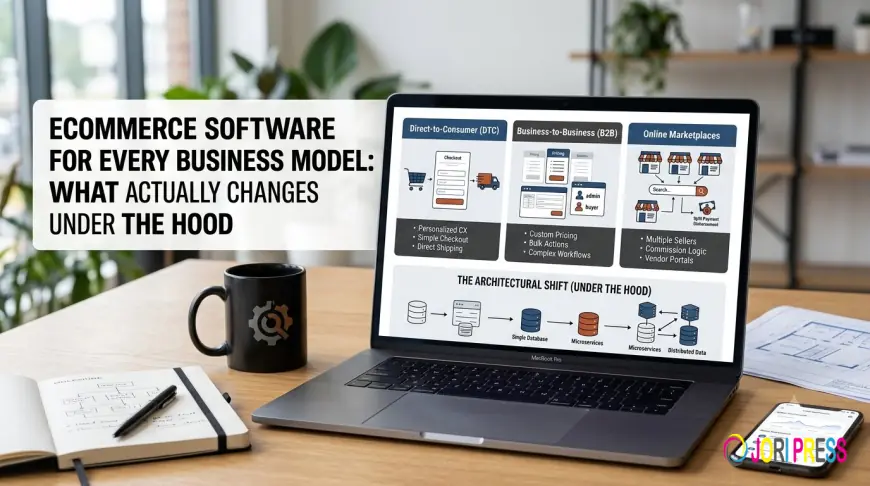
Ecommerce software is often talked about as if it were one category of product. In practice, the software that powers a direct-to-consumer fashion brand, a B2B industrial parts distributor, and a multi-vendor marketplace have very little in common once you look past the shopping cart. The business model determines the data structure, the checkout logic, the integrations that matter, and even how "success" is measured inside the platform.
The global ecommerce market is on track to approach $6.9 trillion in 2026, and that scale is not coming from one uniform type of online store. It is coming from several fundamentally different commercial structures, each of which places different demands on the software running underneath it.
Why Business Model Comes Before Platform Choice
A common mistake in ecommerce planning is choosing a platform first and figuring out the business logic later. This works only when the business fits a narrow, well-supported use case. The moment a business needs account-specific pricing, delivery-slot logic, vendor payouts, or subscription billing, the platform choice either supports that natively or forces it in through workarounds that add fragility over time.
The more useful starting point is the transactional relationship itself: who is buying, who is selling, and how the money and goods actually move.
B2C: Speed and Emotion Drive the Architecture
Business-to-consumer commerce remains the largest and most familiar model, and its software priorities reflect how consumers actually shop: fast page loads, a short path from product page to checkout, and personalization that reduces decision fatigue. Mobile now accounts for the majority of B2C traffic, so the underlying architecture has to treat mobile performance as a baseline requirement rather than an afterthought.
Personalization has become a measurable lever rather than a nice-to-have. AI-driven personalization has been shown to increase revenue per site visit by as much as 175%, largely by surfacing products based on a shopper's past behavior instead of a static catalog view. That kind of personalization requires the underlying software to track behavioral data and feed it back into merchandising in near real time — a very different technical demand than a simple product listing.
B2B: Built Around Accounts, Not Impulse
Business-to-business ecommerce is frequently underestimated because it gets less public attention than consumer retail, despite outpacing it in transaction volume. B2B ecommerce sales reached $2.3 trillion in 2024, growing more than 10% year over year, and buyer behavior on these platforms is fundamentally different from consumer shopping. Purchases involve multiple decision-makers, negotiated pricing, and longer sales cycles, so the software needs to support things a B2C storefront never touches: tiered or customer-specific pricing, quote-to-order workflows, purchase-order handling, and account hierarchies for organizations with multiple buyers.
Marketplace behavior is creeping into B2B as well. Fifty-nine percent of B2B buyers now complete more than a quarter of their purchases through marketplaces, which means even a traditional B2B seller increasingly needs software that can feed accurate, structured product data into third-party marketplace channels, not just its own storefront.
Marketplace Models: The Software Has to Manage Trust, Not Just Transactions
Marketplace platforms connect independent buyers and sellers rather than selling directly, and they now account for the majority of global online retail activity. This model shifts a large share of the software's job away from the product catalog and toward managing the relationship between multiple sellers and a shared customer base: seller onboarding, commission and payout logic, dispute handling, and quality or trust signals that keep a two-sided platform functional.
Because marketplaces don't hold their own inventory in most cases, the technical investment shifts from warehouse and stock systems toward vendor management tooling — dashboards, verification workflows, and automated payout schedules that would be unnecessary in a single-seller store.
Subscription and D2C: Retention Logic Replaces Conversion Logic
Subscription commerce and direct-to-consumer brands optimize for a different outcome than a single transaction. A subscription platform has to handle recurring billing, failed-payment recovery, plan changes, and churn tracking — none of which matter much to a one-time-purchase storefront. Subscription ecommerce is one of the fastest-growing models by percentage growth, and brands using it are increasingly building retention logic directly into the core platform rather than treating it as a billing add-on.
D2C brands, meanwhile, prioritize owning the full customer relationship and the data that comes with it. That means the software has to support first-party data collection, direct customer communication, and brand-controlled experiences, in contrast to a marketplace listing where the platform, not the brand, owns most of the customer relationship.
The Technical Layer That Increasingly Sits Underneath All of Them
Regardless of business model, a few architectural shifts are showing up across nearly every serious ecommerce build in 2026:
Headless or composable commerce separates the customer-facing storefront from the backend systems that manage inventory, pricing, and orders, connecting the two through APIs instead of a single monolithic codebase. This lets a business run the same backend across a website, a mobile app, and even in-store kiosks, and reported performance gains from decoupled storefronts have been substantial — composable setups have shown page-load improvements of roughly 40% compared with traditional monolithic builds.
Product Information Management (PIM) systems are becoming close to mandatory for any business selling across more than one channel, since they centralize product data and keep it consistent whether a customer sees it on a website, a marketplace listing, or a mobile app. Feeding inaccurate or inconsistent product data across channels is now one of the more common points of failure in multi-channel ecommerce operations.
ERP integration remains the connective tissue that keeps inventory, pricing, and order data synchronized between the ecommerce layer and the rest of the business's operational systems, particularly for B2B and marketplace models where manual reconciliation quickly becomes unworkable at scale.
The Real Takeaway
There is no single "ecommerce software" that fits every business, because there is no single way that businesses actually sell. A grocery delivery operation, a B2B parts distributor, and a multi-vendor marketplace are solving structurally different problems even when they share the word "ecommerce." Understanding which business model a platform actually needs to serve — before evaluating features, platforms, or vendors — remains the step most businesses skip, and the one that determines whether the software still fits a year or two after launch.
What's Your Reaction?
 Like
0
Like
0
 Dislike
0
Dislike
0
 Love
0
Love
0
 Funny
0
Funny
0
 Angry
0
Angry
0
 Sad
0
Sad
0
 Wow
0
Wow
0