





































Should You Buy or Build a Freelance Marketplace Platform in 2026?
Deciding whether to buy or build a freelance marketplace platform in 2026? Here's how cost, speed, and validation should shape your decision.
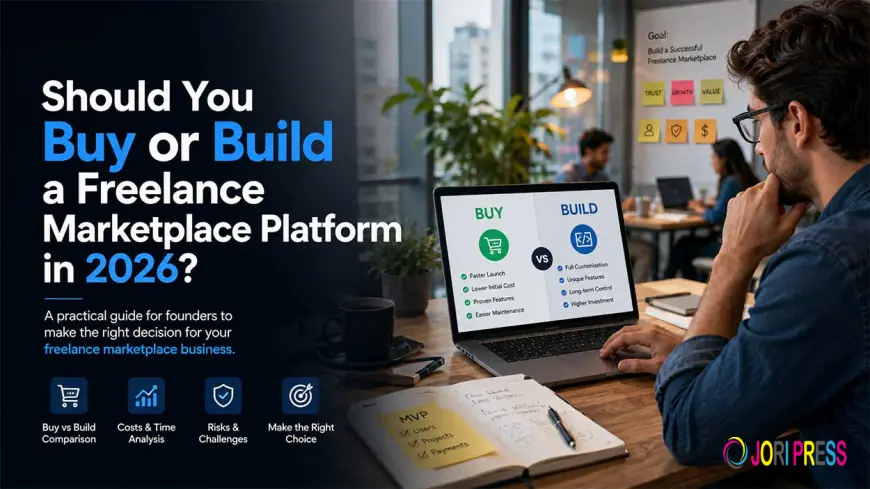
Most founders start planning their freelance marketplace platform by asking the wrong question. They ask "should I hire developers or use a ready-made script?" before they've asked "what do I actually need to prove first?" That order matters more than people think.
The gig economy isn't a niche bet anymore. It's worth an estimated $674 billion globally in 2026, and software development alone makes up 42% of freelance project demand. There's real opportunity here. But opportunity doesn't tell you how to spend your first $30,000, and that's the decision this article is built to help you make.
We'll walk through what buying versus building actually costs, when each path makes sense, and why the timing of that decision matters more than which option "wins" on paper.
Why the Buy-or-Build Question Comes Before the Tech Question
Here's the thing. A freelance marketplace platform doesn't fail because the code was bad. It fails because nobody showed up.
Founders love to obsess over architecture, feature lists, and tech stacks. Meanwhile, the actual risk sitting in front of them is unproven demand. Will freelancers list their services? Will buyers post jobs? Will either side stick around after the first transaction?
Technology can't answer any of that. Only real users can. So before you lock in a development approach, ask yourself what you're actually trying to learn in the next 90 days. If the answer is "whether people want this," speed and low cost should outweigh architectural elegance every time. If the answer is "how to scale something that's already working," the calculation changes completely.
What Does It Actually Cost to Build a Freelance Marketplace From Scratch?
Custom development gives you full control over every feature, workflow, and integration. It also means paying for every one of those things individually, from the ground up.
General software projects in 2026 range from around $15,000 for something simple to $500,000 or more for a complex, enterprise-grade build, and a freelance marketplace sits well above "simple." You're not building a brochure site. You need user registration for two different user types, search and filtering, messaging, job posting, proposals, secure payments, dispute handling, and an admin panel that can actually manage all of it.
Developer rates vary a lot depending on who you hire. Offshore teams run $20 to $50 an hour for senior talent, nearshore teams run $50 to $90, and mid-market agencies charge $120 to $250. A realistic freelance marketplace build, done properly with testing and a working payment system, usually lands somewhere between $30,000 and $150,000. Complex builds with mobile apps, advanced matching, or heavy custom integrations can go well past that.
And that's just the build. You still need hosting, ongoing maintenance, security patching, bug fixes, and feature updates after launch. Total cost of ownership is almost always higher than the number in your original quote, sometimes by a wide margin.
For a fuller breakdown of everything that goes into a ground-up build, including the full process of building a freelance marketplace from the ground up, it helps to see each stage laid out before you commit budget to any of it.
What Does Ready-Made Freelance Marketplace Software Cost, and What Do You Get?
"Buy" doesn't mean one thing. It can mean a licensed script you customize and self-host, a white-label platform, or a subscription-based SaaS solution. Each comes with different tradeoffs around ownership, source-code access, and long-term flexibility.
Pricing for ready-made freelance marketplace software typically runs far lower than a full custom build, often in the low thousands rather than tens of thousands, plus whatever customization or ongoing support you add on top. You're not paying to invent the wheel. You're paying for a wheel that already works, then adjusting the parts that need to match your brand and your niche.
This is exactly why so many first-time founders skip custom development entirely and start with a pre-built freelance marketplace platform instead. They'd rather spend their early budget on marketing and user acquisition than on rebuilding messaging and search functionality that a good script already handles.
Good ready-made software should still give you real ownership. Look for clean source code, the ability to customize workflows, open APIs for integrations, and support for the payment gateways you actually want to use. If a vendor won't hand over source code or locks you into their infrastructure permanently, that's worth knowing before you sign anything, not after.
Not every script is created equal, either. Some skimp on the parts that matter most for revenue, so it's worth checking a platform against the features that actually drive revenue before assuming any two options are interchangeable.
How Do You Know Which One Is Right for Your Marketplace?
Honestly, for most first-time founders, buying is the smarter starting point. Here's why.
If your business model hasn't been tested yet, you don't know which features matter and which ones are wasted effort. Spending $80,000 building custom infrastructure for a marketplace that might pivot in three months is a rough way to learn a lesson. Ready-made software lets you launch in days, not months, and put your money toward the thing that actually determines success: getting freelancers and buyers onto the platform.
That said, building from scratch does make sense in specific situations:
- You've already validated demand with real transactions, not just interest
- Your marketplace needs workflows no existing software supports, like a highly specialized matching algorithm
- Technology itself is your competitive edge, not just the marketplace concept
You have the in-house team to build, secure, and maintain a custom system long-term - If none of those describe your current stage, ready-made software probably gets you further, faster, with less money at risk.
What's the Real Risk of Building Too Early?
Every marketplace faces the same early hurdle: buyers won't come without freelancers, and freelancers won't join without buyers. It's a two-sided cold start, and it has nothing to do with how good your codebase is.
This is where over-investing in custom development actually backfires. Solving that early liquidity gap takes hands-on work: personally recruiting your first suppliers, manually matching early jobs, narrowing your focus to one category or one city before expanding. None of that requires custom software. It requires founder time and a platform that's live enough to test on.
One recent industry case study tracked a marketplace that reached real liquidity in 67 days total by focusing early phases on manual matching and concierge onboarding before automating anything. The lesson isn't about the exact timeline. It's that liquidity comes from sequencing and hustle, not from a more sophisticated tech stack.
Custom builds also carry a documented failure risk that's easy to underestimate. Industry research citing Standish Group data on large software initiatives shows more than a third of major custom builds are abandoned before completion. That's not a reason to never build custom software. It's a reason not to bet your entire launch budget on it before you know your marketplace works.
If you do go the custom route, or even a hybrid one, it's worth studying the common pitfalls founders run into when building a Fiverr or Upwork-style platform. Most of them are avoidable, but only if you know to look for them early.
Is a Hybrid Approach Worth Considering?
Buy versus build isn't always an either-or decision. A lot of successful marketplaces run on a hybrid model: a ready-made core for the standard stuff, with custom development layered on top for the pieces that actually make the business different.
The logic is simple. Buy the commodity components. Build the ones that create real differentiation.
User accounts, basic search, messaging, and payment processing are solved problems. There's no competitive advantage in rebuilding them from zero. But if your marketplace has a genuinely unique matching system, a specialized vetting process, or workflows tailored to a specific industry, that's where custom development earns its cost.
One thing worth remembering here: a "buy" decision doesn't have to be permanent. Plenty of successful platforms start on ready-made infrastructure and later replace specific pieces as growth projections outpace what the original platform was built to handle. Treating your first platform choice as reversible, rather than a lifelong commitment, takes a lot of pressure off the decision.
Final Thoughts
There's no universal right answer to buy versus build. What matters is matching your technology choice to your actual stage. If you're still validating whether your freelance marketplace platform has real demand, a ready-made script gets you to market fast and keeps your risk low. If you've already proven the model and need deep customization or proprietary functionality, custom development starts to make more sense.
The gig economy isn't slowing down, and the founders who move quickly and test their ideas in the real world tend to beat the ones who spend a year perfecting an architecture nobody's used yet. At Best Freelancer Script, we build fully customizable, ready-to-launch freelance marketplace software with clean source code and no hidden charges, and plenty of founders have used platforms like this to start earning revenue faster than they would have with a from-scratch build. If you want to see what a launch-ready platform looks like, connect with us for a free demo.
FAQs
How much does it cost to build a freelance marketplace platform from scratch?
Custom builds typically range from $30,000 to $150,000, depending on features, integrations, and developer rates. Complex builds with mobile apps or advanced matching can cost significantly more, and ongoing maintenance adds to the total over time.
Is ready-made freelance marketplace software actually customizable?
Good ready-made software should support meaningful customization, including branding, workflow adjustments, and API integrations. Always check whether you get source-code access and whether the vendor allows you to configure commissions, payment gateways, and features as your business grows.
How long does it take to launch a freelance marketplace platform?
Ready-made software can go live in a matter of days once branding and configuration are done. Custom development usually takes several months from planning through testing, though timelines vary widely based on scope.
Can I switch from ready-made software to a custom build later?
Yes. Many founders start with ready-made infrastructure to validate demand, then invest in custom development once specific parts of the business need functionality the original platform can't support.
What's Your Reaction?
 Like
0
Like
0
 Dislike
0
Dislike
0
 Love
0
Love
0
 Funny
0
Funny
0
 Angry
0
Angry
0
 Sad
0
Sad
0
 Wow
0
Wow
0