







































How to Build an Uber Clone App for a Ride-Hailing Business
Learn how to build an Uber clone app with passenger and driver features, monetization, admin controls, security, cost, and launch steps.

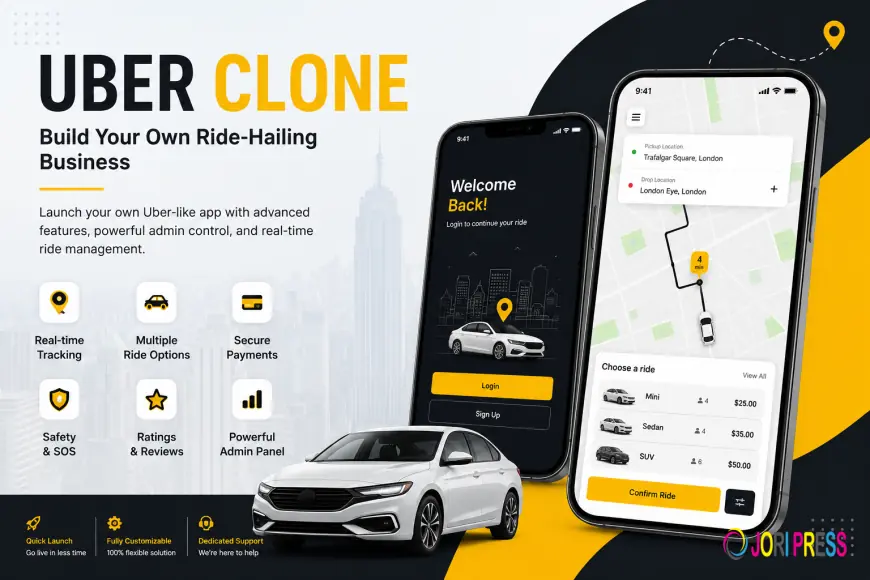
The growth of app-based transportation has changed how people book taxis, schedule airport transfers, and manage daily travel. Customers increasingly expect to choose a pickup point, compare ride options, receive a fare estimate, track their driver, and complete payment from one mobile application.
This creates an opportunity for taxi companies, fleet operators, and mobility startups to launch their own branded ride-hailing platforms.
An Uber clone app provides the technical foundation required to connect passengers with nearby drivers. Rather than developing every booking, navigation, payment, and administration module from scratch, businesses can customize a ready-made solution based on their branding, service areas, pricing policies, and revenue model.
What Is an Uber Clone App?
An Uber clone app is a customizable ride-hailing platform based on the operational model used by popular taxi-booking applications.
The platform normally includes:
- A passenger application
- A driver application
- A responsive web panel
- A dispatcher panel
- A fleet-management panel
- A centralized admin dashboard
Passengers can search for rides, enter pickup and destination locations, view estimated fares, track drivers, make payments, and submit ratings. Drivers can manage availability, receive trip requests, navigate to passengers, monitor earnings, and review completed rides.
The administrator controls users, drivers, vehicles, pricing, commissions, payments, promotions, disputes, and platform reports.
A white-label Uber clone can be customized for services such as:
- Local taxi booking
- Daily commuting
- Shared rides
- Airport transfers
- Hourly rentals
- Outstation travel
- Bike taxis
- Auto-rickshaw services
- Luxury transportation
- Corporate mobility
- Electric vehicle rides
Miracuves currently presents its Uber Clone as a customizable platform supporting daily rides, shared pool rides, rentals, outstation journeys, and driver subscription models.
How Does an Uber-Like App Work?
The ride-booking process begins when a passenger registers and enters a pickup point and destination.
The platform uses GPS and mapping services to calculate the route, distance, estimated travel time, and expected fare. The passenger then chooses a suitable vehicle category and confirms the request.
The dispatch system searches for available drivers near the pickup location. Once a driver accepts the request, the passenger receives the driver’s name, vehicle details, estimated arrival time, and live location.
During the trip, both parties can use navigation, in-app communication, and emergency features. After reaching the destination, the passenger pays through cash, card, wallet, or another supported method.
The user can then rate the driver and receive a digital receipt. Miracuves outlines a similar flow covering registration, location selection, ride choice, fare calculation, driver matching, real-time tracking, trip completion, payment, and receipt generation.
Essential Passenger App Features
Easy registration
Passengers should be able to create accounts through a phone number, email address, social login, or one-time password.
Pickup and destination selection
GPS integration can identify the passenger’s current location while allowing the user to adjust the pickup point manually.
Multiple ride categories
Customers may choose from economy cars, premium vehicles, bikes, autos, shared rides, rentals, or accessible transportation.
Fare estimation
The application should show an estimated fare before booking. Pricing may consider distance, travel time, base fare, vehicle type, tolls, taxes, waiting time, and current demand.
Instant and scheduled booking
Passengers should be able to request a ride immediately or schedule one for a future date and time.
Live driver tracking
Real-time tracking allows passengers to monitor the driver’s location and estimated arrival time.
In-app communication
Passengers and drivers can communicate through messaging or masked calling without exposing private contact information.
Multiple payment methods
The app may support:
- Cash
- Debit cards
- Credit cards
- Digital wallets
- Promotional credits
- Corporate billing
- Local payment gateways
The Miracuves Uber Clone page lists real-time tracking and payment support for cash, debit cards, credit cards, and wallets.
Ride history and ratings
Users should be able to review completed bookings, download receipts, report problems, and rate drivers.
Emergency assistance
An SOS button can connect users with emergency contacts, platform support, or relevant emergency services.
Essential Driver App Features
The driver application should make it easy to manage availability, trips, navigation, and earnings.
Important features include:
- Driver registration and verification
- Document submission
- Online and offline status
- Real-time booking requests
- Accept or reject controls
- Navigation support
- Passenger communication
- Trip-status updates
- Daily and weekly earnings
- Commission details
- Wallet and payout tracking
- Trip history
- Ratings and feedback
- Driver support
Drivers may be required to upload a driving licence, identity proof, vehicle registration, insurance documents, and vehicle photographs before receiving bookings.
A clear earnings dashboard can also improve driver trust by showing completed rides, platform deductions, incentives, tips, and pending payouts.
Uber Clone Admin Panel Features
The admin dashboard functions as the operational centre of the ride-hailing business.
Administrators should be able to manage:
- Passenger accounts
- Driver applications
- Vehicle documents
- Live and completed rides
- Service zones
- Fare rules
- Platform commissions
- Driver subscriptions
- Payments and payouts
- Refunds
- Promotions
- Customer complaints
- Driver disputes
- Ratings and reviews
- Reports and analytics
Dynamic pricing controls allow administrators to change fares according to demand, supply, time, location, or vehicle category.
Miracuves also lists dashboard analytics, fleet management, user management, promotion controls, dynamic pricing, and detailed reports among the available administration features.
Advanced Features for a Competitive Platform
Once the basic ride-booking system is established, businesses can add advanced functionality.
AI-powered route optimization
Route optimization can recommend efficient routes based on distance, traffic, and current road conditions.
Predictive fare calculation
Pricing algorithms can improve fare estimates by evaluating distance, expected duration, demand, and historical trip information.
Shared rides
Passengers travelling in similar directions can share a vehicle and divide the cost.
Multi-stop bookings
Users can add multiple pickup or drop-off points within one trip.
Driver heat maps
Heat maps can show drivers where demand is higher, helping the platform improve availability.
Corporate accounts
Businesses can manage employee transportation, spending limits, invoices, and travel reports through centralized accounts.
Multi-language and multi-currency support
These features make regional expansion easier and improve accessibility for diverse users.
In-app wallet
A digital wallet allows users to store credits, receive refunds, and pay for future trips more conveniently.
Miracuves highlights AI route optimization, multilingual support, predictive pricing, live driver tracking, secure transactions, SOS assistance, and in-app chat as key platform capabilities.
How Does an Uber Clone Make Money?
A ride-hailing platform can generate income through several channels.
Ride commissions
The platform deducts a fixed amount or percentage from every completed booking.
Driver subscriptions
Drivers can pay a weekly or monthly subscription to access the platform, receive reduced commissions, or gain additional benefits.
Passenger service fees
A booking or platform fee can be added to the passenger’s total fare.
Surge pricing
Higher fares can be applied when demand exceeds available driver supply.
Cancellation charges
The platform may retain part of applicable cancellation fees.
Rental and outstation commissions
Revenue can be generated from hourly rentals, airport transfers, and intercity bookings.
Corporate mobility plans
Companies may purchase prepaid travel packages or monthly transportation subscriptions.
Advertising and partnerships
Hotels, restaurants, travel companies, insurance providers, and local businesses can promote relevant services within the platform.
Steps to Launch an Uber-Like App
First, select a target market and identify its transportation problems. Study existing taxi services, pricing, driver availability, passenger demand, payment preferences, and local regulations.
Next, choose the initial service model. A startup may begin with local taxi rides before expanding into rentals, airport transfers, shared rides, or corporate transportation.
The minimum viable product should include passenger registration, driver onboarding, GPS booking, fare estimation, dispatching, live tracking, payments, ratings, notifications, and admin controls.
Businesses must also define operational policies for driver verification, cancellations, commissions, refunds, safety incidents, and customer support.
Before launch, test the complete booking journey across different devices and network conditions. Starting in one city or a limited number of zones can help maintain enough driver availability and reduce pickup times.
Security and Compliance
Ride-hailing platforms process identity documents, payment information, trip histories, and real-time location data.
Important security measures include:
- Data encryption
- Secure authentication
- Payment tokenization
- Role-based admin access
- Driver-document protection
- Fraud monitoring
- Emergency trip sharing
- Route-deviation alerts
- Database backups
- Activity logs
Founders must also review applicable requirements involving taxi licensing, vehicle permits, insurance, taxation, driver eligibility, worker classification, data privacy, and passenger safety.
Why Choose Miracuves for Uber Clone Development?
Miracuves provides a customizable Uber Clone for entrepreneurs, taxi operators, and fleet businesses planning to launch a branded ride-hailing platform.
The solution includes passenger and driver applications, web access, dispatcher and fleet panels, admin controls, real-time booking, GPS tracking, secure payments, scheduled rides, dynamic pricing, promotions, ratings, and analytics.
Miracuves currently lists Flutter applications for Android and iOS, a web and admin stack involving PHP, Node.js, MySQL, and MongoDB, along with integrations such as Google Maps, Twilio, Firebase, payment APIs, and translation services. The package also states that it includes non-encrypted source code, rebranding, deployment, app-store publishing assistance, technical bug support, and eligible product updates.
Using a ready-made foundation can help founders focus on driver acquisition, passenger marketing, local partnerships, service quality, and regional growth instead of rebuilding standard ride-hailing modules.
Conclusion
An Uber clone app gives businesses the technology required to launch and manage a modern taxi-booking platform.
However, long-term success depends on more than application features. A ride-hailing business needs verified drivers, reliable availability, accurate fares, secure payments, responsive support, and strong passenger-safety procedures.
Starting with a focused market and essential functionality allows founders to validate demand before adding advanced services such as shared rides, corporate accounts, electric vehicle categories, driver subscriptions, and multi-city operations.
What's Your Reaction?
 Like
0
Like
0
 Dislike
0
Dislike
0
 Love
0
Love
0
 Funny
0
Funny
0
 Angry
0
Angry
0
 Sad
0
Sad
0
 Wow
0
Wow
0