





































12V Lithium Battery Guide: Specs, Chemistry & Selection Tips

1. Key Takeaways
· "12V" is a nominal voltage class, not a fixed voltage. Most 12V lithium batteries use a 4-cell-in-series (4S) LiFePO4 configuration with a nominal voltage of 12.8V, designed as a functional replacement for 12V lead-acid batteries. The actual voltage varies continuously between the charge voltage and the discharge cutoff voltage.
· Chemistry determines performance trade-offs. LiFePO4 offers longer cycle life and better thermal stability; NMC/Li-ion and Li-Polymer configurations offer higher energy density but different nominal voltage and charging requirements. Mixing assumptions across chemistries is a common and costly selection mistake.
· Capacity (Ah) and discharge current must match the actual load, not just the voltage label. Two "12V" batteries with identical nominal voltage can deliver very different runtime and peak current depending on cell configuration and BMS limits.
· Charging voltage, BMS protections, and communication protocol (SMBus, RS485, I²C, CAN) are as important as voltage when integrating a 12V lithium battery into existing equipment, chargers, or control systems.
· Standard 12V packs suit straightforward replacements, while custom dimensions, connectors, protection functions, and certification support are typically required for medical devices, security equipment, instrumentation, and other application-specific equipment.

2. What Is a 12V Lithium Battery?
A 12V lithium battery is a rechargeable battery pack built from multiple lithium cells connected in series to reach a nominal voltage in the 11–13V range, commonly marketed under the "12V" label because it is intended to interface with 12V-class equipment, chargers, and electrical systems originally designed around 12V lead-acid batteries.
The number "12V" refers to the nominal voltage — a reference value based on cell chemistry and cell count — not the exact voltage the battery produces at every moment. A 12V lithium battery's real-time voltage rises during charging and falls during discharge, moving within a defined operating window.
Common Cell Configurations Behind a "12V" Battery
|
Configuration |
Cell Chemistry |
Cells in Series |
Nominal Pack Voltage |
|
4S1P |
LiFePO4 (3.2V/cell) |
4 |
12.8V |
|
3S1P |
Li-ion / NMC (3.6–3.7V/cell) |
3 |
10.8–11.1V |
|
3S1P |
Lithium-Polymer (3.7V/cell) |
3 |
11.1V |
LiFePO4 4S configurations are the most common choice for true "12V" applications because 12.8V nominal sits close to the voltage range of a 12V lead-acid battery, making integration with existing 12V chargers, wiring, and load equipment more straightforward. Li-ion and Li-Polymer 3S packs produce a lower nominal voltage and are sometimes loosely marketed as "12V," but buyers should verify the actual nominal and charge voltage against their equipment's tolerance before assuming compatibility.
The "1P" in these configurations means a single parallel group; adding parallel groups (e.g., 4S2P) increases capacity (Ah) without changing the nominal voltage — a key distinction covered further in Section 4.
3. 12V Lithium Battery Specifications
Selecting a 12V lithium battery requires looking beyond the voltage label to a full specification set. The table below summarizes the parameters most relevant to selection, using typical reference values for the two most common chemistries. Actual values vary by manufacturer and cell design, so always confirm against the specific product datasheet.
|
Parameter |
LiFePO4 (4S, 12.8V nominal) |
Li-ion/NMC (3S, 11.1V nominal) |
|
Nominal Voltage |
12.8V |
11.1V |
|
Typical Charging Voltage |
14.4–14.6V |
12.6V |
|
Operating Voltage Range |
~10V to 14.6V |
~9V to 12.6V |
|
Discharge Cutoff Voltage |
~10V (2.5V/cell) |
~9V (3.0V/cell) |
Specifications That Matter Most for Selection
· Nominal voltage vs. charging voltage: The charging voltage is always higher than nominal voltage and must match the charger output; using a charger designed for a different chemistry's charge voltage can undercharge the pack or trigger BMS protection.
· Discharge cutoff voltage: The BMS disconnects the load once the pack reaches this voltage to protect cells from over-discharge; equipment that cannot tolerate this sudden cutoff should be matched to a battery with cutoff behavior appropriate to the load profile.
· Capacity (Ah) and energy (Wh): Energy is calculated as Wh = Nominal Voltage (V) × Capacity (Ah). For example, a 12.8V, 20Ah LiFePO4 pack delivers approximately 256Wh. This figure is what should be compared against equipment power consumption and expected runtime, not capacity alone.
· Discharge current (continuous and peak): Determined by the C-rate the cell and BMS can support; undersizing this relative to equipment startup current is a frequent cause of unexpected BMS cutoffs.
· Cycle life: Highly chemistry-dependent; LiFePO4-based custom packs, as reflected in LARGE Battery's LiFePO4 Battery Pack (LFP) product line, are commonly specified at over 2,000 cycles due to the inherent thermal and structural stability of the cathode material.
· Dimensions and weight: Pack footprint is driven by cell configuration and enclosure design; applications with constrained installation space often require custom mechanical design rather than a standard form factor.
4. 12V Lithium Battery Chemistry and Configuration Options
Chemistry Comparison for 12V-Class Packs
|
Chemistry |
Typical Cell Voltage |
Relative Cycle Life |
Thermal Stability |
Common Use Case in 12V Range |
|
LiFePO4 (LFP) |
3.2V |
High (2,000+ cycles reported for LFP packs) |
High |
Direct lead-acid replacement, energy storage, long-duty-cycle equipment |
|
NMC / Li-ion |
3.6–3.7V |
Moderate |
Moderate |
Compact, weight-sensitive portable equipment |
|
Lithium-Polymer |
3.7V |
Moderate |
Moderate |
Thin, shaped, space-constrained device integration |
LiFePO4 is generally the preferred chemistry when a 12V lithium battery needs to behave like a conventional 12V power source — stable voltage under load, long service life, and strong thermal performance. NMC/Li-ion cells deliver higher energy density per unit weight, which benefits portable or weight-sensitive 12V-class equipment where runtime per kilogram matters more than exact voltage matching. Lithium-Polymer cells offer the most flexibility in physical shape, useful when the battery must fit into an irregular or very thin enclosure.
Series and Parallel Configuration Logic
· Series (nS) connections increase voltage: adding cells in series raises the nominal pack voltage (e.g., 4S LiFePO4 = 12.8V).
· Parallel (mP) connections increase capacity: adding parallel cell groups raises Ah without changing nominal voltage (e.g., 4S2P roughly doubles the Ah of 4S1P at the same 12.8V nominal).
· Combined nSmP configurations balance voltage and capacity requirements for a specific application and installation envelope.
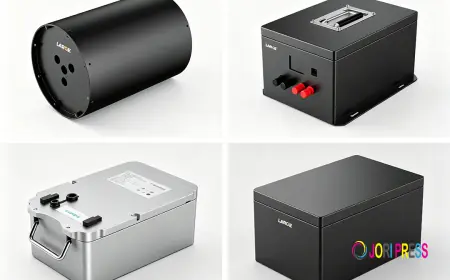
LARGE Battery's product range reflects this logic across multiple lines, including LiFePO4 Battery Packs (LFP), Lithium-Polymer Battery Packs, 18650 Lithium Battery Packs, and Power Lithium Battery Packs, all of which support customized series/parallel configurations, dimensions, and discharge rates based on application requirements rather than a fixed product template.
Low-Temperature Chemistry Considerations
For 12V-class batteries used outdoors or in cold-climate equipment, standard chemistries may lose usable capacity at low temperatures. LARGE Battery's Low-Temperature Battery Pack Series — covering Low Temperature NCM, Low Temperature LiFePO4, Low Temperature Li-Polymer, Semi-Solid, and Self-Heating technical routes — illustrates the range of engineering approaches available when a 12V-class pack must also perform reliably in sub-zero conditions, an important consideration for applications discussed further in Section 6.
5. Battery Performance and Service Life
Several operating factors determine how long a 12V lithium battery performs within specification and how quickly its usable capacity declines:
· Charge/discharge rate (C-rate): Charging or discharging faster than the cell's rated C-rate increases internal heat and accelerates degradation. Equipment with high startup or peak current demand should be matched to a battery and BMS rated for that current.
· Depth of discharge (DoD): Consistently discharging to very low states of charge generally shortens cycle life compared with shallower discharge cycles, particularly relevant for daily-cycling applications such as off-grid or backup power use.
· Operating temperature: Both charging and discharging outside the specified temperature range reduce available capacity and can trigger BMS temperature protection. Low-temperature-optimized cell and electrolyte formulations — as used in LARGE Battery's low-temperature product lines — are designed to reduce this effect in cold-climate deployments.
· Load conditions: Continuous high-current loads generate more heat than intermittent loads of the same average current, which can affect both short-term voltage sag and long-term cycle life.
· BMS management: A properly functioning BMS protects against overcharge, over-discharge, overcurrent, short-circuit, and over-temperature conditions, and performs cell balancing to keep individual cells within a narrow voltage range — reducing the risk of premature capacity loss caused by cell imbalance. LARGE Battery's Smart Lithium Battery Packs integrate charge/discharge management, buck-boost DC-DC conversion, and cell balancing alongside real-time SOC (state of charge) and SOH (state of health) monitoring, supporting longer effective pack life in systems that rely on accurate battery status data.

6. Common Applications of 12V Lithium Batteries
12V-class lithium batteries are used across a wide range of equipment where voltage, weight, and runtime requirements intersect with 12V-compatible electrical systems:
· Medical and portable diagnostic equipment: Devices requiring compact, stable power with precise voltage regulation and communication for battery status monitoring.
· Security and surveillance equipment: Outdoor cameras, alarm systems, and inspection devices that need stable output, weatherproofing, and often data communication for remote status monitoring.
· Instrumentation and surveying equipment: Field instruments requiring predictable voltage behavior and extended runtime in variable outdoor conditions.
· Backup and emergency power: Small-scale UPS and emergency backup systems where a 12V lithium pack replaces or supplements lead-acid batteries for faster charge acceptance and lower weight.
· Portable outdoor energy storage: Compact power stations and off-grid equipment requiring flexible capacity configuration.
· Transportation and rail auxiliary equipment: Low-voltage auxiliary and monitoring systems within larger vehicle or rail platforms.
As a point of reference, LARGE Battery's documented project experience includes multi-series lithium packs in neighboring voltage classes that demonstrate the same engineering approach applicable to 12V designs. For example, a 14.4V (4S) lithium-ion pack was developed for a medical color Doppler ultrasound system with SMBus communication and full BMS protection, and a 10.8V (3S) configuration was developed for home smart surveillance equipment with dual-chip intelligent management and short-circuit/overcharge/over-discharge/over-current protection. These cases are not 12V products themselves, but they illustrate the series-configuration, communication, and protection engineering that applies directly when designing a 12V-class pack for similar medical or security applications.
7. How to Choose the Right 12V Lithium Battery
Selection Checklist
· Confirm actual nominal and charging voltage — do not rely on the "12V" label alone; verify it against the chemistry and cell count (e.g., 12.8V LiFePO4 vs. 11.1V Li-ion).
· Match capacity (Ah) to required runtime using the equipment's actual power draw, not an assumed average.
· Verify continuous and peak discharge current against the equipment's startup and operating current, including any inrush current.
· Select chemistry based on priority: cycle life and thermal stability (LiFePO4) vs. energy density and compactness (NMC/Li-ion or Li-Polymer).
· Check physical dimensions, weight, and mounting against the available installation space, especially for retrofits replacing lead-acid batteries.
· Confirm connector type and communication protocol (e.g., SMBus, RS485, I²C, CAN) match the host device or charger.
· Review BMS protection functions — overcharge, over-discharge, overcurrent, short-circuit, and temperature protection should align with the operating environment.
· Verify certification requirements relevant to the target market and application (e.g., UN38.3 for transport, CE/UL/FCC for regional compliance).
Common Selection Mistakes
· Assuming a "12V lithium battery" is exactly 12.0V at all times, leading to charger or load compatibility issues.
· Using a charger with the wrong charging voltage for the chemistry (e.g., a lead-acid-style charger that does not reach LiFePO4's full charge voltage, or overcharges a lower-voltage Li-ion pack).
· Selecting capacity based on nameplate Ah without accounting for discharge current limits or temperature derating.
· Overlooking communication protocol mismatches between the battery's BMS and the host equipment's monitoring system.
· Choosing a standard off-the-shelf pack for equipment with unique dimensional, connector, or certification requirements, resulting in integration rework.
Standard vs. Custom Solutions
Standard 12V packs are generally adequate for straightforward lead-acid replacement or generic backup power use. Custom engineering becomes necessary when equipment requires specific dimensions, connectors, communication protocols, protection logic, or certification support — areas where LARGE Battery's stated differentiated advantage of flexible customization across voltage, capacity, form factor, discharge rate, environmental adaptability, communication protocol, and certification is directly applicable.
8. Charging Requirements, BMS, and System Compatibility
Charging Parameters
Charging voltage must match the chemistry, not just the nominal voltage label:
· LiFePO4 (4S, 12.8V nominal): typically charged to around 14.4–14.6V.
· Li-ion/NMC or Li-Polymer (3S, 11.1V nominal): typically charged to around 12.6V.
Using a charger designed for the wrong chemistry's charge voltage can result in undercharging, premature BMS cutoff, or — in chargers lacking proper regulation — long-term cell stress. Multi-chemistry and multi-standard chargers reduce this risk when a facility manages several battery types. LARGE Battery's AC-DC/DC-DC Multi-Standard Charger supports multiple voltage outputs (8.4V/12.6V/16.8V and other voltages) with overvoltage, overcurrent, reverse polarity, and short-circuit protection across automotive, consumer, and industrial applications, while the H1 and H4 Lithium-ion Battery Chargers provide per-cell charging profiles (1.5V–3.65V–4.2V) compatible with NiMH, LiFePO4, and ternary lithium chemistries in single- or four-channel configurations.
BMS Protection and Communication
A properly specified BMS for a 12V lithium battery should provide:
· Overcharge, over-discharge, overcurrent, short-circuit, and over-temperature protection.
· Cell balancing to maintain voltage consistency across series-connected cells.
· SOC and SOH monitoring for real-time battery status visibility.
· Communication support matching the host system — common protocols include SMBus, RS485, I²C, and CAN.
LARGE Battery's Smart Lithium Battery Packs integrate these functions, supporting LED or digital SOC display, buck-boost DC-DC conversion, and multiple safety protections designed for intelligent equipment integration.
System Compatibility Checklist
· Confirm the host device's expected voltage range aligns with the battery's full operating window (charge voltage to cutoff voltage), not just the nominal value.
· Match connector type, pinout, and communication interface to the host controller.
· Verify operating temperature range compatibility between the battery and the equipment's deployment environment.
· Confirm charger output matches the specific chemistry's charging profile before deployment.

9. Choosing a Reliable Lithium Battery Manufacturer and Custom Solutions
Supplier Evaluation Criteria
When evaluating a manufacturer for 12V lithium battery packs — standard or custom — procurement and engineering teams should assess:
· Engineering scope: Does the supplier handle cell selection, mechanical design, BMS development, and pack manufacturing as an integrated process, or only final assembly?
· Manufacturing and quality systems: Certifications such as ISO 9001:2015 (quality management), ISO 14001:2015 (environmental management), GB/T 45001-2020 (occupational health and safety), and ISO 13485:2016 (medical device quality management) indicate process discipline relevant to consistent pack quality.
· In-house testing capability: A CNAS-accredited testing laboratory (such as LARGE Battery's CNAS L26157 accreditation) supports credible validation of safety, environmental reliability, and electrical performance claims.
· Track record and scale: LARGE Battery reports 24 years of custom lithium battery manufacturing experience, more than 2,680 completed production projects, and more than 68 million lithium battery modules delivered to over 70 publicly listed companies across 20+ industries.
· Certification support: Access to global certification pathways — including UN38.3, CE, UL, FCC, KC, BIS, PSE, CCC, and CB Scheme support — reduces market-entry friction for equipment shipping to multiple regions.
Relevant Custom Capabilities for 12V-Class Projects
For buyers needing a 12V lithium battery tailored to specific equipment, LARGE Battery's relevant product lines include:
· LiFePO4 Battery Packs (LFP) — for applications prioritizing cycle life (2,000+ cycles) and thermal stability.
· Power Lithium Battery Packs — for high-rate discharge and custom structural fit within limited installation space.
· Energy Storage Lithium Battery Packs — for stable output with customizable enclosure, module structure, and BMS functions.
· Smart Lithium Battery Packs — for applications requiring SOC/SOH monitoring, communication, and integrated power management.
· Custom Chargers (AC-DC/DC-DC Multi-Standard Charger, H1/H4 chargers) — for matched charging solutions across chemistries.
Delivery timelines are typically 15–20 days for standard design samples and 25–45 days for fully customized designs, depending on project complexity. General service commitments include response within 24 hours and a proposed solution within 72 hours, while after-sales support includes an 8-hour response target, a 24-hour solution target, lifetime product maintenance, full-process quality control (IQC, IPQC, OQC), and 100% inspection before shipment. Global product liability insurance coverage of RMB 30 million is also noted as part of the company's service assurance.
10. Frequently Asked Questions (FAQ)
Is a 12V lithium battery exactly 12.0 volts?
No. "12V" is a nominal voltage classification. A common LiFePO4 4S configuration has a nominal voltage of 12.8V and operates between roughly 10V (cutoff) and 14.6V (fully charged), while a 3S Li-ion configuration runs closer to 9–12.6V.
Can I directly replace a 12V lead-acid battery with a 12V lithium battery?
In many cases a 12.8V LiFePO4 pack can replace a 12V lead-acid battery, but the charging system must be checked: the charger needs to reach the LiFePO4 charge voltage (typically 14.4–14.6V) and the equipment must tolerate the lithium battery's voltage range and BMS cutoff behavior.
What charger should I use for a 12V LiFePO4 battery?
Use a charger specifically rated for LiFePO4 chemistry and the correct cell count, delivering the appropriate charge voltage (commonly around 14.4–14.6V for a 4S pack). Using a charger designed for a different chemistry can result in undercharging or BMS protection triggering prematurely.
How long does a 12V lithium battery last?
Cycle life depends on chemistry, depth of discharge, temperature, and charge/discharge rate. LiFePO4-based packs are generally specified for longer cycle life (2,000+ cycles in LARGE Battery's LFP product line) compared with many Li-ion/NMC alternatives, due to the inherent thermal and structural stability of the cathode material.
How do I calculate the capacity (Ah) I need?
Estimate the equipment's power draw in watts, divide by the battery's nominal voltage to get required current, then multiply by expected runtime in hours to estimate required Ah. Always add margin for discharge current limits and temperature derating.
Can 12V lithium batteries be used in cold environments? Standard lithium chemistries lose usable capacity at low temperatures. Applications operating in sub-zero conditions should consider low-temperature-optimized chemistries or pack designs, such as the low-temperature and self-heating technical routes used in LARGE Battery's Low-Temperature Battery Pack Series.
Can I get a custom 12V lithium battery pack with specific dimensions or connectors? Yes. Custom engineering is common when a standard pack does not fit the available installation space, connector type, or communication protocol. Manufacturers offering integrated cell selection, mechanical design, and BMS development — such as LARGE Battery — can configure voltage, capacity, form factor, and protection functions to match specific equipment requirements.
What communication protocols are used in 12V smart lithium battery packs?Common protocols include SMBus, RS485, I²C, and CAN, which allow the battery's BMS to report SOC, SOH, and protection status to host equipment for monitoring and diagnostics.
What's Your Reaction?
 Like
0
 Dislike
0
 Love
0
 Funny
0
 Angry
0
 Sad
0
 Wow
0