

































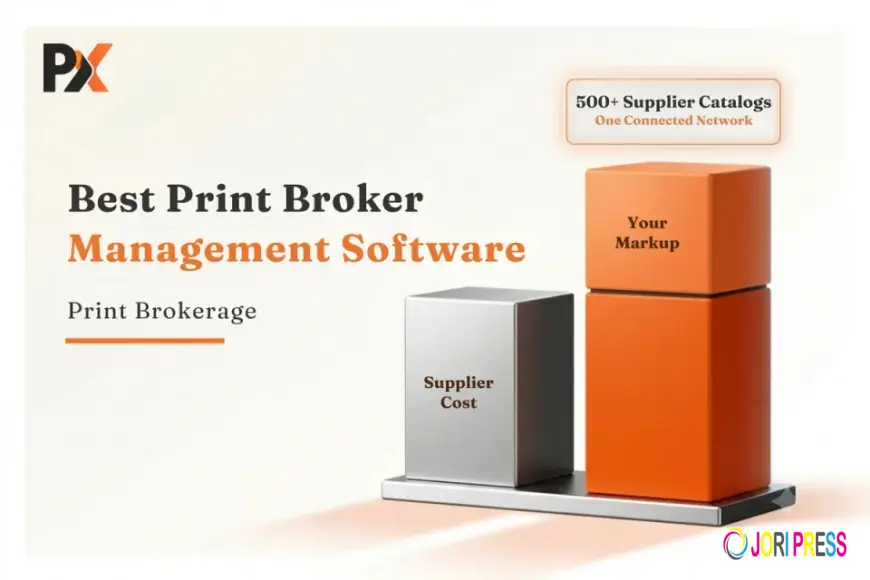
Best Print Broker Management Software in 2026: What to Look For
Print brokers often manage multiple customers, suppliers, quotes, artwork files, production schedules, invoices, and deliveries without owning the entire production process. As order volumes grow, spreadsheets and disconnected tools can make this workflow difficult to manage.
In 2026, print broker software is becoming increasingly important for businesses that want to centralize operations, automate repetitive tasks, and maintain better control over outsourced print jobs.
What Is Print Broker Management Software?
Print broker management software is designed to help brokers manage the complete lifecycle of a print order—from the initial customer inquiry and quotation through supplier coordination, production tracking, invoicing, and delivery.
Unlike basic print estimating tools, broker-focused platforms need to manage relationships between customers, print vendors, and internal teams.
Key Features to Look For in 2026
1. Centralized Quote Management: Quoting is one of the most important broker activities. Good software should allow brokers to:
- Create and manage customer quotes
- Compare supplier costs
- Add margins or markups
- Create customer-specific pricing
- Convert approved quotes into orders
- Track quote status
Automated calculations can also reduce errors in manual spreadsheets.
2. Supplier and Vendor Management: Print brokers frequently work with multiple trade printers and suppliers. The software should make it easy to store vendor information, pricing, capabilities, contact details, and job history.
The ability to assign jobs to the right supplier based on price, production capability, location, or turnaround time can improve operational efficiency.
3. Order and Job Tracking: Once a customer accepts a quote, the order should move smoothly into production.
A capable print broker software platform should provide visibility into:
- Order status
- Supplier assignment
- Production milestones
- Due dates
- Artwork status
- Shipping information
- Customer communication
This helps brokers identify delays before they become customer problems.
4. Artwork and Proof Management: Print jobs often involve multiple files and revisions. Centralized artwork management can help teams organize customer files, proofs, approvals, and final production artwork.
Digital proof approval can also reduce long email chains and provide a clear record of customer approval.
5. Automated Customer Communication: Customers regularly ask questions such as “Has my order shipped?” or “Is the proof approved?”
Automated notifications for quote updates, approvals, production stages, and shipping can reduce repetitive communication while keeping customers informed.
6. Invoicing and Financial Management: The software should connect operational activity with billing.
Useful capabilities include:
- Customer invoices
- Supplier costs
- Margins and profitability
- Payment tracking
- Purchase orders
- Tax calculations
- Financial reporting
This gives brokers better visibility into the actual profitability of each job.
7. Integrations: Modern brokers rarely operate through a single system. Look for software that can integrate with:
- eCommerce platforms
- CRM systems
- Accounting software
- ERP or Print MIS platforms
- Supplier APIs
- Shipping systems
- Payment gateways
Integrations reduce duplicate data entry and help create a connected workflow.
Why Automation Matters for Print Brokers
A typical broker workflow may involve receiving a request, contacting several suppliers, comparing prices, preparing a quote, collecting artwork, obtaining approval, placing a purchase order, tracking production, arranging shipping, and invoicing the customer.
Without automation, each stage can require separate manual actions.
With the right system, much of this process can be connected:
Customer Request → Quote → Approval → Supplier Order → Production → Shipping → Invoice
This creates greater visibility while reducing administrative work.
How to Choose the Right Print Broker Software
Before purchasing a platform, brokers should evaluate it against their actual workflow.
Consider:
- Scalability – Can it handle more customers, vendors, and orders?
- Customization – Can pricing and workflows be configured?
- Supplier management – Can multiple vendors be managed efficiently?
- Automation – Which repetitive tasks can be automated?
- Integrations – Does it connect with existing business systems?
- Reporting – Can you measure sales, costs, margins, and job performance?
- User experience – Is it easy for employees and customers to use?
- Security – How are customer files and business data protected?
A feature-rich platform is not necessarily the best choice if it cannot support the broker’s specific workflow.
Trends Shaping Print Broker Software in 2026
Several developments are influencing print broker operations:
- AI-assisted quoting and workflow automation
- Real-time supplier and inventory data
- Automated purchase orders
- Online customer portals
- Digital artwork proofing
- Advanced profitability reporting
- API-based supplier connectivity
- Automated shipping updates
- Cloud-based collaboration
The overall shift is toward connected systems that reduce manual coordination between customers, brokers, and suppliers.
Final Thoughts
The best print broker software in 2026 should do more than store customer and order information. It should connect quoting, supplier management, artwork, production tracking, communication, billing, and reporting into one efficient workflow.
For print brokers comparing platforms, the priority should be automation, supplier connectivity, scalability, visibility, and ease of use. Choosing software around these capabilities can help brokers manage more orders while maintaining control over costs, deadlines, and customer service.
What's Your Reaction?
 Like
0
Like
0
 Dislike
0
Dislike
0
 Love
0
Love
0
 Funny
0
Funny
0
 Angry
0
Angry
0
 Sad
0
Sad
0
 Wow
0
Wow
0