







































Alwin Highlights Key Integration Risks in Tokenized RWA DeFi Collateral Development

Madurai, India
October 26, 2026
Alwin has published an educational article examining the technical, liquidity, legal, and compliance challenges involved in integrating tokenized real-world assets (RWAs) into decentralized finance (DeFi) lending platforms.
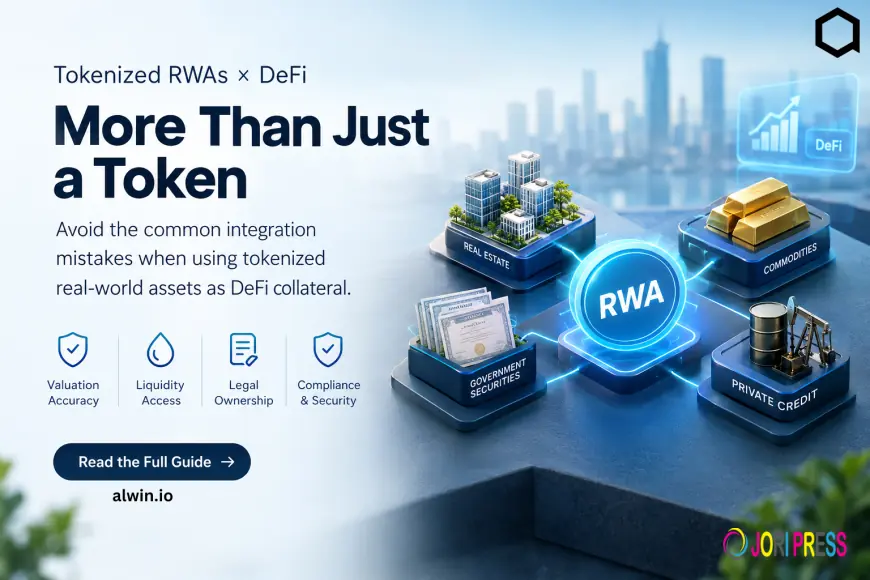
“Tokenized RWAs as DeFi Collateral: What Founders Get Wrong About RWA DeFi Integration,” the article explores why issuing a token is only one part of building a reliable RWA-backed lending system.
Tokenized real-world assets can represent financial instruments, real estate, commodities, and other assets through blockchain-based structures. When integrated with DeFi lending protocols, these tokens may provide additional borrowing opportunities and make previously underutilized assets more functional within digital financial markets.
However, the practical implementation introduces important considerations that developers, founders, and financial technology businesses must address before deployment.
Addressing the Challenges Behind RWA Collateral
The article identifies four major integration mistakes: treating all tokenized assets alike, overlooking liquidation and redemption processes, failing to account for permissioned transfers, and postponing regulatory considerations.
Liquidity remains a particularly important concern. A token may represent an asset with substantial underlying value, but the protocol must still be able to transfer, sell, or redeem it when a borrower defaults. Limited market depth and redemption delays can complicate this process.
Accurate valuation is equally essential. Many real-world assets depend on external data, periodic appraisals, or issuer-reported net asset values. Without appropriate oracle safeguards and risk controls, inaccurate pricing can affect borrowing limits and liquidation decisions.
The article also emphasizes that legal ownership and transfer eligibility must be understood before an asset is integrated into a permissionless or permissioned lending environment.
A Risk-First Approach to DeFi Development
The publication encourages development teams to evaluate collateral suitability before expanding the number of supported assets. Key considerations include verifying asset rights, establishing dependable valuation mechanisms, implementing conservative loan-to-value limits, testing liquidation scenarios, and assessing jurisdiction-specific compliance requirements.
It also highlights the importance of incorporating smart contract security, custody arrangements, transfer controls, and operational safeguards into the architecture from the beginning.
By addressing these considerations early, project teams can make more informed decisions about which assets to support and how to structure their lending mechanisms.
Supporting Better Decisions in the Tokenized Asset Market
As tokenization and decentralized financial infrastructure continue to evolve, the ability to connect digital tokens with enforceable asset rights and practical liquidity mechanisms remains central to sustainable development.
The article aims to help founders, product teams, and businesses understand the risks that can arise when tokenized RWAs are used as DeFi collateral and identify questions to resolve before launching an integration.
Readers can access the full article here:
About Alwin
Alwin provides technology development services across blockchain, decentralized finance, cryptocurrency, and related digital platforms. Its published insights cover emerging technologies, platform architecture, and practical considerations for businesses exploring blockchain-based financial solutions.
Media and Business Enquiries
Email: sales@alwin.io
What's Your Reaction?
 Like
0
 Dislike
0
 Love
0
 Funny
0
 Angry
0
 Sad
0
 Wow
0