



































What Does AI-Powered Personalized Learning Actually Look Like in a Real School?
AI-powered personalized learning is changing how schools support individual students. Instead of making every learner follow the same path, AI can analyze performance, identify learning gaps, personalize practice, adapt learning difficulty, and provide teachers with meaningful insights. This article explores what AI personalized learning looks like in a real school and how the combination of AI, teachers, and student data can create more responsive and student-centered learning experiences.
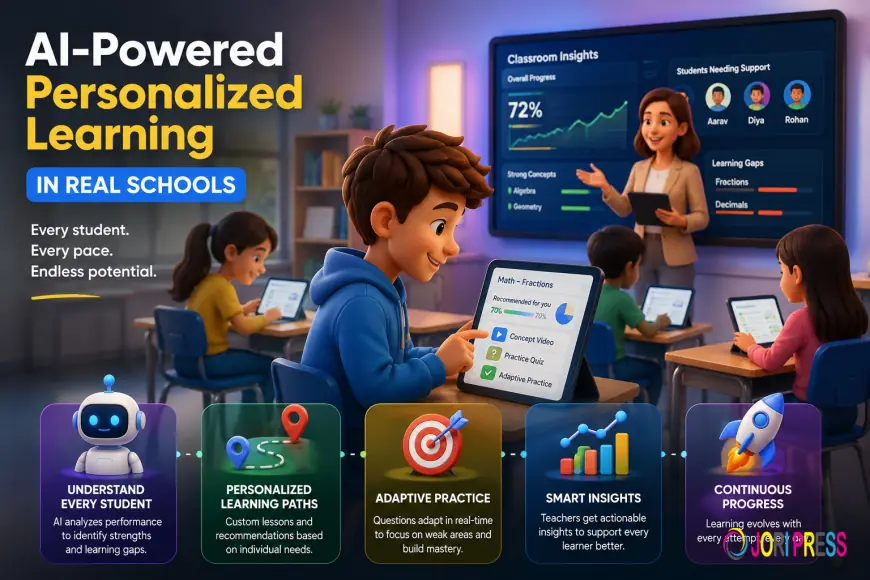
Imagine a classroom where two students are learning the same topic—but not necessarily in the same way.
One student understands the concept immediately. Another needs a simpler explanation. A third needs more practice, while a fourth is ready for a tougher challenge.
This is where AI personalized learning for schools can make a real difference.
Instead of expecting every student to follow the same learning path, AI can help schools create learning experiences that respond to individual needs, progress, and learning gaps.
But what does this actually look like inside a real school?
1. Learning Starts With Understanding the Student
Personalized learning begins with knowing where each student stands.
AI-powered learning systems can analyze information such as quiz performance, practice attempts, response patterns, and progress over time. This can help identify concepts a student has mastered and areas where they may need additional support.
Rather than simply saying, “You scored 60%,” the system can help answer a more useful question:
“What exactly does this student need help with?”
That shift can make learning more targeted and meaningful.
2. Students Can Follow Different Learning Paths
In a traditional classroom, the lesson may move forward according to a fixed schedule.
With AI-powered personalization, students can receive different learning recommendations based on their performance.
For example, one student struggling with fractions might receive additional practice and simpler explanations. Another student who has already mastered the concept could move to advanced problem-solving.
The goal isn't to separate students.
It is to help every student move forward from their current level.
3. Practice Can Adapt to Student Performance
Imagine a student repeatedly making the same type of mistake.
Instead of continuing to receive random questions, an AI-powered system can identify the pattern and recommend targeted practice.
If the student improves, the difficulty can gradually increase.
This creates a learning loop:
Attempt → Analyze → Identify Gap → Practice → Improve → Progress
Over time, learning becomes less about repeatedly completing the same exercises and more about addressing specific needs.
4. Teachers Get More Meaningful Insights
AI doesn't have to replace the teacher.
In fact, one of the biggest opportunities is helping teachers understand their students better.
Instead of looking only at test scores, teachers can use learning insights to identify students who may need additional support, concepts that are creating difficulty across the class, and areas where students are progressing well.
This allows teachers to spend less time interpreting scattered data and more time making informed teaching decisions.
5. Personalization Becomes a Continuous Process
The most powerful part of AI personalized learning for schools is that personalization doesn't have to happen only during exams.
Student performance changes every day.
A student who struggled last month may be ready for advanced work today. Another student who performed well previously may suddenly need support with a new concept.
AI can continuously analyze learning signals and help adjust the learning experience accordingly.
The Future Isn't “AI vs. Teachers”
The real opportunity is AI + Teachers + Student Data working together.
AI can help identify patterns and personalize practice. Teachers bring context, encouragement, creativity, and human connection.
That combination can help schools move toward a model where students aren't simply expected to fit into the same learning system.
The system adapts to the learner.
That is the promise of AI personalized learning for schools—and platforms such as JoraIQ are helping bring this vision closer to reality by making personalized, data-informed learning more practical for modern educational institutions.
What's Your Reaction?
 Like
0
Like
0
 Dislike
0
Dislike
0
 Love
0
Love
0
 Funny
0
Funny
0
 Angry
0
Angry
0
 Sad
0
Sad
0
 Wow
0
Wow
0